Showing posts with label The Failure Cycle. Show all posts

Friday, January 29, 2021

The Main Existential Threat of the 21st Century


(image: pinterest.com)


There are many existential threats to human life in the 21st Century, many of which are carried over from the 20th Century.

The threats of terrorism, nuclear war, militaristic regimes, and so on, are issues that paralysed nations and individuals throughout the 20th Century. On the other hand, it is often argued that climate change is the most significant problem facing human life in the 21st Century. Indeed, the obliteration of all sentient and plant life on the planet is an immeasurable issue, well beyond the imagination of most humans who continue to live in the same way as they have for many decades. It is difficult to argue against climate change being the number one issue facing life on this planet. However, this is just what I would like to do in this article.

My premise is that climate change is the ultimate issue that will cause the destruction of life on Earth if drastic action is not taken very soon, but it is not the most serious threat. It is fully acknowledged by an overwhelming majority of the world’s independent scientists, who are not in the service of the corporate elites, that if action is not taken, then it may be too late. On the other hand, it has been argued that if enough action is taken by governments to tackle emissions, then the planet can be saved in a liveable enough state that human and other life will be able to continue.

So, what is the main threat? Again, many people argue that the corporate elites are the main threat. These owners of massive mining corporations and industrial agriculture are hugely responsible for spewing out massive amounts of emissions which are destroying many aspects of our life-support system. In addition, they are responsible for practices which not only create inequality, but actually have dramatically increased inequality through their practices over the last forty years, and in particular, over the last ten. In other words, the power of the corporate elites, and the consequences of their practices, has increased exponentially over the last ten years. 

As argued earlier, capitalism has reached a point where it is now confronting environmental and economic limits to the accumulation of capital. What this means is that capital can no longer be accumulated through the manipulation of labour and technology to create profit. This kind of profit is simply no longer available. In response, governments have been acquiescent in deregulating many industrial practices and trade regimes to the benefit of the corporate elites. The result of this process is that a new form of accumulation has developed which can be characterized as ‘accumulation by dispossession’. This is basically the accumulation of capital through privatization, deregulation, and the takeover of public space, all facilitated by national governments, mostly in democratic nations such as the USA, the European Union, the UK, Australia, New Zealand, Canada, and South Africa. It is argued, again, that the corporate elites are not the main threat, but only because we have a mechanism that can put the brakes on the corporate elites — that of democratic government.

My argument is that national governments in democratic nations are the current main threat and barrier to finding solutions to climate change. Why? Because they are the ONLY institution that has the potential and the legal power (although this is rapidly diminishing) to curb the power of the corporate elites. This can be achieved through legislation that will place limits on what the corporate sector are allowed to do, and to re-regulate industry, and to reclaim those assets that have been privatized — this is also a point of justice as these very assets have been paid for by tax-payers and have effectively been stolen by the corporate sector with the assistance of government.

Of course, there is nothing in the legal statutes to stop politicians from acting in their own interests or from colluding with the corporate elites to ‘get a piece of the pie’ on the condition that they ‘give’ away a piece of the public pie. And this essentially is the weakness of the democratic system. So, let’s unpack this state of affairs by boiling it back to its basics.

Firstly, democracy is about the people rather than about the politicians. Politicians are supposed to be the representatives of the people. In Australia, the people go to the ballot box and place their votes for their local members in the upper and lower houses of parliament. The local member then gets a seat in the parliament, usually as a backbencher. This is a good opportunity for these elected members to voice their opinions and the opinions of their electorate on crucial issues. So far, the system appears to be very sound. However, Australia has a ‘party political system’, meaning that the parties are very powerful and tend to coerce the members into voting according to the party line. The fact that Australia has such a collective notion of party politics is a huge irony, considering that both major parties see anything at all that is even vaguely collectivist as complete anathema. And yet what could be more collectivist than the process of government?

A number of those who are in the party or coalition that has won the election are appointed into the cabinet as ministers. This may be more due to their ability to ‘make things happen’, or to tow the party line, more so than having any expertise in the portfolio to which they are appointed — the evidence suggests that this is very much the case, with ongoing portfolio reshuffles illustrating this point very clearly.

As representatives of the people, the cabinet ministers and the power of party politics act against true representation. Add to the mix the very powerful influence of Australia’s media monopoly spouting the values of neoliberalism, competition, and divisiveness on social issues, such as on gender, ethnic, immigration, sexuality, and Aboriginal issues, and one can see that the politicians are finding it very difficult to represent the people.

In order to get politicians to represent the people in true democratic fashion, instead of constantly undermining democracy, they need to listen to the mood of the people and to understand the people, instead of brushing off those who do voice their opinions as whingers and leaners. There is no democracy in selling the country off to the corporate elites and the majority certainly does not want to see this happen. Does anyone truly believe that if there was a referendum on the question of: “Should Australia sell everything in the country off to the corporate elites?” that it would not get a massive ‘no’ vote? Only if the politicians listen to the people will they be able to stop the corporate elites as has happened in Iceland.

Sunday, January 10, 2021

QAnon and the storm of the U.S. Capitol: The offline effect of online conspiracy theories

by Marc-Andre Argentino, The Conversation: https://theconversation.com/qanon-and-the-storm-of-the-u-s-capitol-the-offline-effect-of-online-conspiracy-theories-152815


What is the cost of propaganda, misinformation and conspiracy theories? Democracy and public safety, to name just two things. The United States has received a stark lesson on how online propaganda and misinformation have an offline impact.

For months, Donald Trump has falsely claimed the November presidential election was rigged and that’s why he wasn’t re-elected. The president’s words have mirrored and fed conspriacy theories spread by followers of the QAnon movement.

While conspiracy theorists are often dismissed as “crazy people on social media,” QAnon adherents were among the individuals at the front line of the storming of Capitol Hill.

QAnon is a decentralized, ideologically motivated and violent extemist movement rooted in an unfounded conspiracy theory that a global “Deep State” cabal of satanic pedophile elites is responsible for all the evil in the world. Adherents of QAnon also believe that this same cabal is seeking to bring down Trump, whom they see as the world’s only hope in defeating it.

The evolution of QAnon

Though it started as a series of conspiracy theories and false predictions, over the past three years QAnon has evolved into an extremist religio-political ideology.

I’ve been studying the movement for more than two years. QAnon is what I call a hyper-real religion. QAnon takes popular cultural artifacts and integrates them into an ideological framework.

QAnon has been a security threat in the making for the past three years.

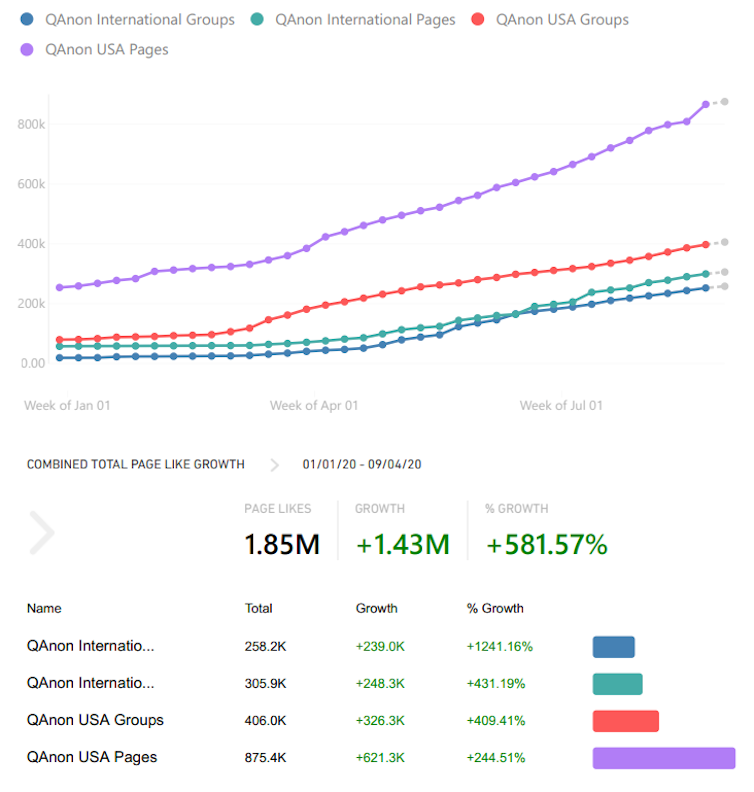
The COVID-19 pandemic has played a signficant role in popularizing the QAnon movement. Facebook data since the start of 2020 shows QAnon membership grew by 581 per cent - most of which occurred after the United States closed its borders last March as part of its coronavirus containment strategy.

Aggregate growth of QAnon membership in Facebook groups and pages between January and September 2020. Data collected and visualized September 4, 2020 courtsey of CrowdTangle.

As social media researcher Alex Kaplan noted, 2020 was the year “QAnon became all of our problem” as the movement initially gained traction by spreading COVID-related conspiracy theories and disinformation and was then further mainstreamed by 97 U.S. congressional candidates who publicly showed support for QAnon.

Crowdsourced answers

The essence of QAnon lies in its attempts to delineate and explain evil. It’s about theodicy, not secular evidence. QAnon offers its adherents comfort in an uncertain - and unprecedented - age as the movement crowdsources answers to the inexplicable.

QAnon becomes the master narrative capable of simply explaining various complex events. The result is a worldview characterized by a sharp distinction between the realms of good and evil that is non-falsifiable.

No matter how much evidence journalists, academics and civil society offer as a counter to the claims promoted by the movement, belief in QAnon as the source of truth is a matter of faith - specifically in their faith in Trump and “Q,” the anonymous person who began the movement in 2017 by posting a series of wild theories about the Deep State.

Trump validated theories

The year 2020 was also Trump finally gave QAnon what it always wanted: respect. As Travis View, a conspiracy theory researcher and host of the QAnon Anonymous podcast  recently wrote: “Over the past few months … Trump has recognized the QAnon community in a way its followers could have only fantasized about when I began tracking the movement’s growth over two years ago.”

Trump, lawyers Sidney Powell and Lin Wood, and QAnon “rising star” Ron Watkins have all been actively inflaming QAnon apocalyptic and anti-establishment desires by promoting voter fraud conspiracy theories.

Doubts about the validity of the election have been circulating in far-right as well as QAnon circles. Last October, I wrote that if there were delays or other complications in the final result of the presidential contest, it would likely feed into a pre-existing belief in the invalidity of the election - and foster a chaotic environment that could lead to violence.

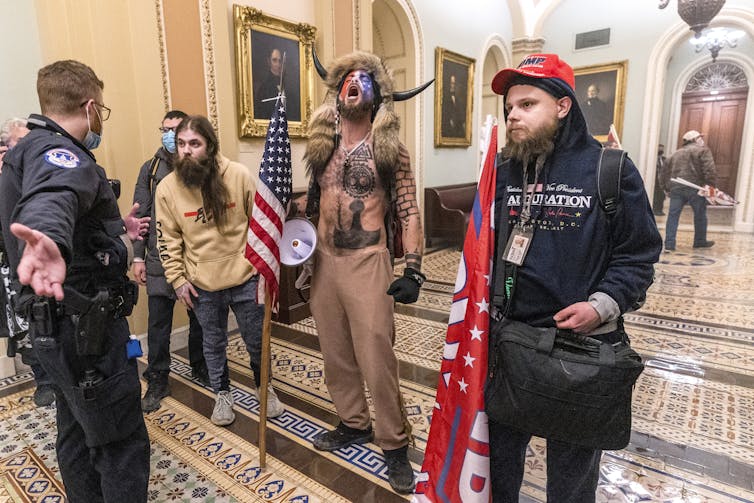
Several protesters, including a shirtless man wearing a fur hat with horns, confront a security guard at the U.S. Capitol.
A shirtless man known as the ‘QAnon Shaman’ was one of the high-profile members of Trump supporters who invaded the U.S. Capitol. (AP Photo/Manuel Balce Ceneta)

Hope for miracles

The storming of the U.S. Capitol saw the culmination of what has been building up for weeks: the “hopeium” in QAnon circles that some miracle via Vice-President Mike Pence and other constitutional witchcraft would overturn the election results.

Instead, QAnon followers are now faced with the end of a Trump presidency - where they had free rein - and the fear of what a Biden presidency will bring.

We have now long passed the point of simply asking: how can people believe in QAnon when so many of its claims fly in the face of facts? The attack on the Capitol showed the real dangers of QAnon adherents.

Their militant and anti-establishment ideology - rooted in a quasi-apocalyptic desire to destroy the existing, corrupt world and usher in a promised golden age - was on full display for the whole world to see. Who could miss the shirtless man wearing a fur hat, known as the QAnon Shaman, leading the charge into the Capitol rotunda?

What will happen now? QAnon, along with other far-right actors, will likely continue to come together to achieve their insurrection goals. This could lead to a continuation of QAnon-inspired violence as the movement’s ideology continues to grow in American culture.

Sunday, July 26, 2020

Australia has an ugly legacy of denying water rights to Aboriginal people. Not much has changed

Water management in the Murray-Darling Basin has radically changed over the past 30 years. But none of the changes have addressed a glaring injustice: Aboriginal people’s share of water rights is minute, and in New South Wales it is diminishing.
In the 1990s, governments tried to restore the health of rivers in the basin by limiting how much water could be extracted. They also separated land and water titles to enable farmers to trade water.
This allowed the recovery of water for the environment and led to the world’s biggest water market, now worth billions of dollars. For a range of reasons, Aboriginal people have largely been shut out of this valuable water market.
Our research, the first of its kind, shows Aboriginal water entitlements in the Murray-Darling Basin are declining, and further losses are likely under current policies. This water injustice is an ongoing legacy of colonisation.

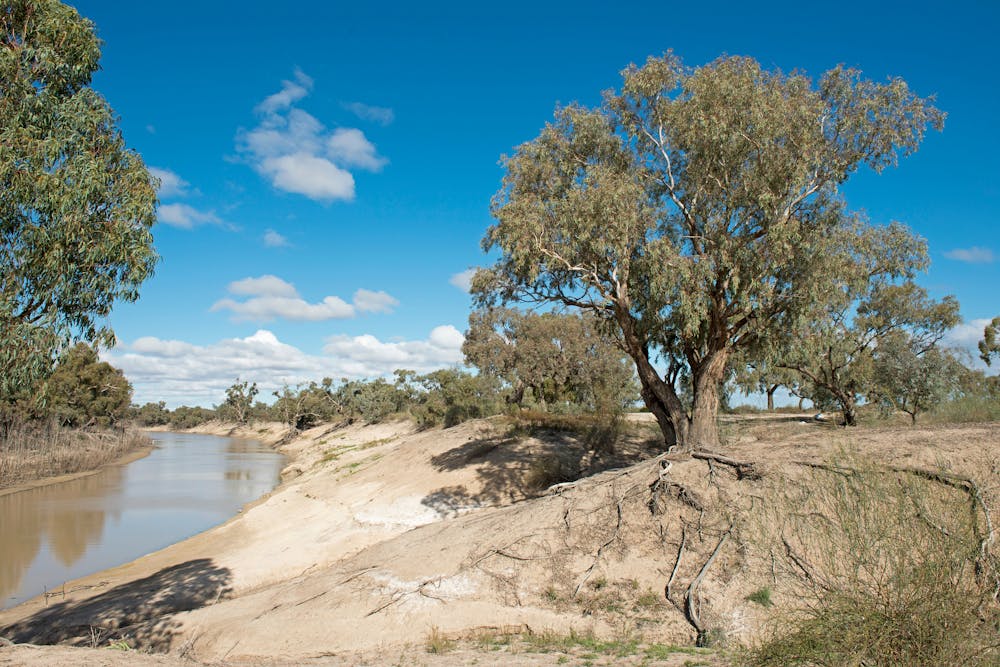
A shallow river cuts through brown land, beside a gum tree.
Aboriginal people have largely been shut out of the market. Shutterstock

An unjust distribution of water

A water use right, also called a licence or entitlement, grants its holder a share of available water in a particular waterway. Governments allocate water against these entitlements periodically, depending on rainfall and water storage. Entitlement holders choose how to use this water. Typically, they extract it for purposes such as irrigation, or sell it on the temporary market.
We mapped Aboriginal water access and rights in NSW over more than 200 years, including the current scale of Aboriginal-held water entitlements.
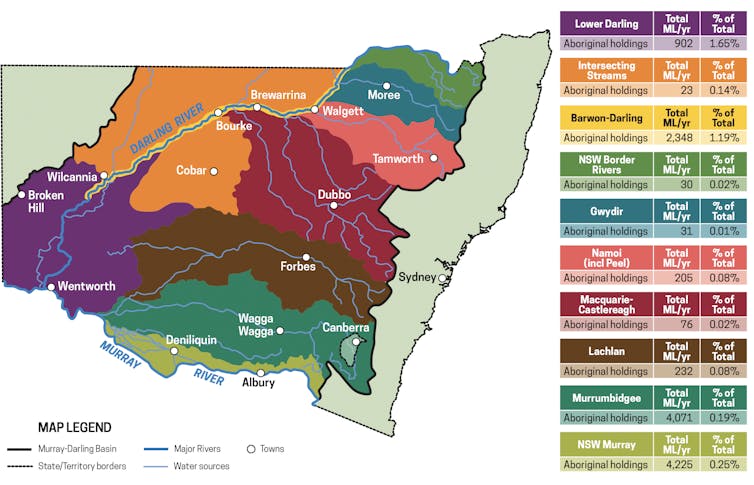
Across ten catchments in the NSW portion of the Murray-Darling Basin, Aboriginal people collectively hold just 12.1 gigalitres of water. This is a mere 0.2% of all available surface water (as of October 2018).
By comparison, Aboriginal people make up 9.3% of this area’s population.
The value of water held by Aboriginal organisations was A$16.5 million in 2015-16 terms, equating to just 0.1% of the value of the Murray-Darling Basin’s water market.
We wanted to understand how these limited water rights affect Aboriginal people today, and the challenges, if any, they face in holding onto these entitlements. This required examining Australia’s water history and its systems of water rights distribution.
What we found were key moments when governments denied Aboriginal people water rights and, by extension, the benefits that now flow from water access. This includes the ability to use water for an agricultural enterprise, or to temporarily trade water as many other entitlement holders do. We describe these moments as waves of dispossession.

The first wave of dispossession

Under colonial water law, rights to use water, for example for farming, were granted to whoever owned the land where rivers flowed. This link between water use and land-holding remained in place until the end of the 20th century.
As a result, Aboriginal people, whose traditional ownership of land (native title) was only recognised by the Australian High Court in 1992, were largely denied legal rights to water.

Water entitlements held by Aboriginal by catchment in the NSW portion of the MDB (as at October 2018)

The second wave

During the last quarter of the 20th century, governments introduced land restitution measures, such as the NSW Aboriginal Land Rights Act (1983), to redress or compensate Indigenous peoples for colonial acts of dispossession.
We found water entitlements were attached to some of the land parcels that were transferred to Aboriginal ownership under these processes – but this was the exception.
Land restitution processes intentionally restricted what land Aboriginal people could claim. They were biased against properties with agricultural potential and, therefore, very few of the properties that were returned to Aboriginal ownership came with water entitlements.
At this crucial juncture in land rights reform, federal and state governments entrenched the inequity of water rights distribution by increasing the security of the water rights of those who historically held entitlements. Governments have yet to pay serious attention to the claims of Aboriginal people who see a clear connection between the past and the present in the distribution of water entitlements.

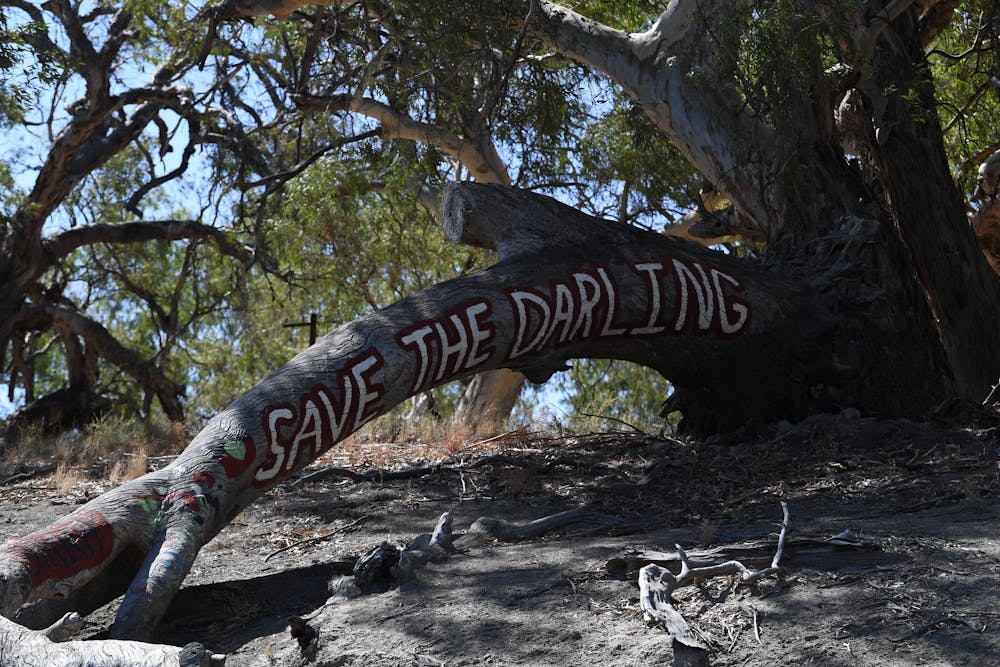
'Save the Darling' is written in white across a leaning tree trunk.
We found key moments when governments denied Aboriginal people water rights and the benefits that come with it. AAP Image/Dean Lewins

The native title framework has not helped the situation either. Native title is the recognition that Indigenous peoples have rights to land and water according to their own laws and customs.
But it’s difficult for those making a native title claim to get substantial interests in land and waters. The Native Title Act 1993 defined native title to include rights to water for customary purposes and courts are yet to recognise a commercial right to water.

The third wave

We also identified a third wave of dispossession, now underway. From 2009 to 2018, the water rights held by Aboriginal people in the NSW portion of the Murray-Darling Basin shrunk by at least 17.2% (2.0 gigalitres of water per year). No new entitlements were acquired during this decade.
The decline is attributable to several factors, the most significant being forced permanent water (and land) sales arising from the liquidation of Aboriginal enterprises.
With water rights held by Aboriginal people vulnerable to further decline, the options for Aboriginal communities to enjoy the wide-ranging benefits of water access may further diminish.
We expect rates of Aboriginal water ownership to be even smaller in other parts of the Murray-Darling Basin (and in jurisdictions beyond the Basin). Research is underway to explore this.

Minister Keith Pitt speaks during Question Time.
The Productivity Commission is currently reviewing the progress of reform in Australia’s water resources sector. AAP Image/Lukas Coch

Australia urgently needs a fair national water policy

The Productivity Commission is now reviewing Australian water policy, and must urgently address the injustices faced by Aboriginal people.
In developing a just water policy, governments must work with First Nations towards the twin goals of redressing historical inequities in water access and stemming further loss of water rights. Treaty negotiations may offer another avenue for water reform.
Over recent decades, Australia has been coming to terms with its colonial history of land management, returning more than a third of the continent to some form of Indigenous control under a “land titling revolution”.
But a water titling revolution that reconnects water law and policy to the social justice agenda of land restitution is long overdue. Indigenous peoples must have the opportunity to care for their land and waters holistically, and share more equitably in the benefits of water use.

Wednesday, July 11, 2018

An Epidemic of Loneliness — Among Lawyers and Doctors

gettyimages.com
Katie Davis spends her afternoons and evenings in therapy sessions with kids. As a clinical psychologist in private practice on Manhattan’s Upper East Side, Davis helps young patients through severe anxiety, mood disorders and other mental health challenges in order to improve their educational attainment.
She says she’s “taking on all of their struggles,” and she’s doing so without an outlet for her own stress. “I’m not allowed to talk about my patients. Everything that happens at work stays just with me,” Davis says. “Which is obviously necessary … but at the same time it’s pretty isolating, and it can be overwhelming.”
Loneliness has been called an epidemic in the United States, and it affects certain professions more severely than others. According to a recent survey by the digital workplace coaching company BetterUp:

LAWYERS AND DOCTORS ARE THE LONELIEST PROFESSIONALS — “BY FAR.”

The research surveyed 1,624 full-time employees about their loneliness, or the “perception of being alone and isolated.” Salary didn’t seem to matter much when it came to this particular state of being: Those making $80,000 a year showed only about a 10 percent improvement in battling loneliness and finding social support over folks making half that much.
Instead, the key factors seem to be type of profession and level of education. In a breakdown of loneliness and social support rates by profession, legal practice was the loneliest kind of work, followed by engineering and science. Occupations involving high degrees of social interaction such as social work, marketing and sales were at the opposite end of the spectrum.
Those with graduate degrees also experienced higher levels of loneliness and less workplace support than respondents with less education. Those lonesome lawyers and doctors? They turned out to be 25 percent lonelier than respondents with bachelor’s degrees and 20 percent lonelier than Ph.D.s. “We found that it really has to do with how much of a culture of social support is in the workplace,” says Andrew Reece, a behavioral data scientist at BetterUp.
Another part of the connection between education and loneliness could be the nature of graduate school, which is best suited for introverts, according to Andrew Selepak, a telecommunications professor at the University of Florida. In his case, most of his work was done alone in front of a computer or in a library, which didn’t sit easily with his extroverted personality. “To get to the point where you become a college professor, a doctor, a lawyer, one of the occupations that might take more education,” Selepak says, “you’ve spent literally years doing work that is relatively solitary.”
As for Davis the psychologist, she anticipated the isolation of running a business. Since she works with child patients, she doesn’t have a social circle of colleagues the way she would in, say, a clinic setting. “I knew that it would be a really overwhelming and lonely experience,” she says.
At the same time, Davis likes having the power and autonomy to handle her cases and her practice as she sees fit. Those factors outweigh the negatives, and over time she has developed ways of managing her loneliness. She has a supervisor she meets about once a month for guidance, and she has joined Listserv and professional groups that organize events. Davis also landed a part-time research job so she could interact and collaborate with others in her field. This kind of workplace culture, she thinks, is powerful for increasing the sense of social connectivity among colleagues.
Like Davis, Selepak saw a solitary work environment as a given part of his career choice. He’d been prepared for it, but he knew he needed to find more ways to interact with people. He made friends with folks outside his area of expertise so he could talk with them about sports and pop culture, and he became a regular at his gym, which provided him with another, more casual social setting.
Still, BetterUp Chief Innovation Officer Gabriella Rosen Kellerman says questions continue to revolve around why loneliness is prevalent in certain careers. Now, though, employers understand that its presence in a workplace can lead to lower productivity and negatively affect a business, so they are shifting their focus to improve workplace culture, which can be difficult. Creating “shared meaning” and emphasizing why an employee’s work matters can make a big difference, Kellerman says.
“[Cultures] are historically the hardest changes to make in a workplace, and part of that is we’ve been approaching it wrong,” Kellerman says. “Each person whose behavior or thinking you want to change has to be dealt with as an individual.”

Friday, August 19, 2016

Are We Feeling Collective Grief Over Climate Change?

Star Jet roller coaster after Hurricane Sandy (Wikipedia)
by Margaret Hetherman, Common Dreams: http://www.commondreams.org/views/2016/08/18/are-we-feeling-collective-grief-over-climate-change

In 1977, I was in middle school in Michigan, and a science teacher shared a tidbit off-curriculum.

Some scientists had postulated that as a result of "pollution," heat-trapping gasses might one day lead to a warming planet. Dubbed "the greenhouse effect," the image was clear in my 12-year old mind: people enclosed in a glass structure, heating up like tomatoes coaxed to ripen. It was an interesting concept, but something in the very, very distant future.

Fast-forward ~ 30 years later. The year was 2006, my daughter was three, and my dreams of a White Christmas were going to hell in a hand basket. There wasn't a snowflake to be seen in Brooklyn and it was DECEMBER - a far cry from childhood memories of jumping off the roof into fluffy mounds after a blizzard.

Something was awry. An Inconvenient Truth had just been released, and those graphs and slides were suspiciously coinciding with what we were beginning to see in the form of extreme weather, à la Hurricane Katrina. Any number of idioms might well have marked the juncture: "canaries in the coal mine" comes to mind.

"The disconnect is almost understandable: we are hitting tipping points of no return, etching our fate in glacial ice while the full consequence of our inaction remains hidden from view." So why weren't we coming together to nip this in the bud? Why were we failing to embrace what appeared to be so obvious?

The deterioration of our planet - the only home we have ever known and an assurance we used to take for granted - is bound to elicit a wide range of emotions in different individuals. Mourning is personal, but as a species, could it be that we are making our way through the stages of grief as outlined by the late Dr. Elisabeth Kübler-Ross?

Psychiatrist and climate activist Lise Van Susteren, M.D. doesn't necessarily think so. She points out that the Kübler-Ross framework was a response to people who hear devastating news and feel personally very involved, extremely vulnerable and know that the diagnosis is essentially inescapable. "That's not where most people are with climate," Dr. Van Susteren states. "It takes a long time for some people to lay down the sense within that something is true."

Yet she speaks of a collective anxiety that is insidious, even if we haven't managed to connect all the dots. "There isn't the slightest shred of doubt in my mind, that everyone on some level is anxious, deeply anxious, about climate change," the forensic psychiatrist says. She attributes her belief to decades of experience with people who have difficulty knowing what they are feeling on a deeper level, and she understands that anxiety comes from many headwaters.

"We can be anxious about ISIS, we can be anxious about our kids ... our health, our finances and all the rest. The confluence is such that it becomes amorphous and we walk around with a great deal of indescribable unease. And it can be either very difficult, or people will outright deny - depending on how deep or great their walls are - that it is coming from an overwhelming sense that the world is turned upside down from climate." 

Denial

Denial has been rampant since the earliest years of climate change awareness. Virtually every day brings reports of a new catastrophe. Bolivia's second-largest lake recently dried up and we won't soon forget the melting of tennis shoes at the Australian Open. Sure, there are cycles of nature to consider. But when you find yourself crossing Main Street in a rowboat on a regular basis? Or happening upon femur bones off the bank of Virginia's Tangier Island because the cemetery is underwater?

The disconnect is almost understandable: we are hitting tipping points of no return, etching our fate in glacial ice while the full consequence of our inaction remains hidden from view.

Dr. James E. Hansen, renowned climatologist and former Director of NASA's Goddard Institute for Space Studies in Manhattan speaks to the matter of timescale. "The problem is that the inertia of the system is not our friend," states the founder of and Adjunct Professor in Columbia University's Climate Science, Awareness and Solutions Program Earth Institute. It has caused the effects to appear only slowly. "That has been the fundamental difficulty. It looks like something in the far future."

Sitting across the table from the 75-year old scientist, it becomes rapidly clear that his greatest concern is for future generations. That, he says, was the point in writing his book, Storms of my Grandchildren. It also inspires his participation as guardian for future generations in a current landmark federal climate change lawsuit against the government for failing to protect children's constitutional rights to life, liberty, and property - a case that Dr. Van Susteren has collaborated on as well.

"These children are going to be around late in this century, so even though the large effects are not so soon, we can now see that they are going to occur if we don't rapidly phase down emissions," states Dr. Hansen. "And I think some of them - mainly the sea level issue - is [coming] sooner than has been assumed by many." Hansen believes people are moving in the direction of accepting that climate is changing and that humans are at least a factor if not the dominant factor.

But there is also the matter of our wiring.

"Denial is something that allows us sometimes to get through the day," says Dr. Van Susteren. "And in some cases that's really good, that's adaptive, but in other cases it's going to kill you ... and this one's going to kill you." 

Anger

While many in the denial camp have now set their tents up elsewhere, stragglers remain, buttressed by a heavily financed machine that has deliberately cultivated and preserved that pesky first stage of mourning. ExxonMobil and The American Petroleum Institute have long sowed doubt about the science behind climate change, taking their lessons from the tobacco industry playbook.

The Koch Brothers estimated by Forbes to be worth $44.2 billion each, have funneled mind-blowing sums through "charitable family trusts" and "think tanks" to influence policy and public opinion, planting seeds of uncertainty among the general public, and blocking attempts to regulate emissions, thereby ensuring that their pockets remain literally coated in oil.

What does it mean when our Senate Majority Leader urges the country's governors to defy regulations to reduce carbon pollution?

Some powerful forces have been messing with our opportunity to process the truth, and move beyond the stage of denial toward a stance of action. From where I sit, the angriest entities at the moment are those whose political and financial fortunes are at stake.

The truth is that our children, and their children, will be the ones to really know the rage. There's no telling how the devastation will play out, as the regions least responsible for the demise become uninhabitable; and the world as we know it, perhaps ungovernable.

"Right now, the path is, as the Buddhists like to say: if we're not careful we're going to end up where we're headed," offers Van Susteren. She believes we are headed to a place where the world will look at our country and recognize that our per capita emissions, the droughts, floods, and searing hot days will be "because we gaily or callously, or with willful ignorance went about our ways, consuming what we wished, emitting what we felt like." 

Bargaining

When the Kyoto protocol was signed in 1997, the atmospheric CO2 level was 368 ppm. Today, it stands at 404 ppm and I'm scratching my head because living in the Holocene has been good (think of it as "life with benefits"), and I'll be sad to lose Miami to the rising sea.

The lengths we've gone to with our bargaining, pollution trading, and decades-away targets are staggering. This year brought April in Paris and 175 countries signed a historic climate accord. The deal, which supports the cap-and-trade system, strives to keep global temps from rising more than 3.6°F by 2100.

Hansen, a proponent of an alternative Carbon Fee-and-Dividend model, argues that the UNFCC and IPCC scenarios assume negative emissions in the second half of the century, and that this will saddle young people with the task of having to phase out fossil fuels.

"They're going to have to somehow achieve negative emissions, which means you're going to have to suck that CO2 out of the atmosphere," says the scientist. "We have to make clear what the burden is, that we're leaving for young people."

The bottom line is that we best make haste. If a heat wave in Phoenix sounds brutal, consider Abu Dhabi and Dubai, which are slated for a heat index of 177°F during this century if we don't mitigate the magnitude of warming. 

Depression

In 2010, the NIH issued "A Human Health Perspective On Climate Change." The report portends dark consequences ranging from sexual dysfunction to the migration of large communities, hostile political environments, conflict, and war.

"Climate change has the potential to create sustained natural and humanitarian disasters beyond the scale of those we are experiencing today," reads the NIH report. "Extreme weather events, sea-level rise, destruction of local economies, resource scarcity, and associated conflict due to climate change are predicted to displace millions of people worldwide over the coming century."

But the future grief on our planet will not be like that of a natural disaster, according to Dr. Van Susteren, when there is a low point and then the worst is over - when people grieve, work together and then pick up. "The fingerprints of humans are all over the frequency and intensity of climate disasters ... what will happen when future generations look back and know that we could have taken action - that we knew - and we didn't?"

Dr. Van Susteren can't shake off a sense of shame when she speaks about how future generations will feel: "That we abandoned them willfully, negligently, intentionally, and out of dereliction of duty." 

Acceptance

Hansen, who first brought global warming to the attention of the Senate Energy and Natural Resources Committee 28 years ago, seemed initially taken aback by the proposition that humanity might be working through a framework typically associated with death and dying.

"That model sort of assumes that ... the consequences are all inevitable," expressed the man who is arguably the planet's most reliable champion of climate health. "So I'm not yet willing to accept that, and here’s the real story - that this is tragedy. Because it's avoidable."

Hindsight may prove the only true vantage by which to see how we've worked through the scaffold of bereavement, and it will be left to our progeny to judge whether we conducted business as usual, or reversed course when approaching the most critical thresholds.

Meanwhile, the cauldron simmers with a stew of emotions, actions and inactions. The realities hit closer to home with every Hurricane Sandy, each new Zika hot spot on the map, and with the ever-dwindling array of animals, from the Monarch butterfly, to the pelican and stork and 1300 other types of birds whose collective song, or lack thereof, might well serve as warning: we, too are a threatened species.

© 2016 Scientific American
Margaret Hetherman is a writer, editor and essayist. Her opinions have appeared in the Op-Ed pages of The New York Times, and other media work has appeared on CNN, MTV and the BBC.

Wednesday, October 15, 2014

The Age of Loneliness is Killing Us

by The Guardian:

Man sitting on a bench under a tree
‘Social isolation is as potent a cause of early death as smoking 15 cigarettes a day. Loneliness is twice as deadly as obesity.’ Photograph: Feri Lukas/Rex

What do we call this time? It’s not the information age: the collapse of popular education movements left a void filled by marketing and conspiracy theories. Like the stone age, iron age and space age, the digital age says plenty about our artefacts but little about society.

The anthropocene, in which humans exert a major impact on the biosphere, fails to distinguish this century from the previous 20. What clear social change marks out our time from those that precede it? To me it’s obvious. This is the Age of Loneliness.

When Thomas Hobbes claimed that in the state of nature, before authority arose to keep us in check, we were engaged in a war “of every man against every man”, he could not have been more wrong. We were social creatures from the start, mammalian bees, who depended entirely on each other.

The hominins of east Africa could not have survived one night alone. We are shaped, to a greater extent than almost any other species, by contact with others. The age we are entering, in which we exist apart, is unlike any that has gone before.

Three months ago we read that loneliness has become an epidemic among young adults. Now we learn that it is just as great an affliction of older people. A study by Independent Age shows that severe loneliness in England blights the lives of 700,000 men and 1.1m women over 50, and is rising with astonishing speed.

Ebola is unlikely ever to kill as many people as this disease strikes down. Social isolation is as potent a cause of early death as smoking 15 cigarettes a day; loneliness, research suggests, is twice as deadly as obesity.

Dementia, high blood pressure, alcoholism and accidents - all these, like depression, paranoia, anxiety and suicide, become more prevalent when connections are cut. We cannot cope alone.

Yes, factories have closed, people travel by car instead of buses, use YouTube rather than the cinema. But these shifts alone fail to explain the speed of our social collapse.

These structural changes have been accompanied by a life-denying ideology, which enforces and celebrates our social isolation. The war of every man against every man - competition and individualism, in other words - is the religion of our time, justified by a mythology of lone rangers, sole traders, self-starters, self-made men and women, going it alone.

For the most social of creatures, who cannot prosper without love, there is no such thing as society, only heroic individualism. What counts is to win. The rest is collateral damage.

British children no longer aspire to be train drivers or nurses - more than a fifth say they “just want to be rich”: wealth and fame are the sole ambitions of 40% of those surveyed.

A government study in June revealed that Britain is the loneliness capital of Europe. We are less likely than other Europeans to have close friends or to know our neighbours. Who can be surprised, when everywhere we are urged to fight like stray dogs over a dustbin?

We have changed our language to reflect this shift. Our most cutting insult is loser. We no longer talk about people. Now we call them individuals. So pervasive has this alienating, atomising term become that even the charities fighting loneliness use it to describe the bipedal entities formerly known as human beings.

We can scarcely complete a sentence without getting personal. Personally speaking (to distinguish myself from a ventriloquist’s dummy), I prefer personal friends to the impersonal variety and personal belongings to the kind that don’t belong to me. Though that’s just my personal preference, otherwise known as my preference.

One of the tragic outcomes of loneliness is that people turn to their televisions for consolation: two-fifths of older people report that the one-eyed god is their principal company. This self-medication aggravates the disease.

Research by economists at the University of Milan suggests that television helps to drive competitive aspiration. It strongly reinforces the income-happiness paradox: the fact that, as national incomes rise, happiness does not rise with them.

Aspiration, which increases with income, ensures that the point of arrival, of sustained satisfaction, retreats before us. The researchers found that those who watch a lot of TV derive less satisfaction from a given level of income than those who watch only a little.

TV speeds up the hedonic treadmill, forcing us to strive even harder to sustain the same level of satisfaction. You have only to think of the wall-to-wall auctions on daytime TV, Dragon’s Den, the Apprentice and the myriad forms of career-making competition the medium celebrates, the generalised obsession with fame and wealth, the pervasive sense, in watching it, that life is somewhere other than where you are, to see why this might be.

So what’s the point? What do we gain from this war of all against all? Competition drives growth, but growth no longer makes us wealthier.

Figures published this week show that, while the income of company directors has risen by more than a fifth, wages for the workforce as a whole have fallen in real terms over the past year. The bosses earn - sorry, I mean take - 120 times more than the average full-time worker (in 2000, it was 47 times).

And even if competition did make us richer, it would make us no happier, as the satisfaction derived from a rise in income would be undermined by the aspirational impacts of competition.

The top 1% own 48% of global wealth, but even they aren’t happy. A survey by Boston College of people with an average net worth of $78m found that they too were assailed by anxiety, dissatisfaction and loneliness.

Many of them reported feeling financially insecure: to reach safe ground, they believed, they would need, on average, about 25% more money (and if they got it? They’d doubtless need another 25%). One respondent said he wouldn’t get there until he had $1bn in the bank.

For this, we have ripped the natural world apart, degraded our conditions of life, surrendered our freedoms and prospects of contentment to a compulsive, atomising, joyless hedonism, in which, having consumed all else, we start to prey upon ourselves. For this, we have destroyed the essence of humanity: our connectedness.

Yes, there are palliatives, clever and delightful schemes like Men in Sheds and Walking Football developed by charities for isolated older people. But if we are to break this cycle and come together once more, we must confront the world-eating, flesh-eating system into which we have been forced.

Hobbes’s pre-social condition was a myth. But we are entering a post-social condition our ancestors would have believed impossible. Our lives are becoming nasty, brutish and long.