Showing posts with label Accountability. Show all posts

Friday, January 29, 2021

The Main Existential Threat of the 21st Century


(image: pinterest.com)


There are many existential threats to human life in the 21st Century, many of which are carried over from the 20th Century.

The threats of terrorism, nuclear war, militaristic regimes, and so on, are issues that paralysed nations and individuals throughout the 20th Century. On the other hand, it is often argued that climate change is the most significant problem facing human life in the 21st Century. Indeed, the obliteration of all sentient and plant life on the planet is an immeasurable issue, well beyond the imagination of most humans who continue to live in the same way as they have for many decades. It is difficult to argue against climate change being the number one issue facing life on this planet. However, this is just what I would like to do in this article.

My premise is that climate change is the ultimate issue that will cause the destruction of life on Earth if drastic action is not taken very soon, but it is not the most serious threat. It is fully acknowledged by an overwhelming majority of the world’s independent scientists, who are not in the service of the corporate elites, that if action is not taken, then it may be too late. On the other hand, it has been argued that if enough action is taken by governments to tackle emissions, then the planet can be saved in a liveable enough state that human and other life will be able to continue.

So, what is the main threat? Again, many people argue that the corporate elites are the main threat. These owners of massive mining corporations and industrial agriculture are hugely responsible for spewing out massive amounts of emissions which are destroying many aspects of our life-support system. In addition, they are responsible for practices which not only create inequality, but actually have dramatically increased inequality through their practices over the last forty years, and in particular, over the last ten. In other words, the power of the corporate elites, and the consequences of their practices, has increased exponentially over the last ten years. 

As argued earlier, capitalism has reached a point where it is now confronting environmental and economic limits to the accumulation of capital. What this means is that capital can no longer be accumulated through the manipulation of labour and technology to create profit. This kind of profit is simply no longer available. In response, governments have been acquiescent in deregulating many industrial practices and trade regimes to the benefit of the corporate elites. The result of this process is that a new form of accumulation has developed which can be characterized as ‘accumulation by dispossession’. This is basically the accumulation of capital through privatization, deregulation, and the takeover of public space, all facilitated by national governments, mostly in democratic nations such as the USA, the European Union, the UK, Australia, New Zealand, Canada, and South Africa. It is argued, again, that the corporate elites are not the main threat, but only because we have a mechanism that can put the brakes on the corporate elites — that of democratic government.

My argument is that national governments in democratic nations are the current main threat and barrier to finding solutions to climate change. Why? Because they are the ONLY institution that has the potential and the legal power (although this is rapidly diminishing) to curb the power of the corporate elites. This can be achieved through legislation that will place limits on what the corporate sector are allowed to do, and to re-regulate industry, and to reclaim those assets that have been privatized — this is also a point of justice as these very assets have been paid for by tax-payers and have effectively been stolen by the corporate sector with the assistance of government.

Of course, there is nothing in the legal statutes to stop politicians from acting in their own interests or from colluding with the corporate elites to ‘get a piece of the pie’ on the condition that they ‘give’ away a piece of the public pie. And this essentially is the weakness of the democratic system. So, let’s unpack this state of affairs by boiling it back to its basics.

Firstly, democracy is about the people rather than about the politicians. Politicians are supposed to be the representatives of the people. In Australia, the people go to the ballot box and place their votes for their local members in the upper and lower houses of parliament. The local member then gets a seat in the parliament, usually as a backbencher. This is a good opportunity for these elected members to voice their opinions and the opinions of their electorate on crucial issues. So far, the system appears to be very sound. However, Australia has a ‘party political system’, meaning that the parties are very powerful and tend to coerce the members into voting according to the party line. The fact that Australia has such a collective notion of party politics is a huge irony, considering that both major parties see anything at all that is even vaguely collectivist as complete anathema. And yet what could be more collectivist than the process of government?

A number of those who are in the party or coalition that has won the election are appointed into the cabinet as ministers. This may be more due to their ability to ‘make things happen’, or to tow the party line, more so than having any expertise in the portfolio to which they are appointed — the evidence suggests that this is very much the case, with ongoing portfolio reshuffles illustrating this point very clearly.

As representatives of the people, the cabinet ministers and the power of party politics act against true representation. Add to the mix the very powerful influence of Australia’s media monopoly spouting the values of neoliberalism, competition, and divisiveness on social issues, such as on gender, ethnic, immigration, sexuality, and Aboriginal issues, and one can see that the politicians are finding it very difficult to represent the people.

In order to get politicians to represent the people in true democratic fashion, instead of constantly undermining democracy, they need to listen to the mood of the people and to understand the people, instead of brushing off those who do voice their opinions as whingers and leaners. There is no democracy in selling the country off to the corporate elites and the majority certainly does not want to see this happen. Does anyone truly believe that if there was a referendum on the question of: “Should Australia sell everything in the country off to the corporate elites?” that it would not get a massive ‘no’ vote? Only if the politicians listen to the people will they be able to stop the corporate elites as has happened in Iceland.

Wednesday, September 2, 2020

When politics fails, call the lawyers: It was legal teams—not politicians—that ultimately held the tobacco industry to account. Their next target? Perpetrators of climate change


Lawyers are one of America’s most distrusted professions, bringing up the rear behind even bankers and local politicians. But what if lawyers end up saving the world?

Scientists have been warning for years that mounting carbon emissions are dangerously destabilizing our climate. Efforts to tackle this urgent challenge through the political process have so far come up far short of the action needed to avoid some very bad outcomes.

Can litigation succeed where politics has so far failed?

We’ve actually been here before. Several decades ago it also seemed the tobacco industry was an invincible foe to public health. Over the course of decades, however, a series of long-shot lawsuits finally enfeebled this previously unassailable political lobby. Civil litigation against cigarette manufacturers began in the 1950s, but did not bear fruit until 40 years later in a series of court victories that culminated in the $206 billion  Master Settlement Agreement with 46 U.S. states.

Terms of this judgment included halting advertising smoking to children, funding anti-smoking campaigns with industry money and dissolving three of the biggest tobacco industry organizations. Phillip Morris and other major cigarette companies were later convicted on racketeering and conspiracy charges for their decades-long conspiracy to deceive the public on the dangers of smoking. Lawyers went where no lawmaker had dared to go before.

Similar to the tobacco industry, the fossil fuel industry enjoys many powerful friends among American politicians. For example, Senator Jim Inhofe, the former Chair of the U.S. Senate Environment Committee, once published a book called  The Greatest Hoax: How the Global Warming Conspiracy Threatens Your Future. The Trump Administration withdrew the U.S. from the Paris Climate Agreement and scrapped Obama’s Clean Power Plan. Scores of international climate gatherings seemingly accomplish little more than burning jet fuel.

But new evidence suggests that perhaps lawyers can succeed where policy makers have so far failed.

The tobacco and fossil fuel industries have a lot in common. They both enjoyed decades of power and influence. They have both engaged in highly effective campaigns in order to delay costly regulation of their dangerous product. In the case of cigarette manufacturers, exposed public deceptions eventually became their undoing when turned against them in a court of law.

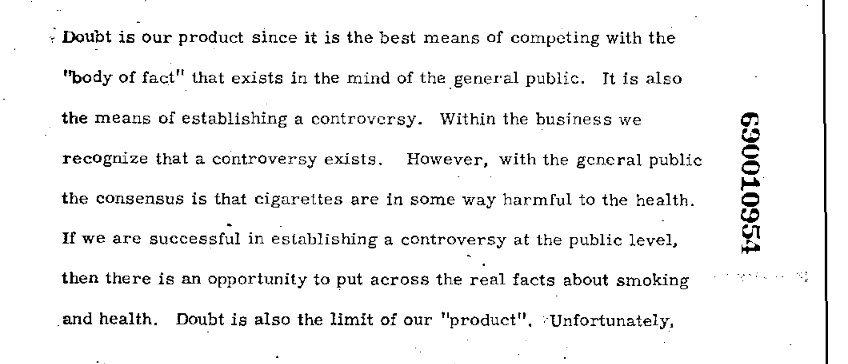
“Doubt is our product” in the 1969 B&W MIS Smoking and Health Proposal. Via UCSF Truth Tobacco Industry Documents

A notorious internal tobacco lobby document stated, “doubt is our product,” outlining how company-funded scientists and doctors are used “as a means to generate controversy” regarding the well-known link between smoking and cancer. These efforts might have bought them some time in avoiding regulation, but ultimately were their undoing when individuals and governments successfully sued companies for health care expenses and personal damages. As settlement costs mounted, the political power of Big Tobacco drained away.

Fast forward several decades and Big Oil is finally beginning to stew in the same pot. Court cases, even if unsuccessful at first, are one of the best ways to compel the production of potentially incriminating documents and evidence. Parties to a lawsuit are required to provide the other side a baseline of discovery information by either opening their file cabinets or through sworn deposition of key witnesses outside of court.

As such, a growing trove of damning evidence against the oil industry is being unearthed in a series of lawsuits and other  investigations—much of which runs afoul of requirements that companies inform regulators and the public if they know their product is dangerous. The bigger the danger, the larger the obligation. 

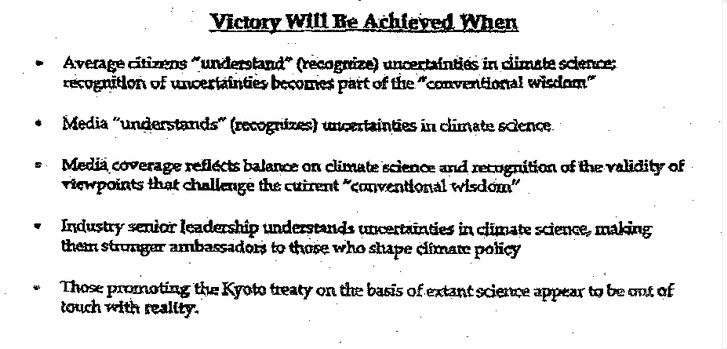
From the 1998 American Petroleum Institute Global Climate Science Communications Team Action Plan, via Climate Files

The fact that these documents are being unearthed is a huge win for the future of climate litigation—it is the first critical step in building the case against the industry that knowingly helped light the planet on fire. There are few dangers more pressing than our destabilized climate. Billions of dollars in potential damages are predicted by not only the scientific community, but by the oil industry’s own scientists. Adding to the tort lawyer allure is the fact that nobody has deeper pockets than Big Oil. We are still a long way from a legal feeding frenzy, but there is already some blood in the water based on what industry knew long before they said they didn’t.

Back in the 1970s Exxon wanted to be a leading research voice in the emerging field of climate change. They hired some of the best scientific minds of the day with generous funding and access to Exxon’s vast resources around the world. One team was using supertanker-based instruments to sample how much CO2 was being absorbed by the world’s oceans.

Their research was published in leading scientific journals. Former Exxon scientist James Black also warned senior management in a 1977 internal memo that doubling atmospheric CO2 would heat the planet by up to three degrees Celsius—similar to what scientists believe today. “Present thinking holds that man has a time window of five to ten years before the need for hard decisions regarding changes in energy strategies might become critical,” he wrote.

But management had other ideas than getting out of the fossil fuel business. By the early 1980s, internal research teams were fired and Exxon instead began investing in public relations. In 1989, Exxon helped fund the Global Climate Coalition and a constellation of other industry front groups in one of the most spectacularly successful misinformation campaigns in the long history of spin doctoring.

Similar to the strategies used by Big Tobacco, a 1998 internal  memo from the American Petroleum Institute stated, “Victory will be achieved when average citizens ‘understand’ uncertainties in climate science” and when “recognition of uncertainties becomes part of the ‘conventional wisdom.’”

And it worked. By 2014, more Americans believed that climate change is due to natural causes than more than a decade earlier in 2001. Those who describe themselves as understanding global warming “very well” are also the demographic most likely to say it is not due to human activity.

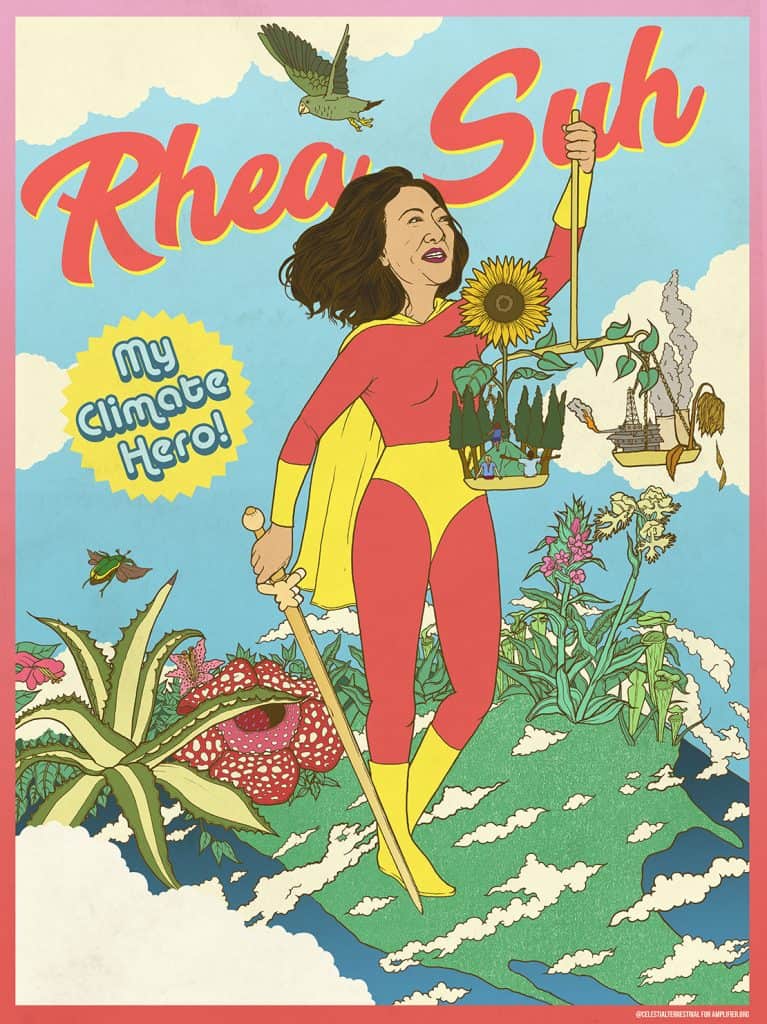
A poster depicting Rhea Suh, president of the National Resources Defense Council, which employs 600 scientists, lawyers, and policy advocates across the globe to fight for the environment. Poster part of Amplifier’s #MyClimateHero campaign

Meanwhile, oil companies were quietly spending vast amounts of money upgrading drilling platforms and other infrastructure to withstand extreme climate and rising sea levels. If industry was certain enough about planet heating to invest in preparing for it, how does that square with what they told the public, the media and regulators for decades? Or their legal obligation to warn people if their product is dangerous? All of that could be a problem to explain to the jury.

So why is this good news? After all, whether or not the lawyers of the world ultimately succeed in holding the fossil fuel industry to account in the same way as cigarette manufacturers remains, to a certain extent, to be seen. It will be a long road no doubt with many setbacks. But on top of the mountains of documentation being unearthed in current court cases, slowly building the case against Big Oil, there is also already evidence that companies are taking note and altering their behavior.

Chevron became the first major oil company to disclose to shareholders their legal climate risk, warning investors of “increased possibility of governmental investigations and, potentially, private litigation against the company.” Royal Dutch Shell recently invested $2 billion in renewable energy technologies, the first stage of which was announced only days  before the first US climate lawsuit was filed against the company. Exxon also joined a growing list of companies cutting ties with the Koch-funded American Legislative Exchange Council over the organization’s climate denial efforts. 

Politics remains an overarching danger to successful litigation against large companies. Seeing what had happened to the tobacco industry, gun manufacturers realized that they could crippled by civil lawsuits for the use of their own (obviously) dangerous products. Instead they successfully lobbied lawmakers to pass a bill granting them indemnity from litigation. If fossil fuel companies succeed in the same outcome, suing for climate damages will be essentially impossible in the U.S.

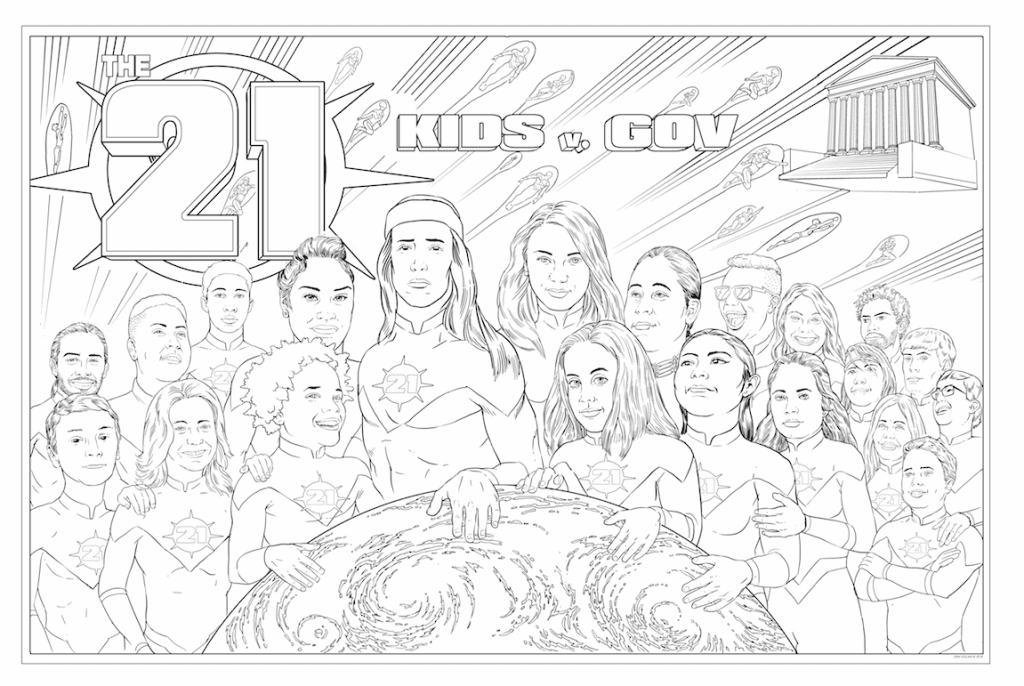
“21 Kids vs. Government” – a depiction of the plantiffs in Juliana v. U.S in 2015 which asserted that, “through the government’s affirmative actions that cause climate change, it has violated the youngest generation’s constitutional rights to life, liberty, and property, as well as failed to protect essential public trust resources.” Poster part of Amplifier’s #MyClimateHero campaign

In spite of these challenges, it would be a game changer if the world’s lawyers begin winning against the fossil fuel industry. After decades of terrorizing politicians, the tobacco lobby  withered under massive legal bills and RICO charges for defrauding the American people on the dangers of smoking.

Legal judgments can also be more than about money. When Volkswagen was caught including illegal emission-evading devices into their diesel cars in the U.S., they were hit with $15.3 billion in civil damages. Interestingly, they were also ordered to spend $2 billion installing electric vehicle charging stations across America and prohibited from disputing the facts of the case anywhere in the world, lest they get sued some more. Imagine if oil and coal companies were likewise ordered in a settlement to tell the truth about their decades of misdeeds? Or, more importantly, to spend some of their billions mitigating climate change? Cases demanding this kind of action are already underway. 

The law can be a blunt instrument, but also a heavy hammer. For some very smart lawyers, the oil industry is starting to look like a nail, and that’s a very hopeful thing.  

This story is part of a collection called Sue the Bastards: Stories about hauling climate change scoundrels into court and suing their pants off. Read more here. Also in this series from Mitch Anderson, an interactive timeline of the most hopeful moments  in climate litigation history … and present. 

Wednesday, August 12, 2020

We know how to fix student debt: The U.S. government spends more on higher education than many countries where students graduate with far less debt. Is there a better way?

by David Byrne, Reasons to be Cheerful:  https://reasonstobecheerful.world/we-know-how-to-fix-student-debt/

In 2019, researchers from Harvard Business School, Indiana University and Georgia State University took advantage of a fortuitous court ruling to find out what happens when you get rid of student debt. A judge had ruled that National Collegiate, a company that bought up student debt and treated it as an asset, actually didn’t have a valid claim to much of that debt. So the debt was cancelled. How much? 800,000 individual loans amounting to $12 billion. A lot of students and their parents were very happy.

The researchers realized this was a golden opportunity. By tracking other graduates who lived in the same zip codes with similar amounts of debt as the lucky 800,000, they could  compare the outcomes of the still-indebted control group with the suddenly debt-free students. Before this ruling, comparing students with debt to those without had always been complicated. Now it was easy.

What they found was that students whose debt was erased ended up with incomes that were 12.5 percent higher than their indebted peers in the years following graduation. Why? Not just because they had more immediate cash on hand — that difference was taken into account. The extra income often derived from changes in their behavior. The debt-free graduates could take more career risks. They were more mobile, able to move to where the higher paying jobs were. They could also pay off other debts — credit cards, car loans, mortgages — which improved their credit ratings and prevented defaults.

Removing college debt, the researchers found, improved these students’ financial outcomes in all sorts of unexpected ways. More of them got married and had kids, for example. Their improved circumstances benefit the entire economy.

blackboard
Credit: Oliver Knill

The debt problem

Some 44.7 million American adults are saddled with student debt totaling $1.6 trillion. That’s more than all U.S. credit card debt combined. This didn’t happen overnight. In the 1980s, the government began to replace student grants (which are essentially gifts) with loans, shifting the financial costs of higher education to students and their parents. Meanwhile, state governments cut the budgets of state colleges. The cost of higher education in the U.S. has surged more than 500 percent since 1985. A $10,000 education 35 years ago would cost over $50,000 today. The costs are rising faster than inflation, which makes for a dicey investment.

Student debt has quadrupled in the last 15 years, leading many high school graduates to wonder if an investment in higher education is still worthwhile. For the most part, it is. With a college education, you stand to make 84 percent more money  than someone with just a high school diploma. In the U.S., this gap between earnings for college grads and high school grads keeps growing, mostly because wages for high school grads are declining, and wages for college grads, even if they haven’t skyrocketed, continue to rise. 

Still, as we saw, all that student debt can hold folks back well beyond college. It’s a drag on the entire economy. Eliminating it is a worthy goal, which is why there have been proposals to cancel student debt. But simply canceling it doesn’t deal with the root of the problem: the high cost of college in the U.S. Until we deal with that, the next crop of students will simply rack up huge debts all over again.

Can this be fixed? Yes, it can. If we look at other countries, many have solved the problem of crazy-expensive higher education, and by extension, the student debt problem. 

blackboard
Credit: Oliver Knill

Free and cheap tuition is good, but that is only part of the solution

College tends to be very affordable in Europe. Top universities are tuition-free in Finland, Norway, Denmark, Iceland, Ireland, Czech Republic, Greece and Scotland. Sweden now charges a nominal fee of E500 for undergraduates. Germany charges for graduate programs, but undergraduate education is free. Austria and France are almost free for EU citizens — they charge a few hundred Euros. 

It’s not just European universities. Mexico and Brazil have extremely cheap higher education options. Argentina is tuition-free, as is Kenya, Morocco, Egypt, Uruguay and Turkey.

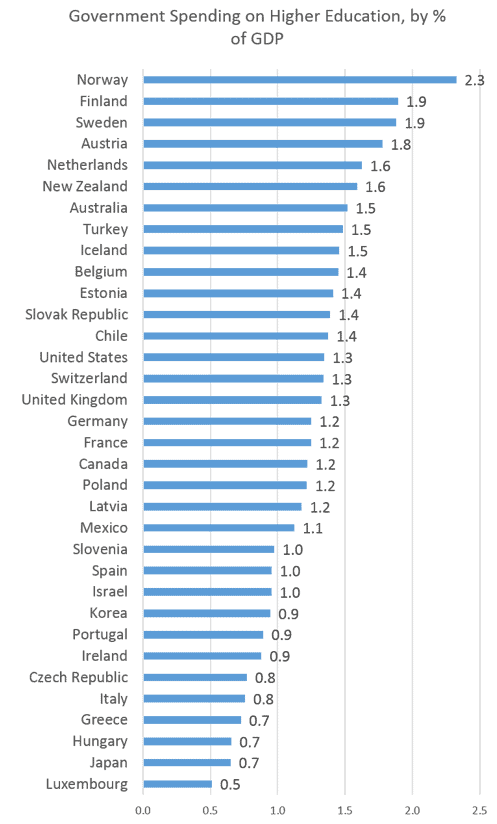
education spending
Credit: Mises Institute

A typical American response to this might be, “Oh, those countries simply have high taxes, so that’s how they subsidize colleges.” But it’s not as simple as that. The U.S. is 73rd in the world in spending on higher education as a percentage of GDP —  below Sweden, New Zealand and Norway, but ABOVE Germany, France and Canada, all of which have college options that are far more affordable. So it’s not a simple matter of tax more, spend more, problem solved. 

In many cases it’s not just the tuition that is the burden, but the cost of housing and eating for four years. Some places have come up with creative approaches.

blackboard
Credit: Oliver Knill

New Zealand

In New Zealand, the first year of college is free, but tuition can be as high as NZ 10,000 ($6,600 USD) a year after that. So, not exactly free at all. However, government student loans are interest-free, and students don’t have to begin paying them back until their post-graduation income rises higher than NZ 20,000 ($13,300 USD). The loans are also interest-free for as long as you stay in New Zealand. This system has allowed a lot more kids to go to college — three years after these loans were introduced in 1992, university enrollment went up 49 percent. 

New Zealand also offers a Student Allowance — basically, grants to cover the cost of living expenses. Whether or not you have to pay these back depends on your parents’ income, your age and whether you are married or have a child.

Norway

Similarly, in Norway tuition is completely free, but the cost of living is high. This is a problem in the U.S., too. Part of what makes American colleges so expensive are all the extras that come with it — the dorms, the food halls, the football stadiums, the fundraising departments. And because American students often don’t live at home, add-ons like housing, food and transportation can be as expensive as tuition. 

Norway solves this problem by making state loans available that can be used by students to cover living expenses. These loans are interest-free until graduation, and some students can convert up to 40 percent of them into grants that don’t have to be paid back.

Denmark

In Denmark, tuition is free, and the cost of living is not as high, but even so there are grants to cover expenses depending on parental income. I’m seeing a pattern here.

South Korea

In South Korea, tuition is about one-third as high as in the U.S., which is still much higher than a lot of other countries. But some 18 percent of these costs are covered by private companies and foundations. I’m not sure how one prevents undue influence from corporations on the syllabus, but one hopes that the companies realize that even without influence an increase in graduates benefits them all.

Germany

The German system is unique. Early in life, kids are placed into one of three tracks: college preparatory, vocational training, or something in between. This means a lower percentage of folks go to university than in similar countries — even though it’s tuition free! This early-stage sorting means that those who do go to college tend to get masters or doctorates, while those on the vocational track get training and go into the job market. One has to make this choice early on — in high school or even earlier — which, for some of us, seems a bit young to commit to one’s life path. It’s not impossible to jump over to the university track later, but not many do.

Like in other countries, to cover the costs there are government interest-free loans for which repayment depends on post-graduation income. This model — repayment based on later income — seems to be a common and successful means of greatly reducing the burden of student debt.

Higher education as a public good?

The countries mentioned above don’t completely subsidize every higher education cost, but they have eased the burden by lowering or eliminating tuition and making loan paybacks flexible. These policies have proven successful and have lessened the crippling effects of student debt. We can learn from their examples. 

We accept lots of things as public goods and happily pay for them: drinking water, fire and police departments, sewage and garbage disposal, roads and bridges. I pay for roads even though I don’t own a car because, well, that’s how my groceries get to the local store. And folks would go nuts if the fire department only served those who paid for the service, though that is actually the case in some communities.

In many countries, higher education is viewed this way, too — as a public good, a basic right (in the U.S., that concept is wholeheartedly embraced up through high school, so the idea of education as a right does exist — it just stops short of college). It would be unthinkable to defund grade schools and high schools (though austerity budget cuts amount to the same thing). The question is, do we accept the idea that, in the contemporary world, college might be essential as well? The bar has been raised. Education fosters resilience, which, as recent events have shown, is something the U.S. needs more than ever. 

Wednesday, July 29, 2020

‘A wake-up call’: why this student is suing the government over the financial risks of climate change

Katta O'Donnell smiles at the camera in a long-sleeved black top.
Katta O'Donnell bringing class action lawsuit against Aust government. M Townsend
As the world warms, the value of “safe” investments might be at risk from inadequate climate change policies. This prospect is raised by a world-first  climate change case, filed in the federal court last week.
Katta O’Donnell – a 23-year-old law student from Melbourne – is suing the Australian government for failing to disclose climate change risks to investors in Australia’s sovereign bonds.
Sovereign bonds involve loans of money from investors to governments for a set period at a fixed interest rate. They’re usually thought to be the safest form of investment. For example, many Australians are invested in sovereign bonds through their superannuation funds.
But as climate change presents major risks to our economy as well as the environment, O'Donnell’s claim is a wake-up call to the government that it can no longer bury its head in the sand when it comes to this vulnerability.

O’Donnell argues Australia’s poor climate policies – ranked among the lowest in the industrialised world – put the economy at risk from climate change. She says climate-related risks should be properly disclosed in information documents to sovereign bond investors.

O'Donnell’s arguments

O'Donnell’s claim alleges that by failing to disclose this information, the federal government breaches its legal duty. It alleges the government has engaged in misleading and deceptive conduct, and government officials breached their duty of care and diligence.
This is a standard similar to that owed by Australian company directors. Analysis from leading barristers indicates that directors who fail to consider climate risks could be found liable for breaching their duty of care and diligence.
O'Donnell argues government officials providing information to investors in sovereign bonds should meet the same benchmark.

Climate change as a financial risk

Under climate change, the world is already experiencing physical impacts, such as intense droughts and unprecedented bushfires. But we’re also experiencing “transition impacts” from steps countries take to prevent further warming, such as transitioning away from coal.
Combined, these impacts of climate change create financial risks. For example, by damaging property, assets and operations, or by reducing demand for fossil fuels with the risk coal mines and reserves become stranded assets.
This thinking is becoming mainstream among Australian economists. As the Australian Prudential Regulation Authority’s Geoff Summerhayes put it:
When a central bank, a prudential regulator and a conduct regulator, with barely a hipster beard or hemp shirt between them, start warning that climate change is a financial risk, it’s clear that position is now orthodox economic thinking.

Why safe investments are under threat

Sovereign bonds are a long-term investment. Katta O’Donnell’s bonds, for example, will mature in 2050. These time-frames dovetail with scientific projections about when the world will see severe impacts and costs from climate change.
And climate change is likely to hit Australia particularly hard. We’ve seen the beginning of this in the summer’s ferocious bushfires, which cost the economy more than A$100 billion.
Over time, climate risks may impact sovereign bonds and affect Australia’s financial position in a number of ways. For example, by impacting GDP when the productive capacity of the economy is reduced by severe fires or floods.
Frequent climate-related disasters could also hit foreign exchange rates, causing fluctuations of the Australian dollar, as well as putting Australia’s AAA credit rating at risk. These risks would reduce if the government took climate change  more seriously.
Already, some investors are voting with their feet. Last November, Sweden’s central bank announced it had sold Western Australian and Queensland bonds, stating Australia is “not known for good climate work”.

Unprecedented, but not novel

O’Donnell’s case against the federal government is an unprecedented climate case, even if its arguments are not novel.
Australia has been a “hotspot” for climate litigation in recent years, but the O'Donnell case is the first to sue the Australian government in an Australian court.
Previous cases suing governments have often raised human rights, such as the high-profile Urgenda case in 2015 against the Dutch government – the first case in the world establishing governments owe their citizens a legal duty to prevent climate change.
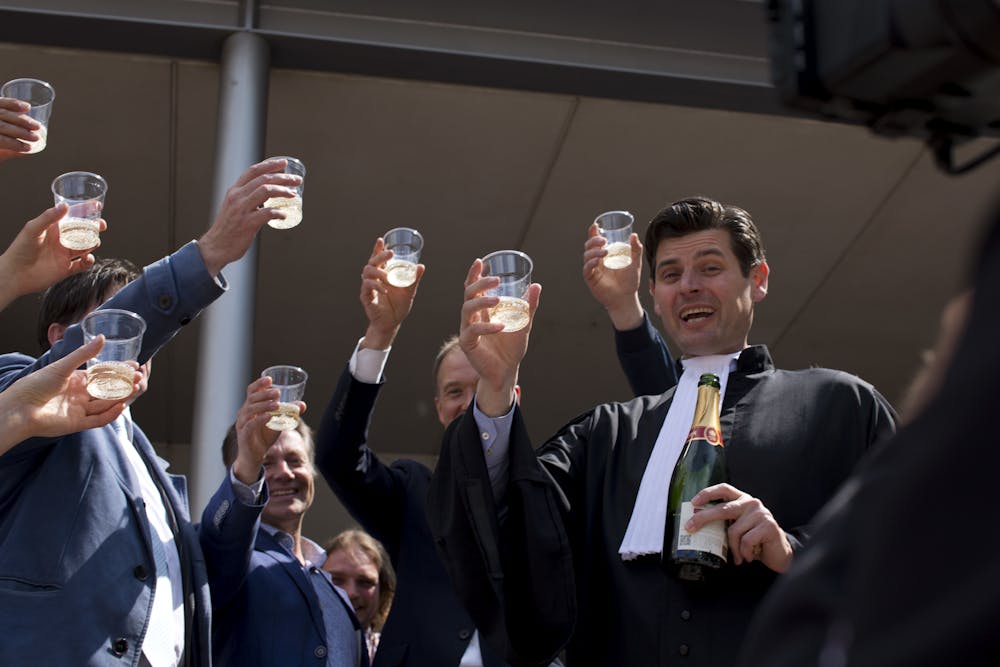
Four people hold up plastic cups with champagne, toasting to their court victory.
A Dutch court ordered the government to cut the country’s greenhouse gas emissions by at least 25 percent by 2020. AP Photo/Peter Dejong
The O'Donnell case is also unique in its focus on sovereign bonds. But cases alleging misleading climate-related disclosures are themselves not new.
In Australia, shareholders sued the Commonwealth Bank of Australia in 2017 for failing to disclose climate change-related risks in its 2016 annual report. The case was settled after the bank agreed to improve disclosures in subsequent reports.
In another headline-making case, 23-year-old council worker  Mark McVeigh is taking his superannuation fund, Retail Employees Superannuation Trust, to court seeking similar disclosures.
The O'Donnell case builds on this line of precedent, extending it to disclosures in bond information documents. As such, courts will likely take it seriously.

What precedent might it set?

If the O'Donnell case is successful it could establish the need for disclosure of climate-related financial risks for a range of investments.
At a minimum, a ruling in O'Donnell’s favour may compel the Australian government to disclose climate-related risks in its information documents for investors. This might make people think twice about how they choose to invest their money, especially as investors seek to “green” their portfolios.
It could also give rise to litigation using the same legal theory in sovereign bond disclosure claims against other governments, much in the way that the Urgenda case has spawned copycat proceedings from Belgium to Canada.
Whether the case provides the impetus for further government action to improve the effectiveness of Australia’s climate policies remains to be seen.
Still, it’s clear climate-related financial risks have entered the corporate boardroom. With this case, they’ve now come knocking at the government’s door.