YOUR RESOURCE FOR OVERCOMING THE ENVIRONMENTAL, SOCIAL, AND POLITICAL CRISES OF THE 21ST CENTURY THROUGH THE GREEN TRANSITION, COMMUNITY BUILDING, AND UNDERSTANDING OF SOCIETY THROUGH SOCIOLOGICAL THEORY AND PRACTICE
A Cherokee language class in pre-COVID times (Photo credit: Cherokee Nation)
Though Jacob Chavez grew up around family members who spoke Cherokee - his grandmother was fluent and his father could understand the language - the 23-year-old didn’t learn it as a child.
Now, as a young adult, the Tahlequah, Oklahoma, resident is taking part in a unique program to train Cherokee Nation citizens and those interested in Cherokee culture to become highly proficient in the language by paying them to study it. It’s one that is quickly disappearing.
“It’s in my family and I would like to kind of like, build it back and strengthen it back amongst some of our younger generation that we have and then, it’s just a passion that I’ve had — probably since senior year of high school,” Chavez says. “I just wanted to have that part of my identity and I’ve just been working on it ever since. And I took a couple classes in high school and in college and then now I’m in this program.”
The Cherokee Language Master Apprentice Program is an immersion program for adult Cherokee language learners. The program is geared for novice language enthusiasts, and it is intense: The 40-hour-per-week program runs for two years. Participants are paid $10 per hour, says Howard Paden, Cherokee Nation Language Department executive director.
“It’s not a whole lot, but what we have learned is people who have been really dedicated to learn the language—you have to have that many consecutive hours so they have to have the ability to live and continue to put some groceries on the table and that sort of thing,” he says. “So, it’s worked out really well. You know, we haven’t expected to make them be rich by any means, but we do want them to survive while they learn the language. And so that incentive has allowed people to focus just on the language instead of other things.”
The program, which started about six years ago, has grown. It went from having four students per year to 16, so at any given time, there will be 32 participants taking part in the two-year program when fully filled, Paden says.
For the Cherokee Nation — the largest tribe in the United States by population with more than 380,000 citizens worldwide — the program is taking on extra importance. There are about 2,000 fluent Cherokee speakers, according to Paden, and in the last year, more than 100 have died, some due to COVID-19-related illnesses.
“Right now, we’re losing roughly 5% of our speakers per year,” Paden says. “But we know that it takes quite a bit of time [to learn the language] and it’s not happening organically in our communities anymore.”
Losing so many fluent elders is one reason that the tribe placed them among the top of their COVID-19 vaccination list. According to the tribe, since receiving the first distribution of vaccines on Dec. 14, the Cherokee Nation administered more than 6,500 vaccines, including about 900 Cherokee speakers, as of Jan. 19.
Due to the pandemic, the coursework for the Master Apprentice Program is taught online, something that Chavez says has been difficult but he is making work.
“I’m a very in-person type of learner,” he said. “I can’t really do this technology interface kind of stuff, but I’ve had to adapt and I’m willing to do that. I want to do whatever I’ve got to do to learn and so it’s just kind of a means to an end, really. If I’ve got to use a laptop and get on Zoom, I’ll do that. But I’d much rather be in a classroom. I think we all would. But this is the world we live in and it is what it is.”
The Cherokee Nation looked to several different initiatives to help guide them when creating the Master Apprentice Program. They looked at a program within the Sac and Fox Nation, also based in Oklahoma, as well as the Euchee (Yuchi) and even the Māori from New Zealand.
The Cherokee Nation’s reservation encompasses 14 countries in northeastern Oklahoma, including parts of Tulsa County. There are ongoing discussions to possibly host a class at one Tulsa high school, though Paden is unsure where that stands now with the pandemic — both the high school and the tribe are doing most things online now.
Chavez believes that a tribe can’t have culture without language, and so that’s why he focuses on the future and learning the language.
“Those two things are just kind of joined, and if you lose our language and you still have culture, it’s kind of just a history, almost, because language is so ingrained inside of a culture,” he said. “You know, there’s names for all this stuff like games and ceremonies and things like that. You need the language to use all that. And so it’s vital for our nation and other nations that struggle with their languages … we’ve lost that connection between our elders and our youth because mainly they didn’t want to pass on language. [T]he consensus is that we’re losing it, so we’re trying to build it back now. It’s really important for us.”
Kristi Eaton is a freelance journalist based in Tulsa, Oklahoma. Her work has appeared in The New York Times, The Associated Press, The Washington Post and elsewhere. Visit her website atKristiEaton.comor follow her on Twitter@KristiEaton.
It’s a cold winter morning in deepest rural Wales and Cassandra Lishman steels herself to face dawn’s frosty bite. She wakes up her 15-year-old son and 17-year-old daughter and leaves the insulated warmth of their cobwood roundhouse. She feeds the dogs, lets the chickens out of the coop and ambles up the hill to smash the ice in the sheep’s drinking trough. Her daughter feeds the horses, and her son lights a fire to kickstart the house’s solar thermal heating.
In the afternoon, she harvests leeks for dinner and cuts up a batch of pumpkins to put in the freezer - to make space she takes out some red-currants and starts the week-long process of making jelly. In the summer, there’ll be hours more work to fit in: gardening, running willow-crafts workshops, building cobwood outhouses. “Then there’s the maintenance of all the fencing, which is constant,” she sighs. “This life isn’t for the faint-hearted.”
Cassandra and her husband Nigel. (Credit: Cassandra Lishman)
In Wales, the average citizen uses almost three times their share of the world’s resources. But Cassandra and her family are part of a groundbreaking scheme launched by the Welsh government in 2011 that aims to address that imbalance. The One Planet Development Policy (OPD) and its predecessor, Pembrokeshire’s Policy 52, allow people to bypass tight planning laws and move to protected areas to live ecologically sustainable lifestyles.
So far, 46 individual smallholdings have signed on to the programs, which require residents to sustain themselves using the resources available on land they inhabit. The policy aims to combat an array of problems: rising temperatures, soil degradation, rural depopulation, a rampant housing crisis and wasteful global supply chains. But at its most basic level, the OPD is an experiment to prove that, by limiting consumption and allocating resources wisely, ecologically responsible development is possible, even in pristine environments.
“A bold and creative policy”
“It was a bold and creative policy when it was introduced,” recalls Dr. Neil Harris, senior lecturer in statutory planning at Cardiff University. “You can’t build new homes in the open countryside - it’s a big no-no in the planning world. So it went against the grain. In Britain, there’s been a strongly protectionist approach to the countryside since World War II. It’s considered a place for recreation and food production, but not a place to live. It’s an attempt to protect nature from sprawl. Other European countries have similar containment policies.”
Participants on a ‘One Planet Experience’ course building a livestock barn. (Credit: Tao Wimbush)
The OPD policy in Wales is one of the rare exceptions to this rule. It comes with stringent restrictions requiring applicants to prove they can live within a set of defined environmental limits. To qualify for the scheme, there are four requirements. First, each household must use only their global fair share of resources, which has been calculated by the Welsh government as equivalent to six acres of land. Second, applicants must show that within five years this land can fulfill 65 percent of their basic needs, including food, water, energy and waste. Third, they must come up with a zero-carbon house design using locally sourced and sustainable materials. Finally, they must set up a land-based enterprise to pay the sort of bills - internet, clothes, council tax - that can’t be met with a subsistence lifestyle.
Cassandra’s smallholding, Plas Helyg, where she lives with her husband and two children, is nestled in bucolic Pembrokeshire in southwest Wales. It’s part of the Lammas eco-village, a 70-acre site that had previously been earning £3,000 (USD $4,100) a year from sheep grazing but now serves as home to nine OPD households. The Lammas received planning permission in 2009 under the county’s Policy 52 for low-impact living, which was subsequently scaled up into the national OPD policy.
A resident delivers milk to her Lammas neighbors by dogcart. (Credit: Tao Wimbush)
Plas Helyg gets all its electricity from its own solar array and the village’s shared hydropower. The lion’s share of the household’s heating comes from burning its own wood; the hot water comes from solar. Around 30 per cent of the family’s food comes from their land - they grow vegetables and fruit, and keep chickens for eggs and sheep for meat and wool. All their water comes from a local spring.
The household’s land-based enterprise involves growing willow, and the family harvests around 2,500 trees each year in order to make baskets and sculptures or sell cuttings and bundles. On the day we spoke, a customer was picking up an order of willow from Cassandra, so she bundled the branches her son had cut the previous day into ten kilogram parcels and dragged them down the drive for collection. She also had an Etsy order for a willow heart, so she soaked some twigs in gelid water and fashioned the malleable wood into shape before heading off to the nearest post office. For extra money, she holds willow-craft workshops for the local adult learning association.
A house at the Lammas eco-village. “There can be tension between affordable living and sustainability, but in the OPD we have an exemplar of low-impact, low-cost development,” says one government minister. (Credit: Tao Wimbush)
From a regulatory perspective, someone applying for OPD planning permission needs to first prove their smallholding will come within the OPD limits within five years. From that point, the household must prove it is maintaining those standards by completing annual monitoring reports for the local council.
“In the annual report, we record how much food we’ve produced, how much willow we’ve sold, how many workshops I’ve done, etc.,” Cassandra explains. “We estimate how much firewood, water and electricity we’ve used for the year. We record all the animals’ costs as well, and our transport costs and biodiversity actions. And at the end of that we provide two figures, using general market prices, for how much we’ve produced and how much we’ve consumed.” According to Cassandra, for a family of four, those “basic needs” amount to around £10,000 (USD $13,700) a year; meaning an OPD household would need to produce equivalent to £6,500 (USD $8,900) either “of or from the land.”
Low-impact, low-cost development
Although its numbers remain small, the OPD policy is widely lauded as a success. It’s allowed a number of committed individuals to pivot to a more planet-friendly existence in a relatively affordable manner - Plas Helyg cost £30,000 (USD $41,100) all in. “There can be tension between affordable living and sustainability, but in the OPD we have an exemplar of low-impact, low-cost development. That’s exactly the kind of thing we want to support,” says Julie James, Minister for Housing and Local Government.
The interior of one of the village homes. (Credit: Tao Wimbush)
But the policy hasn’t been without its critics. In November, councilors in Carmarthenshire called for the OPD to be reviewed and potentially put on hold, citing resentment among locals who were finding it difficult to obtain planning permission to build homes on their land for their families. “Some of the early planning approvals for OPD smallholdings were at appeal, which suggests a degree of local political resistance to the policy,” says Harris.
“But generally these tensions have been solvable,” says James. And as the policy has gone on, there’s been an increasing acceptance of it. The OPD community has done a lot of outreach - led by its volunteer advocacy group, the One Planet Council - to demonstrate their low impact, and to show that their new produce and services could provide a boost to local economies. “That’s won most people over,” says Harris.
An education event at the Lammas Community Hub. (Credit: Tao Wimbush)
Cassandra remembers the initial distrust of the Preseli Hills residents when the Lammas first arrived. “It’s a very Welsh-speaking area and there was a feeling we would dilute the local culture and language … But that completely disappeared in a year or two. It really helped that our children went to the local school and learned Welsh.”
“There’s no going back”
Looking forward, the policy is “absolutely here to stay,” says James, and the current government is looking to apply some of the things it’s learned from the program to its wider housing plans. OPD has been part of the inspiration for the Innovative Housing Program, where the government provides grants and loans to de-risk novel sustainable-building methodologies so that people can invest and scale them up. The government then uses the most successful methods in its standard social-housing construction and retrofitting.
Constructing Cassandra and Nigel Lishman’s stable. (Credit: Cassandra Lishman)
The government also recently changed Welsh development policy to stipulate that all new developments on public land must consist of 50 per cent social housing and 50 per cent from a mixture of tenures, including cooperative housing, community land trusts (CLTs) and shared equity schemes. “There’s nothing to stop us doing a One Planet development as part of a CLT or a cooperative model,” says James (CLTs are community-run, nonprofit landholding organizations that help low-income buyers obtain homes). “Those kinds of affordable housing finance models would make the OPD lifestyle available to a wider segment of the population. There’s a CLT in Solva, Pembrokshire that’s doing just that.”
Equally, the policy sets a perfect template for other small countries that have general constraints on development in their countryside, posits Harris. In England, the counties of Dartmoor and Cornwall are using the OPD framework to put in place similar initiatives, and countries such as Ireland and New Zealand are exploring the policy’s potential.
Building a timber-frame roundhouse. Wales‘s Minister for Housing and Local Government says the OPD Policy is “here to stay.” (Credit: Tao Wimbush)
For Cassandra, the OPD life has been a tough but fulfilling experience. She remembers the hardship of moving, with a 14-year-old disabled son and two small children, to an empty field with nothing to their name - no electricity, no shelter but an old truck and a small yurt, and having to collect water with a wheelbarrow from a local tap. But would she do any of it differently? Not a chance.
“Once you’ve lived like this, there’s no going back. I love living close to the elements, I love living with the sun and the water as my electricity, I love growing my own food and trees, and being in touch with the earth. It’s such a nourishing and joyful existence.”
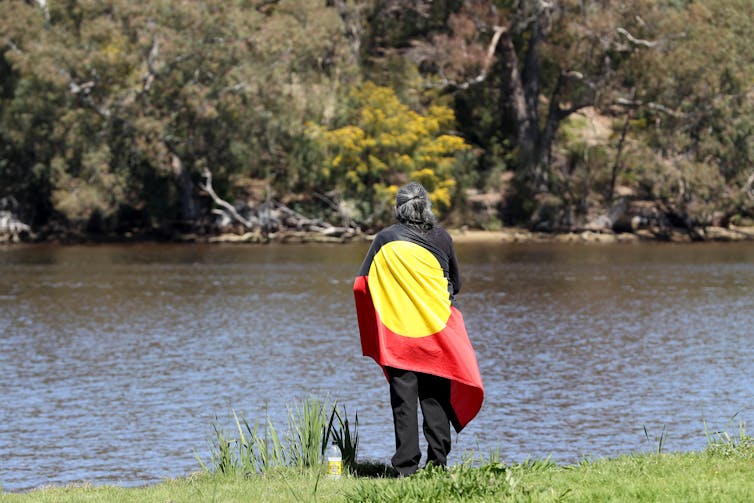
It’s widely understood that rivers, wetlands and other waterways hold particular significance for First Nations people. It’s less well understood that Indigenous peoples are denied effective rights in Australia’s water economy.
Australia’s laws and policies prevent First Nations from fully participating in, and benefiting from, decisions about water. In fact, Indigenous peoples hold less than 1% of Australia’s water rights.
A Productivity Commission report into national water policy released last week acknowledged the demands of First Nations, noting “Traditional Owners aspire to much greater access to, and control over, water resources”.
The commission suggested a suite of policy reforms. While the recommendations go further than previous official reports, they show a lack of ambition and would ensure water justice continues to be denied to First Nations.
Water plays a fundamental role in the cultural, spiritual and physical well-being of Indigenous people.Shutterstock
No voice, no justice
First Nations people have almost no say in how water is used in Australia. This denies them the power to prevent water extraction that will damage communities and landscapes, and in many cases means they’re unable to fulfil their responsibilities to care for Country.
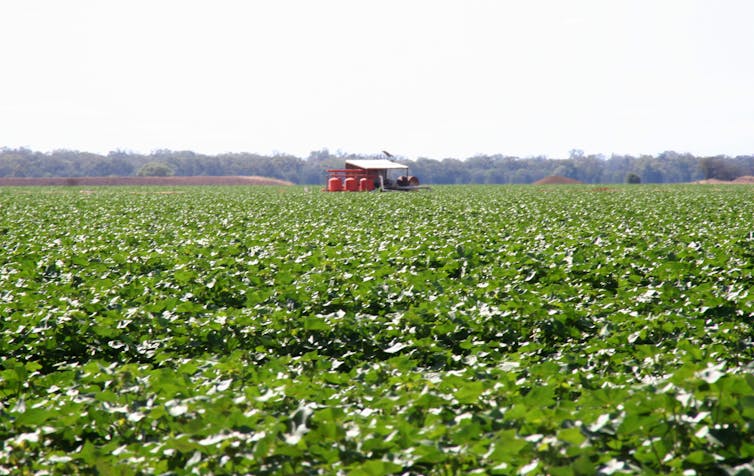
It also means First Nations are excluded from much of Australia’s agricultural wealth, which is tied to access to water for irrigation.
In the New South Wales portion of the Murray-Darling Basin, for example, our research found Indigenous peoples are almost 10% of the population yet comprise only 3.5% of the agricultural workforce. First Nations also own just 0.5% of agricultural businesses and receive less than 0.1% of agricultural revenue.
First Nations people enjoy only a tiny portion of Australia’s agricultural wealth.Alvin Wong/AAP
Piecemeal water reform
The National Water Initiative – a blueprint for water reform signed by all Australian governments in 2004 – committed to consulting with Traditional Owners in water planning, accounting for native title rights to water and including cultural values in water plans.
The Productivity Commission report said progress towards these commitments “has been slow and objectives have not been fully achieved”.
The report contains several welcome recommendations, including that:
a new water policy be devised, with a dedicated objective and targets to improve First Nations access to water and involvement in water management
the recently formed Committee on Aboriginal Water Interests “co-design” new provisions relating to First Nations’ water interests, and have direct dialogue with water ministers
a First Nations-led model of water reform be adopted, centred on the concept of “cultural flows”. This concept calls for substantial increases to First Nations’ water access and more control in decision-making.
The Productivity Commission recommended a First Nations-led model of water reform.Richard Wainwright/AAP
Cause of injustice ignored
Sadly, the Productivity Commission does not address the structural problems underlying inequities in Indigenous water rights.
In particular, it wrongly assumes policy success should be measured in terms of efficiency and the integrity of water markets, rather than justice for First Nations.
Water sold on markets goes to the highest bidder. This rewards large agricultural enterprises and others who historically held land and water rights, gained through the dispossession of First Nations people. And it penalises First Nations peoples who are unlikely to own productive farming land, or who don’t always wish to use water for irrigated agriculture.
In some cases, poorly funded Indigenous organisations have traded away their water rights to keep afloat, and will find it near-impossible to buy the water back. Our research shows this pattern drove a 17% decline in Indigenous water holdings in the Murray-Darling Basin over the past decade.
For example, in 1998 the Howard Government legislated to exclude water infrastructure and entitlements from parts of the Native Title Act. This means that infrastructure and licensing can proceed without negotiation with native title holders.
The Productivity Commission overlooked ways to correct this injustice – such as the Law Reform Commission’s proposal to change the law so native title holders can benefit from commercial use of water.
The commission’s response to conflict over developments such as dams is also inadequate. Rather than transfer final decision-making power to First Nations groups, it proposes that developments be more “culturally responsive”.
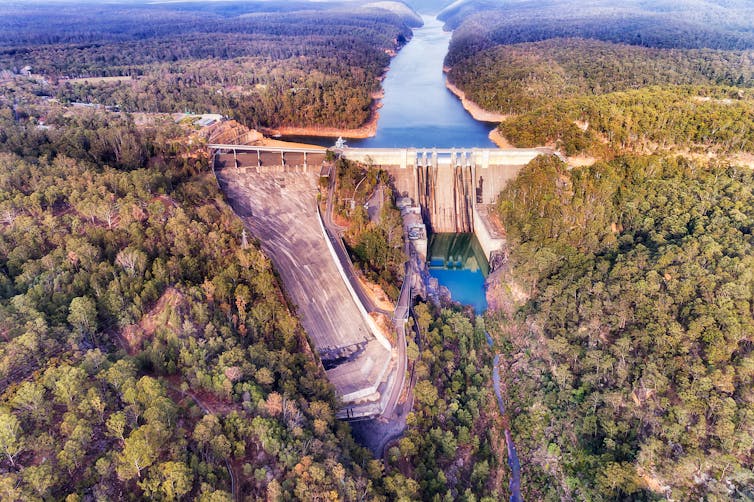
This will not protect cultural heritage. Case in point is the NSW government’s plan to raise the Warragamba Dam wall, creating a flood that threatens more than 1200 Indigenous cultural sites. Statutory protections are needed to head off such proposals.
The Warragamba Dam plan threatens Indigenous cultural sites.Shutterstock
Stronger models for reform
The United Nations’ Declaration on the Rights of Indigenous Peoples is clear: Indigenous peoples should have the power to decide on development proposed on their lands and waters.
An agreement between the Ngarrindjeri nation and the South Australian government in the lower Murray River region shows how even modest rights can both empower Traditional Owners and lead to successful environmental management.
The agreement enables a co-management approach where authority in developing natural resource management policy is shared. Unfortunately, reforms of this type are beyond the ambition of the Productivity Commission report.
Addressing water injustice also requires returning water to First Nations, such as by buying back water entitlements and guaranteeing cultural flows in water plans. The Productivity Commission outlines how this might occur, but falls short of recommending this vital measure.
The current policy framework has allowed some advances. But if water justice to Indigenous peoples is to be realised, changes to policy and laws must go far deeper.
There are many existential threats to human life in the 21st Century, many of which are carried over from the 20th Century.
The threats of terrorism, nuclear war, militaristic regimes, and so on, are issues that paralysed nations and individuals throughout the 20th Century. On the other hand, it is often argued that climate change is the most significant problem facing human life in the 21st Century. Indeed, the obliteration of all sentient and plant life on the planet is an immeasurable issue, well beyond the imagination of most humans who continue to live in the same way as they have for many decades. It is difficult to argue against climate change being the number one issue facing life on this planet. However, this is just what I would like to do in this article.
My premise is that climate change is the ultimate issue that will cause the destruction of life on Earth if drastic action is not taken very soon, but it is not the most serious threat. It is fully acknowledged by an overwhelming majority of the world’s independent scientists, who are not in the service of the corporate elites, that if action is not taken, then it may be too late. On the other hand, it has been argued that if enough action is taken by governments to tackle emissions, then the planet can be saved in a liveable enough state that human and other life will be able to continue.
So, what is the main threat? Again, many people argue that the corporate elites are the main threat. These owners of massive mining corporations and industrial agriculture are hugely responsible for spewing out massive amounts of emissions which are destroying many aspects of our life-support system. In addition, they are responsible for practices which not only create inequality, but actually have dramatically increased inequality through their practices over the last forty years, and in particular, over the last ten. In other words, the power of the corporate elites, and the consequences of their practices, has increased exponentially over the last ten years.
As argued earlier, capitalism has reached a point where it is now confronting environmental and economic limits to the accumulation of capital. What this means is that capital can no longer be accumulated through the manipulation of labour and technology to create profit. This kind of profit is simply no longer available. In response, governments have been acquiescent in deregulating many industrial practices and trade regimes to the benefit of the corporate elites. The result of this process is that a new form of accumulation has developed which can be characterized as ‘accumulation by dispossession’. This is basically the accumulation of capital through privatization, deregulation, and the takeover of public space, all facilitated by national governments, mostly in democratic nations such as the USA, the European Union, the UK, Australia, New Zealand, Canada, and South Africa. It is argued, again, that the corporate elites are not the main threat, but only because we have a mechanism that can put the brakes on the corporate elites — that of democratic government.
My argument is that national governments in democratic nations are the current main threat and barrier to finding solutions to climate change. Why? Because they are the ONLY institution that has the potential and the legal power (although this is rapidly diminishing) to curb the power of the corporate elites. This can be achieved through legislation that will place limits on what the corporate sector are allowed to do, and to re-regulate industry, and to reclaim those assets that have been privatized — this is also a point of justice as these very assets have been paid for by tax-payers and have effectively been stolen by the corporate sector with the assistance of government.
Of course, there is nothing in the legal statutes to stop politicians from acting in their own interests or from colluding with the corporate elites to ‘get a piece of the pie’ on the condition that they ‘give’ away a piece of the public pie. And this essentially is the weakness of the democratic system. So, let’s unpack this state of affairs by boiling it back to its basics.
Firstly, democracy is about the people rather than about the politicians. Politicians are supposed to be the representatives of the people. In Australia, the people go to the ballot box and place their votes for their local members in the upper and lower houses of parliament. The local member then gets a seat in the parliament, usually as a backbencher. This is a good opportunity for these elected members to voice their opinions and the opinions of their electorate on crucial issues. So far, the system appears to be very sound. However, Australia has a ‘party political system’, meaning that the parties are very powerful and tend to coerce the members into voting according to the party line. The fact that Australia has such a collective notion of party politics is a huge irony, considering that both major parties see anything at all that is even vaguely collectivist as complete anathema. And yet what could be more collectivist than the process of government?
A number of those who are in the party or coalition that has won the election are appointed into the cabinet as ministers. This may be more due to their ability to ‘make things happen’, or to tow the party line, more so than having any expertise in the portfolio to which they are appointed — the evidence suggests that this is very much the case, with ongoing portfolio reshuffles illustrating this point very clearly.
As representatives of the people, the cabinet ministers and the power of party politics act against true representation. Add to the mix the very powerful influence of Australia’s media monopoly spouting the values of neoliberalism, competition, and divisiveness on social issues, such as on gender, ethnic, immigration, sexuality, and Aboriginal issues, and one can see that the politicians are finding it very difficult to represent the people.
In order to get politicians to represent the people in true democratic fashion, instead of constantly undermining democracy, they need to listen to the mood of the people and to understand the people, instead of brushing off those who do voice their opinions as whingers and leaners. There is no democracy in selling the country off to the corporate elites and the majority certainly does not want to see this happen. Does anyone truly believe that if there was a referendum on the question of: “Should Australia sell everything in the country off to the corporate elites?” that it would not get a massive ‘no’ vote? Only if the politicians listen to the people will they be able to stop the corporate elites as has happened in Iceland.
Anti-vaccination groups are projected todominatesocial media in the next decade if left unchallenged. To counter their viral misinformation at a time when COVID-19 vaccines are being rolled out, our research team has produced a “psychological vaccine” that helps people detect and resist the lies and hoaxes they encounter online.
The World Health Organization (WHO) expressed concern about a global misinformation “infodemic” in February 2020, recognising that the COVID-19 pandemic would be fought both on the ground and on social media. That’s because an effective vaccine roll out will rely on high vaccine confidence, and viral misinformation can adversely affect that confidence, leading to vaccine hesitancy.
We recently published a large study which found that higher belief in misinformation about the virus was consistently associated with a reduced willingness to get vaccinated. These findings were later reaffirmed in a subsequent study which found a significant relationship between disinformation campaigns and declining vaccination coverage.
The spread of false information about COVID-19 poses a serious risk to not only the success of vaccination campaigns but to public health in general. Our solution is to inoculate people against false information – and we’ve borrowed from the logic of real-life vaccines to inform our approach.
When looking for ways to mitigate misinformation, scientists are confronted with several challenges: first,rumours have been shownto spread faster, further and deeper in social networks than other news, making it difficult for corrections (such as fact-checks) to consistently reach the same number of people as the original misinformation.
Second, even when someone is exposed to a fact-check, research has shown that corrections are unlikely to entirely undo the damage done by misinformation – a phenomenon known as the “continued influence effect”. In other words, approaches to combating misinformation “post-exposure” are probably insufficient.
Our work in recent years has therefore focused on how to prevent people from falling for misinformation in the first place, building on a framework from social psychology known as inoculation theory.
Psychological inoculations are similar to medical vaccines. Exposing someone to a severely weakened dose of the “virus” (in this case misinformation) triggers the production of mental “antibodies”, thus conferring psychological resistance against future unwanted persuasion attempts.
However, rather than only “vaccinating” people against individual examples of misinformation, we instead focus on the more general ways in which people are misled – manipulation techniques such as the use of excessively emotional language, the construction of conspiracy theories, and the false testimony of fake experts.
To do so, we developed a series of online games in which players learn how misinformation works from the inside by being encouraged to create their own fake news: Bad News (about misinformation in general), Harmony Square (about political misinformation) and Go Viral!, which is specifically about misinformation around COVID-19.
Research has shown that a powerful way to induce resistance to persuasion is to make people aware of their own vulnerabilities. In our games, players are forewarned about the dangers of fake news and encouraged to actively generate their own antibodies through gradual exposure to weakened examples of misinformation in a simulated social media environment.
When we assessed the success of these projects, we found that playing a misinformation game reduces the perceived reliability of misinformation (even if participants had never seen the misinformation before); increases people’s confidence in their ability to assess the reliability of misinformation on their feed; and reduces their self-reported willingness to share misinformation with other people in their network. We also found that similar inoculation effects are conferred across cultures and languages.
An image from the ‘psychological vaccine’ game GoViral!Sander van der Linden, Author provided (No reuse)
We then looked at how long the games’ inoculation effect lasted and found that people remained significantly better at spotting manipulation techniques in social media content for at least one week after playing our game Bad News. This “immunity” lasted up to three months when participants were assessed at regular intervals each week. We see these prompts as motivational “booster shots”, topping up people’s immunity to misinformation by staying engaged.
Herd Immunity
Of course, our work is not without its limitations. Although these games have been played over a million times around the world and have been shared by governments, the WHO, and the United Nations, not everyone is interested in playing an online game.
But the game itself functions as just one kind of “virtual needle”. A global “vaccination programme” against misinformation will require a suite of different interventions. For example, we’re working with Google’s technology incubator “Jigsaw”, and our colleague Professor Stephan Lewandowsky, to develop and test a series of short animated inoculation videos.
Like the game, these videos forewarn and administer a micro-dose of a manipulation technique, which primes the watcher to spot similar techniques in the information they subsequently consume online. We intend to publish our study on the efficacy of video vaccines later this year.
As the pandemic continues to wreak havoc worldwide, a successful vaccine rollout is of vital interest to the global community. Preventing the spread of misinformation about the virus and the vaccines that have been developed against it is a crucial component of this effort.
Although it is not possible to inoculate everyone against misinformation on a permanent basis, if enough people have gained a sufficient level of psychological immunity to misinformation, fake news won’t have a chance to spread as far and as wide as it does currently. This will help arrest the alarming growth of anti-vaccination sentiment on the internet.