YOUR RESOURCE FOR OVERCOMING THE ENVIRONMENTAL, SOCIAL, AND POLITICAL CRISES OF THE 21ST CENTURY THROUGH THE GREEN TRANSITION, COMMUNITY BUILDING, AND UNDERSTANDING OF SOCIETY THROUGH SOCIOLOGICAL THEORY AND PRACTICE
A Cherokee language class in pre-COVID times (Photo credit: Cherokee Nation)
Though Jacob Chavez grew up around family members who spoke Cherokee - his grandmother was fluent and his father could understand the language - the 23-year-old didn’t learn it as a child.
Now, as a young adult, the Tahlequah, Oklahoma, resident is taking part in a unique program to train Cherokee Nation citizens and those interested in Cherokee culture to become highly proficient in the language by paying them to study it. It’s one that is quickly disappearing.
“It’s in my family and I would like to kind of like, build it back and strengthen it back amongst some of our younger generation that we have and then, it’s just a passion that I’ve had — probably since senior year of high school,” Chavez says. “I just wanted to have that part of my identity and I’ve just been working on it ever since. And I took a couple classes in high school and in college and then now I’m in this program.”
The Cherokee Language Master Apprentice Program is an immersion program for adult Cherokee language learners. The program is geared for novice language enthusiasts, and it is intense: The 40-hour-per-week program runs for two years. Participants are paid $10 per hour, says Howard Paden, Cherokee Nation Language Department executive director.
“It’s not a whole lot, but what we have learned is people who have been really dedicated to learn the language—you have to have that many consecutive hours so they have to have the ability to live and continue to put some groceries on the table and that sort of thing,” he says. “So, it’s worked out really well. You know, we haven’t expected to make them be rich by any means, but we do want them to survive while they learn the language. And so that incentive has allowed people to focus just on the language instead of other things.”
The program, which started about six years ago, has grown. It went from having four students per year to 16, so at any given time, there will be 32 participants taking part in the two-year program when fully filled, Paden says.
For the Cherokee Nation — the largest tribe in the United States by population with more than 380,000 citizens worldwide — the program is taking on extra importance. There are about 2,000 fluent Cherokee speakers, according to Paden, and in the last year, more than 100 have died, some due to COVID-19-related illnesses.
“Right now, we’re losing roughly 5% of our speakers per year,” Paden says. “But we know that it takes quite a bit of time [to learn the language] and it’s not happening organically in our communities anymore.”
Losing so many fluent elders is one reason that the tribe placed them among the top of their COVID-19 vaccination list. According to the tribe, since receiving the first distribution of vaccines on Dec. 14, the Cherokee Nation administered more than 6,500 vaccines, including about 900 Cherokee speakers, as of Jan. 19.
Due to the pandemic, the coursework for the Master Apprentice Program is taught online, something that Chavez says has been difficult but he is making work.
“I’m a very in-person type of learner,” he said. “I can’t really do this technology interface kind of stuff, but I’ve had to adapt and I’m willing to do that. I want to do whatever I’ve got to do to learn and so it’s just kind of a means to an end, really. If I’ve got to use a laptop and get on Zoom, I’ll do that. But I’d much rather be in a classroom. I think we all would. But this is the world we live in and it is what it is.”
The Cherokee Nation looked to several different initiatives to help guide them when creating the Master Apprentice Program. They looked at a program within the Sac and Fox Nation, also based in Oklahoma, as well as the Euchee (Yuchi) and even the Māori from New Zealand.
The Cherokee Nation’s reservation encompasses 14 countries in northeastern Oklahoma, including parts of Tulsa County. There are ongoing discussions to possibly host a class at one Tulsa high school, though Paden is unsure where that stands now with the pandemic — both the high school and the tribe are doing most things online now.
Chavez believes that a tribe can’t have culture without language, and so that’s why he focuses on the future and learning the language.
“Those two things are just kind of joined, and if you lose our language and you still have culture, it’s kind of just a history, almost, because language is so ingrained inside of a culture,” he said. “You know, there’s names for all this stuff like games and ceremonies and things like that. You need the language to use all that. And so it’s vital for our nation and other nations that struggle with their languages … we’ve lost that connection between our elders and our youth because mainly they didn’t want to pass on language. [T]he consensus is that we’re losing it, so we’re trying to build it back now. It’s really important for us.”
Kristi Eaton is a freelance journalist based in Tulsa, Oklahoma. Her work has appeared in The New York Times, The Associated Press, The Washington Post and elsewhere. Visit her website atKristiEaton.comor follow her on Twitter@KristiEaton.
Resilience as a form of resistance, especially to neoliberalism in the current epoch, is essential to those people who struggle to change the system and yet find it difficult to continue to do their work.
The history of social change tells us that it is collective social movements that create generally progressive social change from the grassroots upwards. This is the story of every revolution, of every progressive change, of every initiative taken that enhances freedom, and it is social movements that are critical to such progress.
Recently, there has been much said, particularly by politicians, about the virtues of the Magna Carta on its 800th anniversary. The perverse hypocrisy of their utterances serve to prove one thing — that we can have as many Magna Carta’s, as many laws, as many protections, as we want, but if the people we vote into power (in democratic nations) wish to usurp those protections, then it appears that there is little that can be done in response.
This presents a very difficult situation for people who are struggling for justice and fairness and who need to find some measure of resilience in order to keep up their struggle. Without resilience, a person can simply collapse emotionally, physically, and mentally in the face of onslaught of a political system that seeks to do nothing to support disadvantaged groups.
It is the collective nature of social change, through social movements, where people find their strength to stand up against injustice and inequality. In doing so, people find meaning, friendship, and strength. In fact, what many of them find is that very sense of community that makes up one the tools of resilience in the toolbox. This is one major reason why people are attracted to groups with similar values to their own. In the process, as has been the case with social movements across time, they are also major agents of social change. From the grassroots, they put moral and, on occasions, economic pressure (perhaps through strikes) on government to make progressive changes.
As resilience is learnt through experience, such involvement can be a positive enhancement to a person’s resilience. In addition, people learn much through the process of social change, especially enhancing their problem-solving skills.
Social change always involves a struggle between progressive and conservative thought and action. As such, this struggle is fought out firstly at the grassroots level where the forces of conservatism often put quite draconian practices in place to control the people at the grassroots. As the progressive side starts to gain an advantage through sheer weight of numbers (and make no mistake about it, this takes years or decades), the struggle starts to move upwards until it reaches the houses of parliament and the courts when finally progressive laws are enacted. The lengthy nature of the struggle is precisely why resilience is necessary, and why resilience needs to be taught to individuals and groups to be able to continue the work they do.
A vital part of the resilience toolbox is the notion of exploring the good life. This has been a major topic of debate over the centuries, starting with the ideas put forward by Aristotle and Epicurus, both great Greek Philosophers of the Classical Age of Athens.
Aristotle professed that the ‘good life’ could be attained through balance and moderation in all aspects of life, from eating and drinking through to doing business. Rather than an Eastern circular notion of ‘completing the cycle’ through balance, for the Greeks, balance and moderation was more of a pendulum in which the further from the centre that the pendulum would swing, the less moderation and balance there was. As one guided their life towards the centre, meaning a lesser swing of the pendulum, the more likely one would be to find balance through moderation. There are similarities here to the notion of resilience. If one has extreme thoughts and emotional swings, that person is less likely to be resilient. This does not mean that the resilient person cannot be passionate. What it does mean is that the passion must be channelled into action. This is a moderation of passion and a very positive and powerful outcome.
Epicurus has a somewhat different view from Aristotle, but it is still associated with a search for the meaning of the ‘good life’. For Epicurus, the main motivation is to avoid pain. This is somewhat controversial in terms of resilience because it may well be that going through the downs of life is somewhat educative in terms of being able to rebuild one’s life. However, let us explore Epicurus’ position a little further.
Firstly, many people see Epicurus as the epitome of excess, hence the notion of epicurian delights and the associated connotations. However, Epicurus was a highly moderate character whose argument was that excess in anything would only lead to some form of pain. Thus, the consumption of too much food would lead to heartburn, feeling overly-full, or in the long run, obesity, all of which lead to either uncomfortable physical sensations, including a lack of fitness, or feelings of guilt.
Likewise, exercise was considered to be good if it was a stroll in the park or a long, leisurely walk, just enough to keep one relatively fit. But, exerting oneself too much would lead to muscle aches and so on, which would be considered to be painful. For Epicurus, life was about avoiding pain. As a result, he created a haven on his own property where his friends and acquaintances would come together to eat, drink and philosophise, but all in moderation of course.
The implications of this philosophy for resilience may well lie in the idea that moderation, as similar to Aristotle, may be one of the keys to resilience. However, the jury is out on the concept of avoidance of pain.
The concept of hospitality also plays a significant part in resilience, particularly the Greek interpretation of the concept. Hospitality or Xenia, as it is known in Greece, is much wider than the notion that we understand in the English-speaking world.
Xenia is the idea of welcoming and entertaining the stranger who comes from far away. Of course, trust comes into this, but it is seen as the obligation of the host, not as something reciprocal that might be repaid at some time in the future, but as ‘the right thing to do’, because the stranger is at least temporarily displaced and in need of support in an unfamiliar environment.
The value of hospitality for resilience is about the spirit of hospitality, that we should treat those around us with hospitality, so that a sense of community can be built. If a community is strong, this holds the potential for greater personal resilience of community members as a source of support. More on community later, but at this point, one can say that indeed hospitality as the basis of community IS the social support side of the resilience equation. The final point on hospitality is that it is a reciprocity that drives it; instead, it is done through a sense of ‘doing the right thing’ (even though reciprocity itself is a valuable tool as well).
Living in a city means accepting a certain level of dysfunction: long commutes, noisy streets, underutilized spaces. Carlos Moreno wants to change that. He makes the case for the "15-minute city," where inhabitants have access to all the services they need to live, learn and thrive within their immediate vicinity -- and shares ideas for making urban areas adapt to humans, not the other way around.
This talk was presented at an official TED conference, and was featured by our editors on the home page.
The lockdowns and restrictions introduced to control the spread of COVID-19 have resulted in huge changes to urban life. Previously bustling city centres remain empty,shunned in favourof suburban or rural areas where social distancing is easier and connections to the outdoors are abundant.
The roll out of vaccines provides hope for a partial restoration of normality in cities. However, the impact of COVID-19 could last much longer.
In particular, the pandemic has shown how damaging congestion, pollution and lack of green space can be – including how these factors have contributed to the severity of suffering for city dwellers. We have an opportunity to change city living for the better.
Barcelona offers an example of how city areas can be transformed to reduce pollution and increase access to green space.
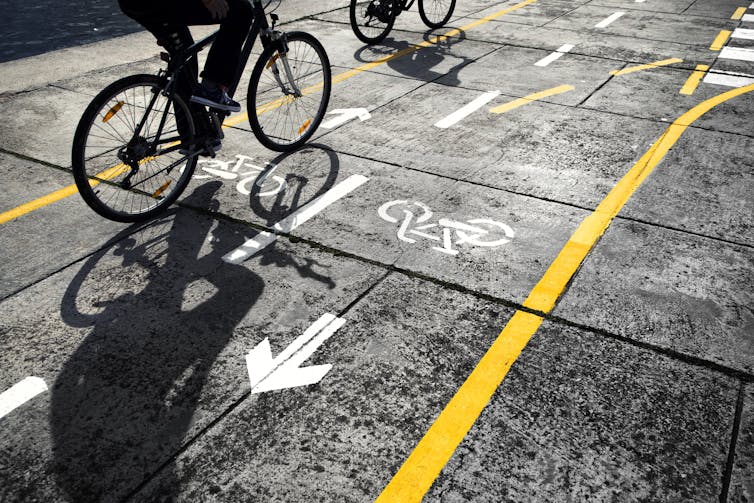
The city pioneered the concept of superblocks, first introduced in 2016, as part of green urban planning. Superblocks are neighbourhoods of nine blocks. Traffic is restricted to major roads around the superblocks, leaving the streets inside for pedestrians and cyclists.
Recently, further plans have been announced to expand green zones in the city’s central district, Eixample. This is a major expansion of low-traffic zones, giving priority to pedestrians and cyclists to reduce pollution and provide green spaces.
The new plan will cover 21 streets and have space for 21 new pedestrian plazas at intersections. At least 80% of each street is to be shaded by trees in summer and 20% unpaved. A public competition in May 2021 will decide the final design.
The purpose of the plan is to ensure that no resident will be more than 200 metres from a green space.
There are many benefits to creating urban green spaces like these. They include an improvement in air quality and noise levels on the car-free streets, and a reduction in levels of nitrogen dioxide (NO₂) from road traffic. Exposure to high level of NO₂ can lead to a range of respiratory problems.
COVID-19 has made the case for green urban planning even more compelling. However, these plans can come at a cost.
Barriers to green cities
A particular negative impact of green zones could be a high demand for housing, leading to subsequent rises in property prices. This can lead to gentrification and displacement of local residents and businesses. Care must be taken to make sure that homes remain affordable and urban green zones do not become rich enclaves.
The COVID-19 lockdowns highlighted the difference in living conditions faced by city dwellers. Green initiatives must work for all socio-economic groups, and must not exacerbate existing inequalities.
In addition, while city centres are the usual focus areas for greening initiatives, suburbs and other peripheral areas also need attention. The goal is to reduce carbon dependence in total – not shift it from one area to another, or one sector to another.
The plan should also include steps to make private and public transport completely green. This could include replacing carbon-producing transport system with zero-emission vehicles and providing ample infrastructure such as dedicated lanes and charging stations for electric vehicles.
Cities differ hugely in how they look, shape and operate. One size will not fit all. If other cities choose to follow Barcelona’s model, local issues must be carefully considered. Superblocks work really well in a neat grid system such as in central Barcelona. But many cities do not have a well-designed grid system.
However, the principles of green, environmentally friendly, car-free or restricted-traffic neighbourhoods can be adopted in any city. Examples of schemes include low-traffic neighbourhoods in London, the 15-minute city initiative in Paris, or Manchester’s plans for azero-carbon city centre.
While adopting such interventions, it is important to keep citizens’ daily needs in mind to avoid adding extra burdens on them. If motor traffic is to be limited, the availability of public transport must be considered, safe infrastructure for walking and cycling as well as adequate road structure for essential services or deliveries.
Significant capital investment is needed to support these plans. The Barcelona plan is projected to cost €38 million (£34 million). Much more will be required if it is to roll out to more areas. Cities in the developing world and poorer countries cannot afford such huge sums. Moreover, COVID-19 has left several cities laden with a huge amount of debt.
Green city initiatives need to be long-term – and created with the support of local people. Recognition of the benefits of green living and informed support of developments will result in positive behaviour changes by the citizens.
Urban parks and green spaces protect our health by providing opportunities for physical activity, time in nature, social connection and respite. During the coronavirus (COVID-19) pandemic, they’ve helped us maintain our sanity when, day after day, we and our children have been cooped up indoors. Parks also filter air, remove pollution, buffer noise, cool temperatures, filter stormwater and replenish groundwater.
But access to parks and green spaces is starkly unequal across lines of race and class. Too many communities go without these health-promoting resources, facing greater exposure to pollution and other environmental hazards and higher rates of premature death from chronic illnesses, like heart disease and type 2 diabetes.
Tracking the Data
To better understand the potential health impacts of expanding park acreage in areas that face park deficits and lack trees, Prevention Institute partnered with the University of California, Los Angeles’ (UCLA’s) Department of Environmental Health Sciences and an advisory board of community-based organizations to study census tract-level data made available recently through the U.S. Small-Area Life Expectancy Estimates Project (USALEEP). We looked at life expectancy - the number of years a person can expect to live averaged across the population.
This new research (tinyurl.com/yxta6lu8) is based on data from the Los Angeles, California, region, but provides insights for park agencies across the country. In Los Angeles (L.A.) County, more than half of residents live in areas with high or very high park need, and these areas are concentrated in low-income communities of color.The research reveals that:
Increasing park acreage in areas that face park deficits and low levels of tree canopy could lead to significant population-level increases in life expectancy.
Targeted investments in park infrastructure would significantly benefit the health of Latino and Black community members.
This is especially important in communities, like South Los Angeles, where the median life expectancy is 77 years, which is well below the upper bound for the county as a whole. In Beverly Hills, less than 15 miles away, life expectancy is as high as 90 years - 13 years longer.
The research suggests that if all the census tracts in L.A. County expanded park access up to the county median, it could add up to 164,700 years in life-expectancy gains for residents living in park-poor tracts. Latino and Black community residents comprise almost 72 per cent of the gain (118,000 years).
Park inequities in Los Angeles and other cities across the United States reflect the systematic production of inequities through historical and current-day policies, practices and procedures. Factors contributing to park inequities have included racial segregation, biased planning decisions and exclusionary zoning, among others. Present-day drivers of park inequities include shifting responsibility for public services and reduced ability of cities with limited tax bases and large lower income populations to provide parks and recreation services.
Achieving park equity will require developing new policies and practices and reforming existing ones to prioritize investments in communities experiencing the greatest park deficits. Other actions agencies could take include: collecting data on park inequities and making it publicly available; building relationships with community-based organizations that work in and with marginalized communities to secure their input regarding park investments; evaluating agency policies and initiatives to assess their impact to reverse or reinforce park inequities and make corrections as necessary; and including line-item funding in public finance measures for parks (e.g., bonds, assessments, etc.) to explicitly eliminate park deficits. They also should ensure transparency and community oversight of park investments.
Most importantly, park agencies should engage with and listen to people living in low-income communities of color that have been historically excluded from park-related decision making. The materials in the Advocacy Toolkit for Park Equity, Life Expectancy, and Power Building (tinyurl.com/yxta6lu8), which were developed based on the research described above, are designed to support community-based organizations, their members and others who are building power to secure equitable investments in park infrastructure in disinvested communities.
Note: This work was supported by the Urban Institute through funds provided by the Robert Wood Johnson Foundation. It was guided by an advisory board that includes the Center for Health Equity at the Los Angeles County Department of Public Health and seven local base-building organizations: Community Coalition, Esperanza Community Housing Corporation, Long Beach Forward, National Health Foundation, Social Justice Learning Institute, Pacoima Beautiful and Promesa Boyle Heights.
Elva Yañez is the Director of Health Equity at the national nonprofit Prevention Institute (elva@preventioninstitute.org).
Lauren Kaljur is a freelance journalist who lives on the unceded traditional territories of the xʷməθkwəy̓əm (Musqueam), Skwxwú7mesh (Squamish), and Səl̓ílwətaɬ (Tsleil-Waututh) Nations. She's passionate about connection and collaboration through storytelling.
As soon as he heard the news, Paqtnkek Mi’kmaw Nation’s Chief Paul Prosper’s heart began to race. A school bus, a grade school and a sign in Antigonish, Nova Scotia, the remote county on the east coast of Canada encircling Paqtnkek Mi’kmaw Nation’s reserve, had been tagged with anti-Black and Indigenous racist slurs. Prosper’s heartbeat was anticipating terse interactions with parents, the school board and the Royal Canadian Mounted Police, not to mention the students. “You’re sort of walking into a hornet’s nest, you know, you’re bound to get stung,” he says.
But looking back now at the 2018 incident, a different detail stands out to him: a text message from Owen McCarron, warden of Antigonish, who wrote:“I heard what has happened. This is completely unacceptable, it doesn’t reflect the attitudes of the vast majority of people and I’m here to support in any way I can,” Prosper recounts.
“That was sort of a moment for me. That indicated to me that somebody actually cared for us,” Prosper says. Later, some members of the Antigonish council stood behind him at a school-wide debrief of the events.
These are small gestures, but what they represent is revolutionary. Across Canada, hundreds of counties like Antigonish sit right next to First Nations communities with very little communication, let alone collaboration. While the Canadian government now touts a “nation-to-nation” relationship with Indigenous Peoples, at the local level reconciliation is more of an afterthought. Municipalities often treat reserves as “blank spaces” as they develop around them and on the Nations’ traditional territories. For this and many other historical reasons, Indigenous communities like Paqtnkek Mi’kmaw Nation report that racial divides are ever-present.
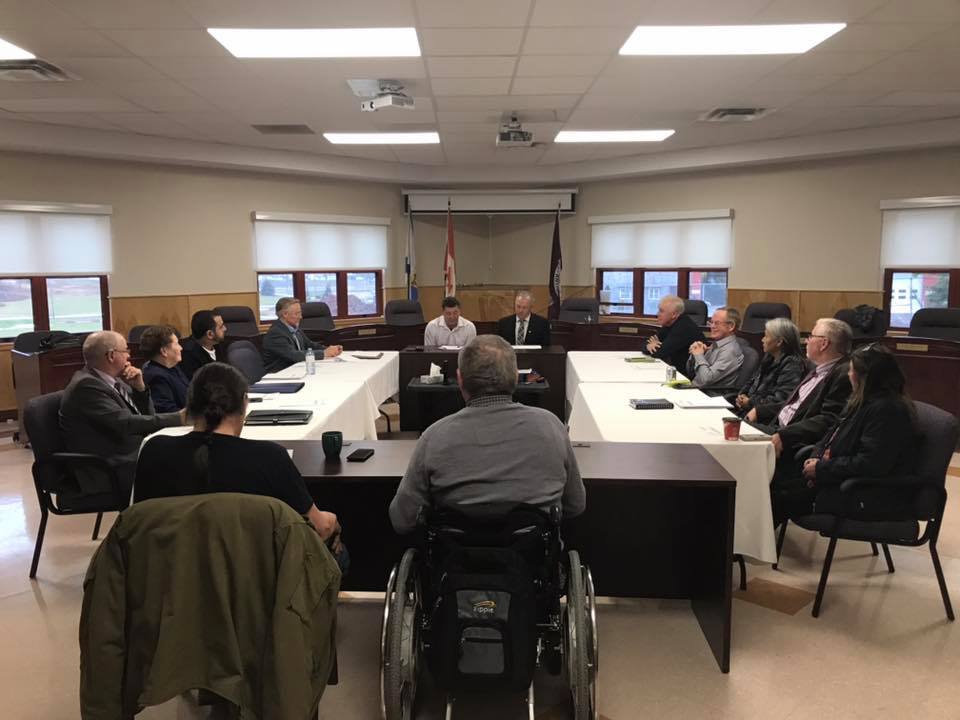
An Antigonish County and Paqtnkek Mi’kmaw Nation joint council, part of a program designed to help longtime neighbors act like neighbors. Credit: Municipality of Antigonish
But the united front that Paqtnkek Mi’kmaw Nation and the county of Antigonish presented that day did not come easily. For the past five years, they have benefitted from a unique country-wide program designed to help longtime neighbors like them become neighbors. The First Nation–Municipal Community Economic Development Initiative, known as CEDI, empowers municipal and First Nation leaders and their staff to, for once, sit down and talk as equals.
CEDI is a partnership between the Federation of Canadian Municipalities and the Council for the Advancement of Native Development Officers, known as Cando, which represents Indigenous communities in support of economic growth. Since 2013, 15 pairs — out of hundreds of requests — have taken part in the program that is in principle about joint economic development, but in reality more decolonization bootcamp.
CEDI was born out of a tragically common juxtaposition in Canada. Municipalities across the country were investing millions in municipal water infrastructure. Meanwhile, according to an OECD report, it is estimated that “half of the water systems on First Nations reserves pose a medium or high health risk to their users.”
“How could it be that the municipality has perfectly clean piped water, and across the street, if it’s a reserve, they could be living with a boil-water advisory? Where’s the breakdown?” Josh Regnier, a facilitator for the program, reflected on the program’s origins.
For Cando, the motivation to develop CEDI was pragmatic: over the years, funding for First Nations infrastructure and development from the federal government has eroded, generating an incentive to combine efforts regionally toward economic prosperity. “That, though, is easier said than done,” says Cando’s executive director Ray Wanuch.
Though it seems obvious that immediate neighbors should pool resources to share in water treatment plants or firefighting, it’s not that simple. In Canada, municipalities are products of the provinces, while First Nations have a direct relationship with the federal government. Although chiefs, mayors and councillors may share the same grocery stores, they have no obligation to work together.
The jurisdictional barriers, however, create a false sense of separation. The elephant in the room is that municipalities like Antigonish across Canada have taken over Indigenous land. As Prosper points out, in the early 18th century Indigenous nations signed peace and friendship treaties with Great Britain to respectfully coexist. But in the centuries that followed, Indigenous Peoples were increasingly faced with racist policies aimed at eradicating their identities and taking their land. In many communities, the relics of this violence — such as the residential school houses where children were forcibly assimilated — still stand in neighboring towns.
“Some of our communities have had very bad history and relationships with their surrounding municipal neighbors,” says Wanuch.
That’s why the CEDI program doesn’t kick off talking logistics or finances — it starts with history.
In one of the key early exercises, each community’s council and staff, along with Indigenous elders, are asked to outline their own understanding of the region’s history through sticky notes on the wall. Regnier describes one regional partnership where the municipalities outlined a laundry list of infrastructure: town hall, school, fire hall. The First Nations, at their turn, outlined a much longer timeline of teachings, cultural history, and relationships and wars with other Nations. At the end of their timeline came a turning point, a nation-to-nation treaty signed with colonial governments, followed by a tight succession of painful events: the Indian Act defined Indigenous rights and identities, residential schools removed youth from their parents, the last fluent language-speaker passed. They were deeply offended that the treaty responsible for the existence of the municipalities, and the many examples of First Nation resiliency, were ignored.
From this groundwork, deeper conversations sprang up, like the question of who should have a voice in development decisions. With help from independent mediators and regular meetings over three years, the municipalities now include First Nations in development planning. “We should have been doing that all along,” said one participating mayor. “Better late than never.”
Collaboration between Indigenous and non-Indigenous communities has never been more vital.
Across the United States and Canada together, there are more than 1,200 federally recognized Indigenous communities. Urban centers are growing and sprawling closer to Indigenous reserves, 80 percent of which are less than 500 hectares in size (roughly 2.5 percent the size of Portland), limiting independent infrastructure. Meanwhile, challenges from homelessness to wildfires eschew borders and demand a regional response.
The relationship between Paqtnkek Mi’kmaw Nation and Antigonish shows what incremental steps toward reconciliation can accomplish.
In the 1960s, a section of the Trans-Canada Highway connecting Halifax and Cape Breton severed Paqtnkek Mi’kmaw Nation’s reserve lands in two. And while they were guaranteed access in the early negotiations, the Nation was locked out from 200 hectares (500 acres) of its reserve lands. McCarron said it was an “eye-opener” to learn of this deep wound in early meetings. Despite being effectively landlocked, his Mi’kmaq neighbors were “resilient in their resolve to someday get access to that highway,” McCarron says.
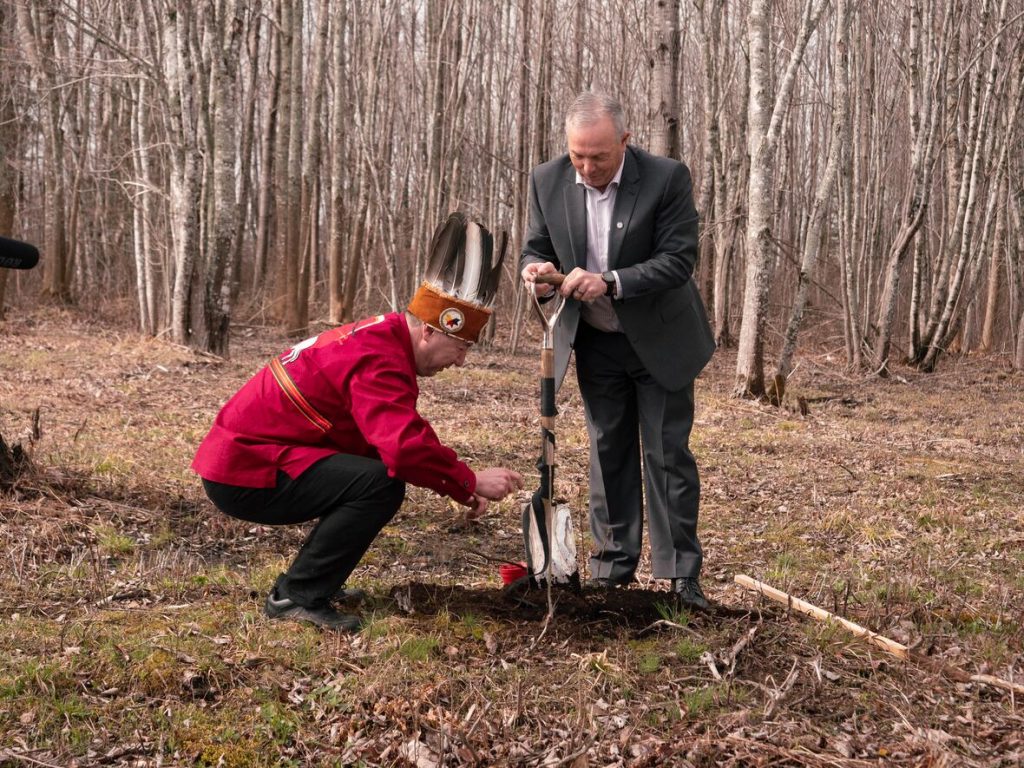
Paqtnkek Mi’kmaw Nation’s Chief Paul Prosper and Antigonish Warden Owen McCarron participate in a ceremony acknowledging the Mi’kmaq territory on which they all live. Credit: Richard Perry
Now they have. With a multimillion-dollar highway expansion in 2019 came “an opportunity to right a historic wrong,” says Prosper. Through negotiations with all levels of government, and support from CEDI, the Nation was able to recover access to its land with a highway interchange complete with a fuel depot, travel center and cardlock.
In 2018, Prosper and McCarron signed a friendship accord in ceremony thatacknowledges the Mi’kmaq territory on which they all live, and commits to regular joint council meetings. Now, they’re working towards a joint solar energy farm that will employ members of both communities. “There’s an understanding that we are connected, that our success will only further success in the area surrounding us,” says Prosper, adding there’s “a genuine feeling of congratulations” from the wider community. From his own conversations with the non-Indigenous community, McCarron agrees: “Attitudes are changing.”
Paqtnkek Mi’kmaw Nation and Antigonish aren’t the only communities making progress.
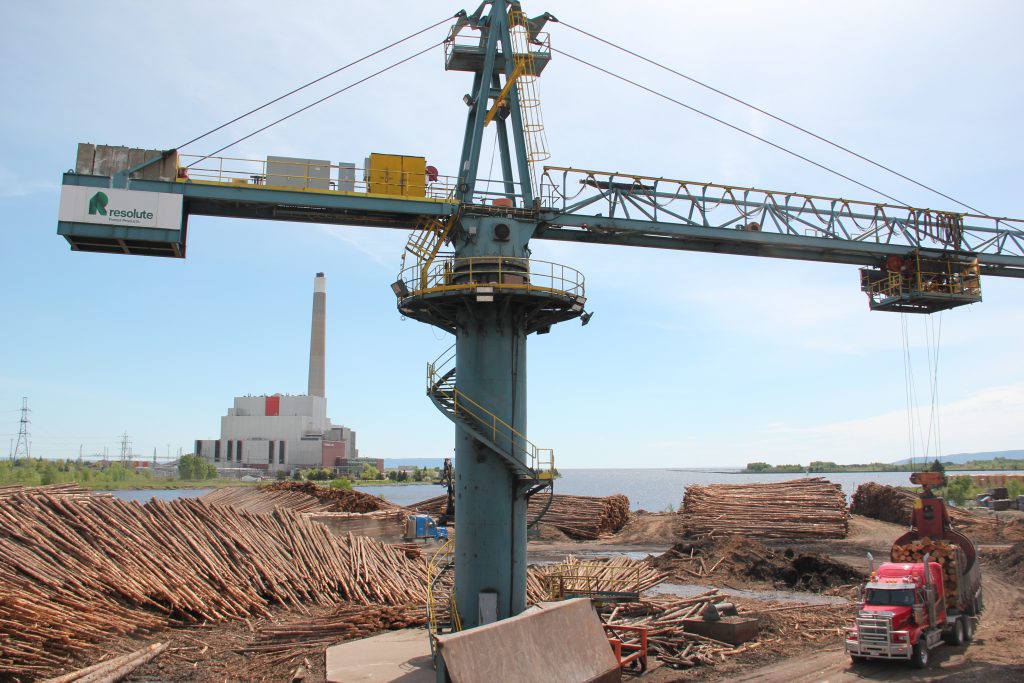
In Thunder Bay, where more than a third of Canada’s reported anti-Indigenous hate crimes took place in 2015, Fort William First Nation and the City of Thunder Bay found their own shared area of economic interest. The First Nation had a large piece of contaminated lands they couldn’t use. The city, on the other hand, had run out of land for industrial clients. So they came together, pitched the idea of an industrial park to funders and were able to secure the money needed to bring it to market.
Fort William First Nation and the City of Thunder Bay came together to pitch the idea of an industrial park to funders. Credit: John Mason
And though they have every reason to turn inward in face of Covid-19, these relationships are proving their strength. The pandemic has revealed the lack of relationship between many municipalities and First Nations across Canada, as towns reopened without consulting their First Nation neighbors, many of which still have travel restrictions. In contrast, Antigonish and Paqtnkek Mi’kmaw Nation released a joint statement in response to the pandemic in March, while in April, a regional district and First Nation in British Columbia built a joint economic recovery task force through video conference. In Manitoba, partners overcame a deep historical trauma to lobby governments and investors to reverse the closure of a local factory that would have eliminated roughly 250 jobs. As CEDI prepares to welcome another cohort in 2021, program managers say its primary funder, the federal government, is looking to adapt the model toward recovery from the pandemic.
Marissa Lawrence, senior program officer for CEDI, says the nine partnerships finishing the program have embraced video conferencing, but there’s no doubt Covid-19 presents challenges. “My personal opinion is that you can’t replace relationship-building face-to-face,” says Lawrence, noting that their current partners had spent one year together before the pandemic hit.
As this crisis has us turning back to local economies, Lawrence says, these relationships are proving their worth. A resolve to come back to the table in the face of disruption may be harder to measure — but it’s an important marker of success.
Chief Prosper has a similar measure: “If it appears to be uncomfortable, and you seem almost out of your place, then I think that’s a certain indicator that you’re doing something groundbreaking.”