Showing posts with label Transition. Show all posts

Saturday, February 20, 2021

Wales’s “One Planet” policy is transforming rural life

by Oliver Gordon, Reasons to be Cheerful: https://reasonstobecheerful.world/one-planet-development-policy-wales-rural-sustainability/

Image: Reasons to be Cheerful

It’s a cold winter morning in deepest rural Wales and Cassandra Lishman steels herself to face dawn’s frosty bite. She wakes up her 15-year-old son and 17-year-old daughter and leaves the insulated warmth of their cobwood roundhouse. She feeds the dogs, lets the chickens out of the coop and ambles up the hill to smash the ice in the sheep’s drinking trough. Her daughter feeds the horses, and her son lights a fire to kickstart the house’s solar thermal heating. 

In the afternoon, she harvests leeks for dinner and cuts up a batch of pumpkins to put in the freezer - to make space she takes out some red-currants and starts the week-long process of making jelly. In the summer, there’ll be hours more work to fit in: gardening, running willow-crafts workshops, building cobwood outhouses. “Then there’s the maintenance of all the fencing, which is constant,” she sighs. “This life isn’t for the faint-hearted.”

wales
Cassandra and her husband Nigel. (Credit: Cassandra Lishman)

In Wales, the average citizen uses almost three times their share of the world’s resources. But Cassandra and her family are part of a groundbreaking scheme launched by the Welsh government in 2011 that aims to address that imbalance. The One Planet Development Policy (OPD) and its predecessor, Pembrokeshire’s Policy 52, allow people to bypass tight planning laws and move to protected areas to live ecologically sustainable lifestyles. 

So far, 46 individual smallholdings have signed on to the programs, which require residents to sustain themselves using the resources available on land they inhabit. The policy aims to combat an array of problems: rising temperatures, soil degradation, rural depopulation, a rampant housing crisis and wasteful global supply chains. But at its most basic level, the OPD is an experiment to prove that, by limiting consumption and allocating resources wisely, ecologically responsible development is possible, even in pristine environments. 

“A bold and creative policy”

“It was a bold and creative policy when it was introduced,” recalls Dr. Neil Harris, senior lecturer in statutory planning at Cardiff University. “You can’t build new homes in the open countryside - it’s a big no-no in the planning world. So it went against the grain. In Britain, there’s been a strongly protectionist approach to the countryside since World War II. It’s considered a place for recreation and food production, but not a place to live. It’s an attempt to protect nature from sprawl. Other European countries have similar containment policies.”

Participants on a ‘One Planet Experience’ course building a livestock barn. (Credit: Tao Wimbush)

The OPD policy in Wales is one of the rare exceptions to this rule. It comes with stringent restrictions requiring applicants to prove they can live within a set of defined environmental limits. To qualify for the scheme, there are four requirements. First, each household must use only their global fair share of resources, which has been calculated by the Welsh government as equivalent to six acres of land. Second, applicants must show that within five years this land can fulfill 65 percent of their basic needs, including food, water, energy and waste. Third, they must come up with a zero-carbon house design using locally sourced and sustainable materials. Finally, they must set up a land-based enterprise to pay the sort of bills - internet, clothes, council tax - that can’t be met with a subsistence lifestyle.

Cassandra’s smallholding, Plas Helyg, where she lives with her husband and two children, is nestled in bucolic Pembrokeshire in southwest Wales. It’s part of the Lammas eco-village, a 70-acre site that had previously been earning £3,000 (USD $4,100) a year from sheep grazing but now serves as home to nine OPD households. The Lammas received planning permission in 2009 under the county’s Policy 52 for low-impact living, which was subsequently scaled up into the national OPD policy.

wales
A resident delivers milk to her Lammas neighbors by dogcart. (Credit: Tao Wimbush)

Plas Helyg gets all its electricity from its own solar array and the village’s shared hydropower. The lion’s share of the household’s heating comes from burning its own wood; the hot water comes from solar. Around 30 per cent of the family’s food comes from their land - they grow vegetables and fruit, and keep chickens for eggs and sheep for meat and wool. All their water comes from a local spring.

The household’s land-based enterprise involves growing willow, and the family harvests around 2,500 trees each year in order to make baskets and sculptures or sell cuttings and bundles. On the day we spoke, a customer was picking up an order of willow from Cassandra, so she bundled the branches her son had cut the previous day into ten kilogram parcels and dragged them down the drive for collection. She also had an Etsy order for a willow heart, so she soaked some twigs in gelid water and fashioned the malleable wood into shape before heading off to the nearest post office. For extra money, she holds willow-craft workshops for the local adult learning association. 

wales
A house at the Lammas eco-village. “There can be tension between affordable living and sustainability, but in the OPD we have an exemplar of low-impact, low-cost development,” says one government minister. (Credit: Tao Wimbush)

From a regulatory perspective, someone applying for OPD planning permission needs to first prove their smallholding will come within the OPD limits within five years. From that point, the household must prove it is maintaining those standards by completing annual monitoring reports for the local council.

“In the annual report, we record how much food we’ve produced, how much willow we’ve sold, how many workshops I’ve done, etc.,” Cassandra explains. “We estimate how much firewood, water and electricity we’ve used for the year. We record all the animals’ costs as well, and our transport costs and biodiversity actions. And at the end of that we provide two figures, using general market prices, for how much we’ve produced and how much we’ve consumed.” According to Cassandra, for a family of four, those “basic needs” amount to around £10,000 (USD $13,700) a year; meaning an OPD household would need to produce equivalent to £6,500 (USD $8,900) either “of or from the land.”

Low-impact, low-cost development

Although its numbers remain small, the OPD policy is widely lauded as a success. It’s allowed a number of committed individuals to pivot to a more planet-friendly existence in a relatively affordable manner - Plas Helyg cost £30,000 (USD $41,100) all in. “There can be tension between affordable living and sustainability, but in the OPD we have an exemplar of low-impact, low-cost development. That’s exactly the kind of thing we want to support,” says Julie James, Minister for Housing and Local Government.

wales
The interior of one of the village homes. (Credit: Tao Wimbush)

But the policy hasn’t been without its critics. In November, councilors in Carmarthenshire called for the OPD to be reviewed and potentially put on hold, citing resentment among locals who were finding it difficult to obtain planning permission to build homes on their land for their families. “Some of the early planning approvals for OPD smallholdings were at appeal, which suggests a degree of local political resistance to the policy,” says Harris. 

“But generally these tensions have been solvable,” says James. And as the policy has gone on, there’s been an increasing acceptance of it. The OPD community has done a lot of outreach - led by its volunteer advocacy group, the One Planet Council - to demonstrate their low impact, and to show that their new produce and services could provide a boost to local economies. “That’s won most people over,” says Harris.

wales
An education event at the Lammas Community Hub. (Credit: Tao Wimbush)

Cassandra remembers the initial distrust of the Preseli Hills residents when the Lammas first arrived. “It’s a very Welsh-speaking area and there was a feeling we would dilute the local culture and language … But that completely disappeared in a year or two. It really helped that our children went to the local school and learned Welsh.”

“There’s no going back”

Looking forward, the policy is “absolutely here to stay,” says James, and the current government is looking to apply some of the things it’s learned from the program to its wider housing plans. OPD has been part of the inspiration for the Innovative Housing Program, where the government provides grants and loans to de-risk novel sustainable-building methodologies so that people can invest and scale them up. The government then uses the most successful methods in its standard social-housing construction and retrofitting. 

wales
Constructing Cassandra and Nigel Lishman’s stable. (Credit: Cassandra Lishman)

The government also recently changed Welsh development policy to stipulate that all new developments on public land must consist of 50 per cent social housing and 50 per cent from a mixture of tenures, including cooperative housing, community land trusts (CLTs) and shared equity schemes. “There’s nothing to stop us doing a One Planet development as part of a CLT or a cooperative model,” says James (CLTs are community-run, nonprofit landholding organizations that help low-income buyers obtain homes). “Those kinds of affordable housing finance models would make the OPD lifestyle available to a wider segment of the population. There’s a CLT in Solva, Pembrokshire that’s doing just that.” 

Equally, the policy sets a perfect template for other small countries that have general constraints on development in their countryside, posits Harris. In England, the counties of Dartmoor and Cornwall are using the OPD framework to put in place similar initiatives, and countries such as Ireland and New Zealand are exploring the policy’s potential.  

wales
Building a timber-frame roundhouse. Wales‘s Minister for Housing and Local Government says the OPD Policy is “here to stay.” (Credit: Tao Wimbush)

For Cassandra, the OPD life has been a tough but fulfilling experience. She remembers the hardship of moving, with a 14-year-old disabled son and two small children, to an empty field with nothing to their name - no electricity, no shelter but an old truck and a small yurt, and having to collect water with a wheelbarrow from a local tap. But would she do any of it differently? Not a chance.

“Once you’ve lived like this, there’s no going back. I love living close to the elements, I love living with the sun and the water as my electricity, I love growing my own food and trees, and being in touch with the earth. It’s such a nourishing and joyful existence.”

Sunday, February 14, 2021

How working less could solve all our problems - really

by Rutger Bregman, Ideas.Ted.com: https://ideas.ted.com/how-working-less-could-solve-all-our-problems-really/

Image: Stocksy

Shorter workweeks could help reduce accidents, combat climate change, make the genders more equal, and more, contends historian and author Rutger Bregman.

Had you asked the greatest economist of the 20th century what the biggest challenge of the 21st would be, he wouldn’t have had to think twice.

Leisure.

In the summer of 1930, just as the Great Depression was gathering momentum, British economist John Maynard Keynes gave a curious lecture in Madrid titled “Economic Possibilities for Our Grandchildren” — in other words, for us. At the time, Madrid was a mess. Unemployment was spiraling out of control, fascism was gaining ground, and the Soviet Union was actively recruiting supporters. 

Speaking in a city on the precipice of disaster, the British economist hazarded a counterintuitive prediction. A hundred years from then, he said, humankind would be confronted with the greatest challenge it had ever faced: what to do with a sea of spare time. And he anticipated that within a century the Western standard of living would have multiplied to at least four times that of 1930.

His conclusion: In 2030, we’ll be working just fifteen hours a week. We are long past due for the fulfillment of this prophecy. Around the year 2000, countries such as France, the Netherlands and the US were already five times as wealthy as in 1930. Yet nowadays our biggest challenges are not leisure and boredom, but stress and uncertainty. Why are we working so much? 

In notable experiments by Henry Ford and W.K. Kellogg, it’s been found that productivity and long work hours do not go hand in hand. In the 1980s, Apple employees sported T-shirts that read, “Working 90 hours a week and loving it!” Later, productivity experts calculated that if they had worked half the hours, the world might have enjoyed the groundbreaking Macintosh computer a year earlier.

Consuming less starts with working less — or, better yet, with consuming our prosperity in the form of leisure.

There are strong indications that in a modern knowledge economy, even working 40 hours a week is too much. Research suggests that someone who is constantly drawing on their creative abilities can, on average, be productive for no more than six hours a day. It’s no coincidence that the world’s wealthy countries, those with a large creative class and highly educated populations, have also shaved the most time off their workweeks. And working less could actually solve many of the world’s greatest problems.

Working less could reduce stress — countless studies  have shown that people who work less are more satisfied with their lives. In a recent poll conducted among working women, German researchers even quantified the “perfect day.” The largest share of minutes (106) would go toward “intimate relationships.” “Socializing” (82), “relaxing” (78) and “eating” (75) also scored high. At the bottom of the list were “parenting” (46), “work” (36), and “commuting” (33). The researchers dryly noted that “in order to maximize well­-being, it is likely that working and consuming (which increases GDP) might play a smaller role in people’s daily activities compared to now.”

Could working less even slow climate change? Turns out, yes. A worldwide shift to a shorter workweek could cut the CO2 emitted this century by half. Countries with a shorter workweek have a smaller ecological footprint. Consuming less starts with working less — or, better yet, with consuming our prosperity in the form of leisure.

Since long workdays lead to more errors, shorter workdays could reduce accidents. Overtime is deadly. Tired surgeons have been found to be more prone to slip­ups, and soldiers who get too little shuteye are more prone to miss targets. From Chernobyl to the Space Shuttle Challenger, overworked managers often prove to have played a fatal role in disasters. It’s no coincidence that the financial sector, which triggered the biggest disaster of the last decade, is absolutely drowning in overtime.

The countries with the biggest disparities in wealth are precisely those with the longest workweeks.

Working less could reduce unemployment. In times of recession, with spiking unemployment and production exceeding demand, sharing jobs can help to soften the blow. Researchers at the International Labour Organization have concluded that work sharing — in which two part-­time employees share a workload traditionally assigned to one full-time worker — went a long way toward mitigating the effects of the 2008-2009 recession on workers.

Gender equality could come closer to being a reality.  Countries with short workweeks consistently top gender­ equality rankings. The central issue is achieving a more equitable distribution of work. Not until men do their fair share of cooking, cleaning and other domestic labor will women be free to fully participate in the broader economy. 

Nowhere is the time gap between men and women smaller than in Sweden, a country with a truly decent system in place for childcare and paternity leave. And paternity leave, in particular, is crucial: Men who spend a few weeks at home after the birth of a child devote more time to their wives, to their children, and to the stove than they would have otherwise. Plus, this effect lasts — are you ready for it? — for the rest of their lives. 

Research in Norway has shown that men who take paternity leave are then 50 percent more likely to share laundry duty with their wives. Canadian research shows that they’ll spend more time on domestic chores and childcare. Paternity leave is a Trojan horse with the potential to truly turn the tide in the struggle for gender equality.

Working less could also reduce inequality. The countries with the biggest disparities in wealth are precisely those with the longest workweeks. While the poor are working longer and longer hours just to get by, the rich are finding it ever more “expensive” to take time off as their hourly rates rise. 

Nearly a hundred years ago, our old friend John Maynard Keynes made an outrageous prediction — he understood that the stock -market crash of 1929 hadn’t called curtains on the entire world economy. Producers could still supply just as much as they had the year before; only the demand for many products had dried up. “We are suffering, not from the rheumatics of old age,” Keynes wrote, “but from the growing­ pains of over-­rapid changes.”

Today, the dream of a shorter workweek has been trampled — there is hardly a politician willing to endorse it, even with stress and unemployment surging. Yet Keynes wasn’t crazy. In his own day, workweeks were shrinking fast and he simply extrapolated into the future the trend that had begun around 1850. So imagine that the leisure revolution were to gain steam again in this century. Even in conditions of slow economic growth, we could work fewer than 15 hours a week by 2050, and earn the same amount as in 2000. If we can indeed make that happen, it’s high time we start to prepare.

 True leisure is as vital to our brains as vitamin C is to our bodies.

First we must ask ourselves: Is a shorter workweek what we want? Pollsters have already asked people all over the world this question, and the answer is “Yes, very much, please.” When US scientists surveyed employees to find out whether they would rather have two weeks’ additional salary or two weeks off, twice as many people opted for the extra time. 

And when British researchers asked employees if they would rather win the lottery or work less, again, twice as many choose the latter. Plenty of evidence points to the fact that we can’t do without a sizable daily dose of unemployment. Working less provides the bandwidth for other things that are also important to us, like family, community involvement and recreation.

And the second question is: How can we manage to work less? We can’t all just go ahead and switch to a 20-hour or 30-hour workweek on our own. Reduction of work first has to be reinstated as a political ideal; from there, we can curb the workweek step by step, trading in money for time, investing more money in education, and developing a more flexible retirement system and good provisions for parental leave and childcare. It all starts with reversing incentives. 

Currently, it’s cheaper for employers to schedule one person to work overtime than to hire two people. That’s because many labor costs, such as health care benefits, are paid per employee instead of per hour. And that’s also why we as individuals can’t just unilaterally decide to start working less. At the end of the workday in almost every office you can find exhausted staff sitting at their desks aimlessly browsing the Facebook profiles of people they don’t know, waiting until the first of their coworkers has left for the day. Breaking this vicious circle will require collective action — by companies or, better yet, by countries.

True leisure is neither a luxury nor a vice. It is as vital to our brains as vitamin C is to our bodies. There’s not a person on earth who on their deathbed thinks, “Had I only put in a few more hours at the office or sat in front of the tube some more.” Sure, swimming in a sea of spare time will not be easy. A 21st-century education should prepare people not only for joining the workforce, but also, and more important, for life. And we can handle the good life, if only we take the time.

Excerpted from the new book Utopia for Realists: How We Can Build the Ideal World by Rutger Bregman. Reprinted with permission from Little, Brown and Company, a division of Hachette Book Group, Inc. © 2017 Rutger Bregman.

Wednesday, January 13, 2021

How carbon capture networks could help curb climate change

by Bas Sudmeijer, TED:  https://www.ted.com/talks/bas_sudmeijer_how_carbon_capture_networks_could_help_curb_climate_change

What if we could build a global waste disposal service for carbon? In this forward-thinking talk, carbon capture advisor Bas Sudmeijer proposes building CO2 networks: partnerships between cities around the world that would share the cost and geological resources needed to trap emissions deep in the earth -- and give us a shot at stalling climate change.

This talk was presented at a TED Institute event given in partnership with BCG. TED editors featured it among our selections on the home page. Read more about the TED Institute.

Sunday, December 27, 2020

VIDEO: The city planting a million trees in two years

by Yvonne Aki-Sawyerr, TED:  https://www.ted.com/talks/yvonne_aki_sawyerr_the_city_planting_a_million_trees_in_two_years

Yvonne Aki-Sawyerr, mayor of Freetown, Sierra Leone, is on a mission to plant a million trees over the next two years, increasing vegetation in her city by fifty percent while shoring up eroding riverbanks and increasing biodiversity. "This isn't just about planting trees; it's about growing trees, and it's about ensuring that each one of us is part of the process," she says. "A million trees is our city's small contribution to increasing the much-needed global carbon sink."


This talk was presented at an official TED conference, and was featured by our editors on the home page.

Wednesday, December 16, 2020

Sustainable cities after COVID-19: are Barcelona-style green zones the answer?

by Anupam Nanda, The Conversation: https://theconversation.com/sustainable-cities-after-covid-19-are-barcelona-style-green-zones-the-answer-150774

Image: The Conversation

The lockdowns and restrictions introduced to control the spread of COVID-19 have resulted in huge changes to urban life. Previously bustling city centres remain empty, shunned in favour of suburban or rural areas where social distancing is easier and connections to the outdoors are abundant.

The roll out of vaccines provides hope for a partial restoration of normality in cities. However, the impact of COVID-19 could last much longer.

In particular, the pandemic has shown how damaging congestion, pollution and lack of green space can be – including how these factors have contributed to the severity of suffering for city dwellers. We have an opportunity to change city living for the better.

Barcelona offers an example of how city areas can be transformed to reduce pollution and increase access to green space.

The city pioneered the concept of superblocks, first introduced in 2016, as part of green urban planning. Superblocks are  neighbourhoods of nine blocks. Traffic is restricted to major roads around the superblocks, leaving the streets inside for pedestrians and cyclists.

Recently, further plans have been announced to expand green zones in the city’s central district, Eixample. This is a major expansion of low-traffic zones, giving priority to pedestrians and cyclists to reduce pollution and provide green spaces.

The new plan will cover 21 streets and have space for 21 new pedestrian plazas at intersections. At least 80% of each street  is to be shaded by trees in summer and 20% unpaved. A public competition in May 2021 will decide the final design.

The purpose of the plan is to ensure that no resident will be more than 200 metres from a green space.

There are many benefits to creating urban green spaces like these. They include an improvement in air quality and noise levels on the car-free streets, and a reduction in levels of nitrogen dioxide (NO₂) from road traffic. Exposure to high level of NO₂ can lead to a range of respiratory problems.

Green spaces have been shown to improve mental health, as well as lead to a reduction in risk of obesity and diabetes – conditions which significantly increase vulnerability to COVID-19.

COVID-19 has made the case for green urban planning even more compelling. However, these plans can come at a cost.

Barriers to green cities

A particular negative impact of green zones could be a high demand for housing, leading to subsequent rises in property prices. This can lead to gentrification and displacement of local residents and businesses. Care must be taken to make sure that homes remain affordable and urban green zones do not become rich enclaves.

The COVID-19 lockdowns highlighted the difference in living conditions faced by city dwellers. Green initiatives must work for all socio-economic groups, and must not exacerbate  existing inequalities.

In addition, while city centres are the usual focus areas for greening initiatives, suburbs and other peripheral areas also need attention. The goal is to reduce carbon dependence in total – not shift it from one area to another, or one sector to another.

The plan should also include steps to make private and public transport completely green. This could include replacing carbon-producing transport system with zero-emission vehicles and providing ample infrastructure such as dedicated lanes and charging stations for electric vehicles.

Cities differ hugely in how they look, shape and operate. One size will not fit all. If other cities choose to follow Barcelona’s model, local issues must be carefully considered. Superblocks work really well in a neat grid system such as in central Barcelona. But many cities do not have a well-designed grid system.

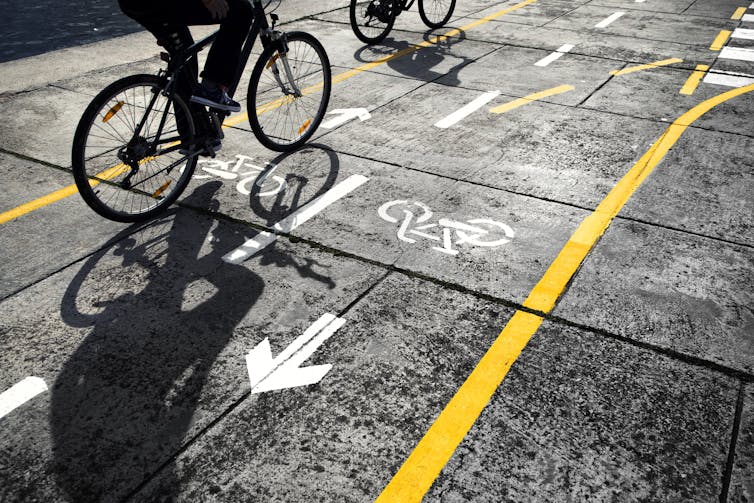
Cyclist on cycle lane
Many cities are looking to expand green initiatives. Robsonphoto/Shutterstock

However, the principles of green, environmentally friendly, car-free or restricted-traffic neighbourhoods can be adopted in any city. Examples of schemes include low-traffic neighbourhoods  in London, the 15-minute city initiative in Paris, or Manchester’s plans for a zero-carbon city centre.

While adopting such interventions, it is important to keep citizens’ daily needs in mind to avoid adding extra burdens on them. If motor traffic is to be limited, the availability of public transport must be considered, safe infrastructure for walking and cycling as well as adequate road structure for essential services or deliveries.

Significant capital investment is needed to support these plans. The Barcelona plan is projected to cost €38 million (£34 million). Much more will be required if it is to roll out to more areas. Cities in the developing world and poorer countries cannot afford such huge sums. Moreover, COVID-19 has left several cities laden with a huge amount of debt.

Green city initiatives need to be long-term – and created with the support of local people. Recognition of the benefits of green living and informed support of developments will result in positive behaviour changes by the citizens.

Wednesday, May 27, 2020

What a sustainable circular economy would look like

More than 100 billion tonnes of materials entered the global economy in 2017 to generate power, build infrastructure and homes, produce food, and provide consumer goods such as clothes and phones. There are now more phones than people on the planet, and the amount of clothes purchased is forecast to reach more than 92 million tonnes by 2030.
Some estimates suggest that 99% of the things people buy is discarded within six months of purchasing without the material being recovered. That’s because we have what you might call a linear economy. It works by extracting resources and manufacturing products from them, that are sold to people and then generally disposed of after a short period of use.
But the COVID-19 pandemic has upended normal economic activity, dipping the global economy into what may become the worst economic downturn since the Great Depression. Rather than try to revive a system that’s inherently wasteful, the European Commission has vowed to build a sustainable circular economy post-pandemic.
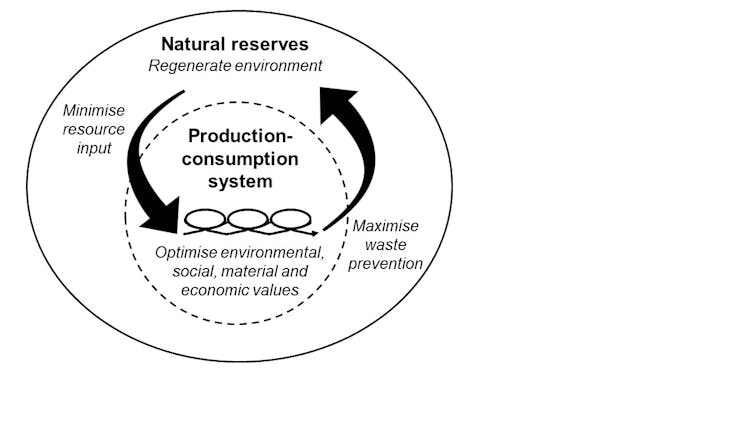
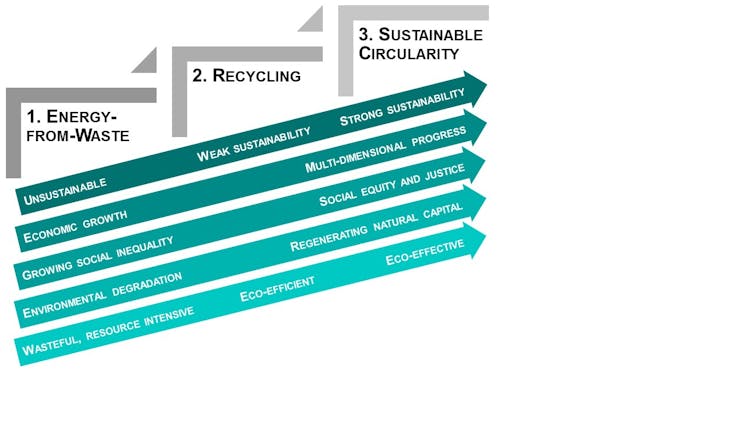
A sustainable circular economy in which production and consumption are optimised and embedded in the natural environment. Anne VelenturfAuthor provided
The idea of a circular economy is simple: to make better use of resources, close loops of resource flows by fully recovering materials instead of wasting them, and prevent waste and pollution by better design of products and materials and keeping them in use for longer.
Sounds great, but how might it work? Our research programme supported the implementation of a circular economy in the UK and we discovered that three broad types exist.

1. Closing loops with energy from waste

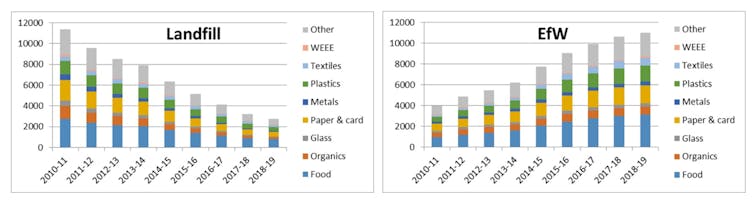
The first strategy to “close” loops of material flows is energy from waste (EfW) – burning discarded material to generate electricity. This has replaced landfill as the main processing method for household waste in the UK. Local authorities in the UK collect 26 million tonnes of waste per year, of which 11 million tonnes goes to EfW while three million tonnes ends up in landfill. Between three to six times more waste plastic, food and textiles go to EfW than are recycled. One and a half times more paper and card go to recycling as go to EfW.
The shift from landfill to energy from waste (million tonnes per year). DEFRA and WRAP/Phil PurnellAuthor provided
Burning materials that could be recycled means everything invested in them is lost, such as money, energy, water and labour. Materials such as nutrients in food and fibres in textiles are then replaced by virgin resources, perpetuating the unsustainable impacts of resource extraction.
Although a recent inquiry suggests EfW may have some social benefits – like providing heat to fuel-poor households – it creates fewer jobs than recycling, reuse, repair and remanufacturing and releases greenhouse gases.
But investment in the UK favours EfW. It’s the path of least resistance, requiring hardly any changes to supply chains or how goods are consumed and disposed of. The UK is practically heading for this pseudo circular economy that is effectively unchanged from the linear take-make-waste model, fitting in with the prevailing short-term economic thinking and a singular focus on GDP growth.

2. A circular economy based on recycling

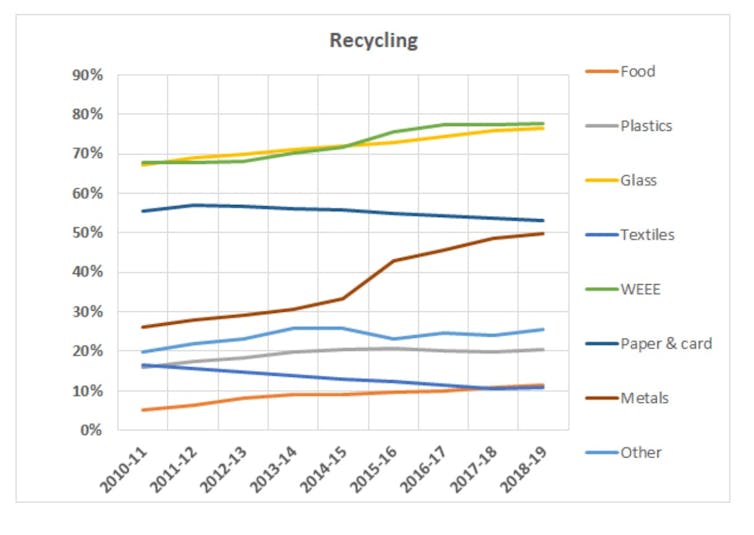
One step up from EfW is the recovery of materials – recycling. In England, the volumes of municipal waste and the proportion that is collected for recycling has remained more or less unchanged (42%) for the past ten years. Some recycling rates have gone up (eg. from 5% to 11% for food) but others have dropped (56% to 53% for paper and card).
Changes in recycling rates for materials collected by local authorities. DEFRA and WRAP/Phil PurnellAuthor provided
Textiles are particularly poor. The average UK citizen buys  26.7 kg of clothing annually – the most in Europe – and one million tonnes are discarded each year in England. Most binned clothes are incinerated, and increasingly less are recycled (from 17% to 11% since 2010). The recovered fibres are normally suitable only for lower-value applications, such as carpets and insulation. New clothes rarely contain more than a few percent of recycled material, sustaining demand for virgin natural resources.
In a circular economy that relies on recycling to close loops, people aren’t forced to change how much stuff they buy, but manufacturers and waste management companies would change more radically. For example, drinks bottles often use different plastics for the body, cap and label. If these mix in the recycling process they reduce the quality of the recycled material, but separating them is awkward. All products should be redesigned to ensure they are recyclable.
Manufacturers should use more recycled material in new products too, creating markets for recovered materials. Massive investment in recycling infrastructure would be required though. Just to meet plastic packaging recycling targets, more than 50 new recycling plants would be needed in England.
Although recycling normally is less energy-intensive than processing virgin resources, it still uses a lot of energy which produces carbon emissions. Even if all recycling used  renewable energy, the new infrastructure would require vast amounts of virgin materials to be built. In developed countries the total amount of materials within the economy has to be reduced.

3. A sustainable circular economy

To achieve a truly sustainable circular economy, consumption and production practices would need to change together. A  sustainable circular economy involves designing and promoting products that last and that can be reused, repaired and remanufactured. This retains the functional value of products, rather than just recovering the energy or materials they contain and continuously making products anew.
We have to do more with less material and consume responsibly. For example, people in the UK should buy fewer new clothes and wear what they already have more often. Repairing and restyling our favourite clothes can also help to use them more and waste less.
New ways of consuming opens up opportunities for circular economy business models, such as leasing clothes and producing things that people need on demand only. Business models based on reuse, leasing, repair and remanufacturing could generate four times more jobs than waste treatment, disposal and recycling. They generate local economic activity, helping to strengthen relations within communities.
The transition towards an increasingly sustainable circular economy radically changes the purpose of the economy. Anne VelenturfAuthor provided
A sustainable circular economy represents a new economic model in which the aim shifts from narrow GDP growth to “multi-dimensional progress” – the broader strengthening of environmental quality, human well-being and economic prosperity for current and future generations. Only such a circular economy could potentially regenerate the environment.
How we use resources has transformed our economy and society in the past. A circular economy offers us a chance to deliver sustainable benefits for the future. Let’s not waste it.