YOUR RESOURCE FOR OVERCOMING THE ENVIRONMENTAL, SOCIAL, AND POLITICAL CRISES OF THE 21ST CENTURY THROUGH THE GREEN TRANSITION, COMMUNITY BUILDING, AND UNDERSTANDING OF SOCIETY THROUGH SOCIOLOGICAL THEORY AND PRACTICE
Resilience as a form of resistance, especially to neoliberalism in the current epoch, is essential to those people who struggle to change the system and yet find it difficult to continue to do their work.
The history of social change tells us that it is collective social movements that create generally progressive social change from the grassroots upwards. This is the story of every revolution, of every progressive change, of every initiative taken that enhances freedom, and it is social movements that are critical to such progress.
Recently, there has been much said, particularly by politicians, about the virtues of the Magna Carta on its 800th anniversary. The perverse hypocrisy of their utterances serve to prove one thing — that we can have as many Magna Carta’s, as many laws, as many protections, as we want, but if the people we vote into power (in democratic nations) wish to usurp those protections, then it appears that there is little that can be done in response.
This presents a very difficult situation for people who are struggling for justice and fairness and who need to find some measure of resilience in order to keep up their struggle. Without resilience, a person can simply collapse emotionally, physically, and mentally in the face of onslaught of a political system that seeks to do nothing to support disadvantaged groups.
It is the collective nature of social change, through social movements, where people find their strength to stand up against injustice and inequality. In doing so, people find meaning, friendship, and strength. In fact, what many of them find is that very sense of community that makes up one the tools of resilience in the toolbox. This is one major reason why people are attracted to groups with similar values to their own. In the process, as has been the case with social movements across time, they are also major agents of social change. From the grassroots, they put moral and, on occasions, economic pressure (perhaps through strikes) on government to make progressive changes.
As resilience is learnt through experience, such involvement can be a positive enhancement to a person’s resilience. In addition, people learn much through the process of social change, especially enhancing their problem-solving skills.
Social change always involves a struggle between progressive and conservative thought and action. As such, this struggle is fought out firstly at the grassroots level where the forces of conservatism often put quite draconian practices in place to control the people at the grassroots. As the progressive side starts to gain an advantage through sheer weight of numbers (and make no mistake about it, this takes years or decades), the struggle starts to move upwards until it reaches the houses of parliament and the courts when finally progressive laws are enacted. The lengthy nature of the struggle is precisely why resilience is necessary, and why resilience needs to be taught to individuals and groups to be able to continue the work they do.
A vital part of the resilience toolbox is the notion of exploring the good life. This has been a major topic of debate over the centuries, starting with the ideas put forward by Aristotle and Epicurus, both great Greek Philosophers of the Classical Age of Athens.
Aristotle professed that the ‘good life’ could be attained through balance and moderation in all aspects of life, from eating and drinking through to doing business. Rather than an Eastern circular notion of ‘completing the cycle’ through balance, for the Greeks, balance and moderation was more of a pendulum in which the further from the centre that the pendulum would swing, the less moderation and balance there was. As one guided their life towards the centre, meaning a lesser swing of the pendulum, the more likely one would be to find balance through moderation. There are similarities here to the notion of resilience. If one has extreme thoughts and emotional swings, that person is less likely to be resilient. This does not mean that the resilient person cannot be passionate. What it does mean is that the passion must be channelled into action. This is a moderation of passion and a very positive and powerful outcome.
Epicurus has a somewhat different view from Aristotle, but it is still associated with a search for the meaning of the ‘good life’. For Epicurus, the main motivation is to avoid pain. This is somewhat controversial in terms of resilience because it may well be that going through the downs of life is somewhat educative in terms of being able to rebuild one’s life. However, let us explore Epicurus’ position a little further.
Firstly, many people see Epicurus as the epitome of excess, hence the notion of epicurian delights and the associated connotations. However, Epicurus was a highly moderate character whose argument was that excess in anything would only lead to some form of pain. Thus, the consumption of too much food would lead to heartburn, feeling overly-full, or in the long run, obesity, all of which lead to either uncomfortable physical sensations, including a lack of fitness, or feelings of guilt.
Likewise, exercise was considered to be good if it was a stroll in the park or a long, leisurely walk, just enough to keep one relatively fit. But, exerting oneself too much would lead to muscle aches and so on, which would be considered to be painful. For Epicurus, life was about avoiding pain. As a result, he created a haven on his own property where his friends and acquaintances would come together to eat, drink and philosophise, but all in moderation of course.
The implications of this philosophy for resilience may well lie in the idea that moderation, as similar to Aristotle, may be one of the keys to resilience. However, the jury is out on the concept of avoidance of pain.
The concept of hospitality also plays a significant part in resilience, particularly the Greek interpretation of the concept. Hospitality or Xenia, as it is known in Greece, is much wider than the notion that we understand in the English-speaking world.
Xenia is the idea of welcoming and entertaining the stranger who comes from far away. Of course, trust comes into this, but it is seen as the obligation of the host, not as something reciprocal that might be repaid at some time in the future, but as ‘the right thing to do’, because the stranger is at least temporarily displaced and in need of support in an unfamiliar environment.
The value of hospitality for resilience is about the spirit of hospitality, that we should treat those around us with hospitality, so that a sense of community can be built. If a community is strong, this holds the potential for greater personal resilience of community members as a source of support. More on community later, but at this point, one can say that indeed hospitality as the basis of community IS the social support side of the resilience equation. The final point on hospitality is that it is a reciprocity that drives it; instead, it is done through a sense of ‘doing the right thing’ (even though reciprocity itself is a valuable tool as well).
To achieve lasting change sometimes requires the hard, even radical, choice of partnering with people you'd least expect. Justice reform advocate Nisha Anand shares her story of working with her ideological opposite to make history and save lives -- and urges us all to widen our circles in order to make progress with purpose.
WEAll Scotland response to the Programme for Government in Scotland
by Lukas Hardt and Katherine Trebeck; 28 September 2020
Earlier this month, the Scottish government published its Programme for Government, setting out its plans until the election for the Scottish parliament next year and explicitly committing to building a wellbeing economy in Scotland; an economy that is “fairer, greener, more prosperous”.
We welcome that commitment. And lot of the measures go in a promising direction.
For example, the government recognises that rebuilding the economy after COVID needs to simultaneously contribute to climate change mitigation and other environmental goals. The promised investment in energy efficient buildings, green sectors, tree planting and peatland restoration is important and to be welcomed, even if it still falls short of the scale necessary.
There are nods to the importance of social enterprises, community wealth building and the 20-minute neighbourhood. Some money is provided for cycling infrastructure. The emerging Scottish National Investment Bank could be used to provide the long-term investment we need for a just and green transition. The Youth Guarantee could be a great way to provide meaningful, well-paid job opportunities (although it could also become another way to subsidise poverty wages). Adopting the UN Convention on the Rights of the Child into Scots law gives society real power to hold the government to account.
But, despite the promising direction, the Programme for Government doesn’t live up to the ambition of a wellbeing economy. Building a wellbeing economy is about transforming our economic system so that it delivers social justice on a healthy planet, the first time round. That last phrase is important, because the Programme for Government, and much of our social policy debate in Scotland, is still too much about cleaning up and redistributing after the fact.
What do we mean by that? Our current socio-economic model is failing because it tries to deliver good lives, but does so by taking the long way round. The approach can be described in three steps1:
Get the economy to grow bigger, but don’t fret too much about the damage to people or the environment that this does.
Second, sequester a chunk out of this economy via taxes.
Third, channel some of this money into helping people and the planet to cope with step number 1.
The limits of this approach are clear – it implicitly concedes to damage and harm being done to people and planet by stage 1; such damage is now so great that actions in Step 3 cannot keep up, so people and planet are inadequately repaired; and in a world of finite resources and ever-more apparent limits to growth, the risks of step 1 are mounting.
Unfortunately, the main thrust of the Programme for Government seems largely confined to such a model. Step 1 policies include the £100 million “Green Jobs Fund” or the “Inward Investment Plan” aimed to boost GDP. Yes, the government is now putting a strong green slant on such policies, which is good, but fundamentally such policies are still about stimulating more growth within the current system. That won’t work.
On the other end, the government needs to spend heavily on Step 3 policies to patch up social inequalities and environmental damage.
Consider the high-profile announcement of a Scottish Child Payment and Child Winter Heating Assistance; or the Tenant’s Hardship Loan facility, which will help tenants, but is only shifting their debt from landlords to the government; or the £150 million of additional funding quietly earmarked for additional flood protection measures (and, while you’re at it, compare the latter amount to the Green Jobs Fund – telling isn’t it?). Such policies are good and important if we are to take care of people in the face of an economic system that generates inequality, financial insecurity and poverty and climate chaos.
But the real tragedy is that they are necessary in the first place.
Heralding redistribution as progress and patting ourselves on the back for helping people survive and cope with the current system is a sad reflection of how low our ambitions are.
A wellbeing economy is about attending to root causes – looking upstream. Designing the nature and configuration of the economy so it enables people to live good lives first time around rather than allowing so much damage to be done – often in some outdated and misguided pursuit of growth – and then thinking we’ve done well when we patch up that damage. A wellbeing economy agenda asks more of the economy. It starts from the premise we can no longer be content to patch and heal and repair – we need to construct the economic system in a way that delivers social justice on a healthy planet. From the outset.
Building a wellbeing economy requires changing the rules of the game and redesigning our institutions, our infrastructure and our laws. It means embracing the potential of pre-distribution rather than re-distribution and measuring our progress in a way that is better aligned with what is really needed. We already have lots of ideas on how to do this.
Some of what is needed is already being done in Scotland – just too tentatively. Take support for alternative business models that put people and planet before profits, such as worker-owned cooperatives or social enterprises. There are good steps towards community wealth building to keep wealth in the place where it is created and reform of land ownership rules (and that of other assets). The National Performance Framework is starting to broaden goals away from simply GDP growth – but hasn’t yet knocked GDP off its ill-deserved pedestal.
While the Scottish government’s powers are limited, it could use planning and procurement and business support much more proactively to cultivate the sort of business activities required for a wellbeing economy. Radical transformative action can be done in small steps. It is time that it takes its own rhetoric on the wellbeing economy seriously and initiates transformative change.
[1]Trebeck, K., and Williams, J., 2019. The economics of arrival: Ideas for a grown up economy. Policy Press, Bristol, p. 86
Vietnam was a clear success story of the COVID-19 pandemic by May, recording very low infection rates and being widely praised for locking down early to prevent serious outbreaks. But on July 25, the virus mysteriously resurfaced after 99 days of no infections.
The coastal city of Danang became the centre of the second wave, and in a few days of the first new case, the virus had spread as far as Hanoi and Saigon. On July 31, this resurgence broke Vietnam’s no-deaths streak. The death toll is now 35 countrywide, with 1,059 infections since the beginning of the pandemic.
But throughout the first and second waves, Vietnamese business people and ordinary citizens have been coming up with innovative ways to respond to the pandemic. For the past year, we have been working on a research project focused on Vietnamese inclusive innovation – meaning innovation that helps the community in some way, with a focus on sharing the benefits with a wide range of people from different socio-economic backgrounds. Through our research, we have observed how the pandemic has unfolded across the country.
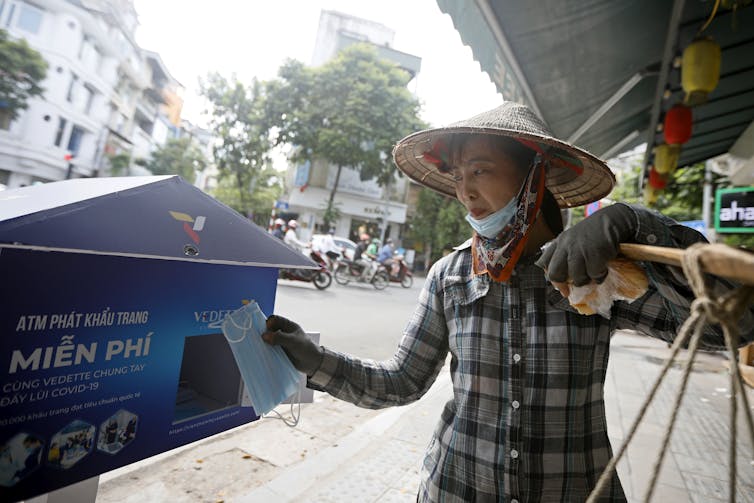
Free masks have been a significant feature of Vietnam’s coronavirus response. They are distributed with various means, from simple boxes, as shown, to remotely operated dispensers.Luong Thai Linh/EPA
During both waves, we have been struck by how grassroots innovators and socially minded entrepreneurs have helped to soften the blow of the pandemic. Here, we want to share some of these good news stories, drawing on our research into how inclusive innovation has meant that society’s most vulnerable have had access to sustenance, testing, tracing and treatment throughout the crisis.
Prevention, identification and awareness
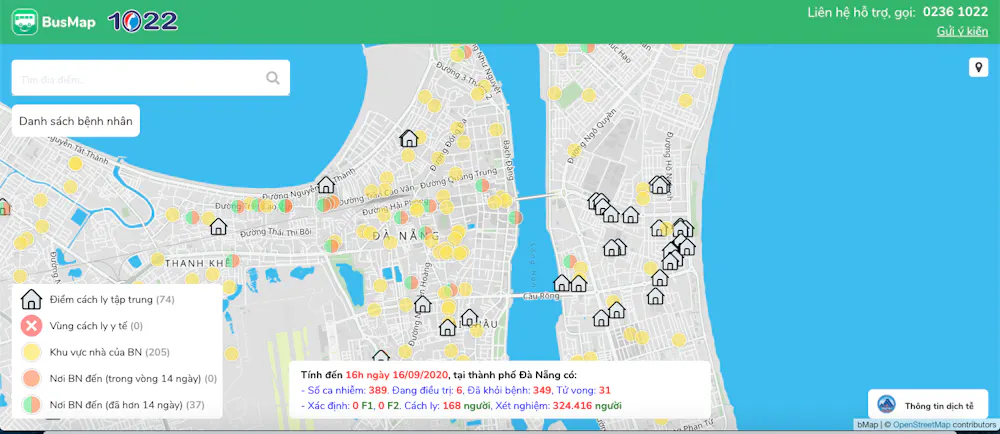
Some pandemic innovations have been aimed at preventing further infections. In the centre of the outbreak, Danang, local tech startup BusMap has worked with the authorities to create an infection map to help locals avoid hotspots and to find the nearest medical facility.
BusMap uses government data to help people avoid COVID-19 hotspots in Danang.BusMap
Various automatic hand-sanitiser dispensers have been assembled by school students around the country, using commercially available parts. On being discharged from hospital, the country’s 687th coronavirus case even gathered his friends to produce disinfectant and sanitising booths, which he donated to hospitals, including the one that had treated him.
In the early days of the outbreak, the Ghen Co Vy, or Washing Hand Song, composed by local musicians in collaboration with the Ministry of Health went viral around the world for its quirky message and dedicated choreography. Since then, ordinary people have written their own COVID-19 songs, including one by an adorable father-child duo, titled Worry Not, Danang Will Overcome COVID. The lyrics are about the second wave in Danang and remind people to take precautionary measures.
Alleviating the negative social impact
While the above interventions were mainly dedicated to prevention and control, another group of innovators has focused on alleviating the negative social impact of COVID-19.
A famous baker in Saigon by the name of Kao Sieu Luc has used dragon fruit to make bread, sharing his recipe with the country. His intent is to help dragon fruit farmers who cannot export their crops due to Vietnam’s strict travel restrictions. The recipe has been taken up not only by ordinary people but also by other businesses, resulting in the creation of KFC dragon fruit burger. During the second wave, Kao is making dragon fruit mooncakes as the annual autumn festival draws close.
In Hanoi, doctor Khuat Thi Hai Oanh has set up a charity called An Egg A Day to provide food, masks and essential goods for the homeless and extremely poor families throughout northern Vietnam. The charity also helps people in need to find work and accommodation, and it subsidises their rent.
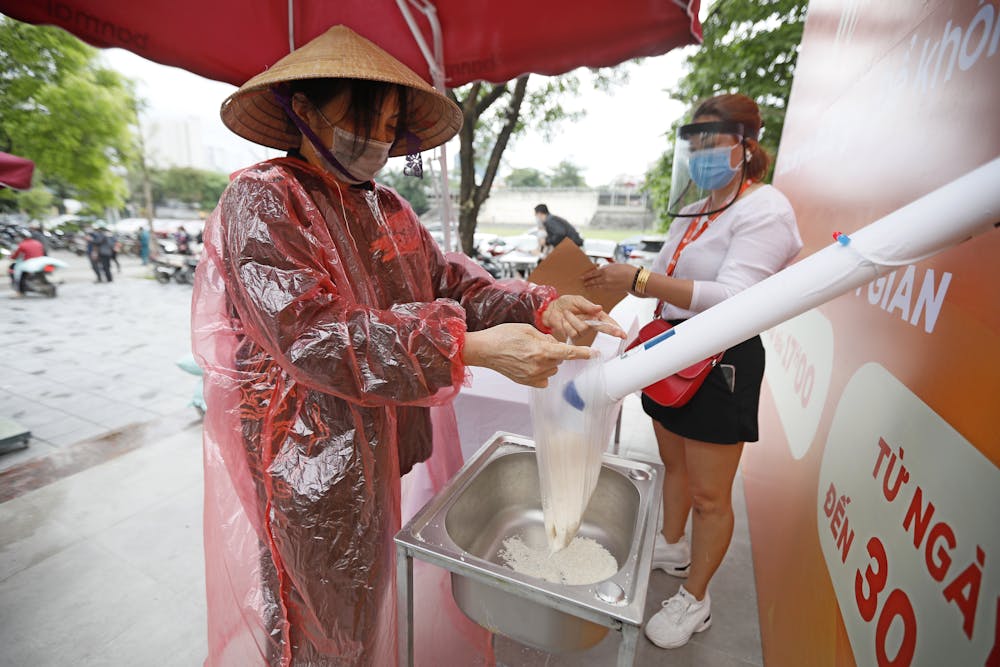
Saigon businessman Hoang Tuan Anh has built a mask ATM for his community during the second wave. The machine dispenses free, individually wrapped masks, with a remote operator to ensure fair distribution and to remind recipients to wash their hands before touching the dispenser. During the first wave, Hoang set up the first rice ATM in front of his office. The ATM provides free 1.5kg of rice and was reported to have dispensed 5 tonnes of rice in its first two days. Hoang’s rice and mask dispensers have been replicated by entrepreneurs and charities across the country.
Free rice for those who need it, thanks to a Vietnamese rice ATM.Luong Thai Linh/EPA
Finding humanity in a pandemic
When we started this research, we set out to conduct interviews and fieldwork to track how inclusive innovation is advancing productivity, and more broadly, striving to benefit society in Vietnam. Our fieldwork in 2019 revealed amazing examples of this happening around the country.
Since February 2020, our interviews have become virtual (usually conducted over Skype), and the focus of the innovators and social entrepreneurs we interview has shifted to stop the spread of the virus or to alleviate the social impact of lockdowns.
Over the past seven months, we’ve been struck by the range and speed of innovations, and awestruck by the people and companies who are working for the greater good. This pandemic is harrowing for all of us, and it’s important to stay up to date on daily figures on infections and deaths. But each interview we have conducted in Vietnam has also reminded us of humanity’s virtues. These heartening examples of solidarity can help us all get through this crisis.
A cultural shift from owning everything we might ever conceivably want to simply have access to good quality items when we need them started to take shape following the recession in the late 2000s. As the economy recovered, there was a general concern that most people would return to pre-recession levels of consumption and the act of sharing would fall out of vogue. But, according to Gene Homicki, co-founder of myTurn*, a cloud-based inventory platform for Libraries of Things (LoT) even as the economy rebounded, Libraries of Things continued to gain popularity.
There are more than 400 publicly accessible libraries that provide tools, kitchen items, toys, audio/visual equipment, electronics, musical instruments, and more on myTurn alone. These comprise more than a quarter-million items available to rent and nearly a million loans annually.
Wounaan Indigenous community of Union Balsalito along the San Juan River in Colombia’s Choco. Photo by D.H. Rasolt
Rights of Nature is a movement that has been fortifying itself around the world as an antithesis to the dominant paradigm of limitless growth and extractivism. Firmly grounded in holistic Indigenous worldviews, this ecocentric paradigm could be a global game changer if a coordinated and adaptable effort — based on shared knowledge systems and accountability — is established.
Colombia, with its biological, cultural and hydrological richness, has become a trailblazer in legally formalizing Rights of Nature, beginning with the 2017 Judgement of the Atrato River, but to what end? Who will defend these rights against powerful legal and illegal natural resource exploiting interests in such a conflicted country, and how can these formal voices for nature be strengthened by tools of modern science and technology, as opposed to repressed by them?
Colombia’s Choco: Illegal gold mining, conflict and a river with rights
The Choco Rainforest along Colombia’s Pacific Coast pulsates with life. Thousands of endemic species call this dense foresthome, while expansive rivers empty out into the ocean through extensive deltas and mangrove forests. Afro-Colombian and Indigenous communities live side-by-side — or, more frequently, face-to-face — along the rivers of the Choco.
The isolated rivers and forests of the Choco have also been hotspots of conflict, illicit activity and state neglect, facilitated by their strategic access to the coast. Illegal gold mining in particular — along with drug, arms, timber and wildlife trafficking — has run the illegal economy and fueled conflict in the Choco for decades, making its Rivers of Blood the harsh, semi-literal inverse of the Indigenous interpretation of rivers as Mother Earth’s lifeblood.
While artisanal mining for alluvial gold was — and remains — a relatively low-impact livelihood for the Choco’s many descendents of African slaves, semi-industrial mechanized mininghas deforested, degraded and contaminated the rivers and riverine habitats of the Choco for the past 20-30 years. Both the open-pit mines and dredges along the rivers have used mercury in copious quantities, poisoning the drinking water and fish species. The ecological and health crisis is devastating Afro-Colombian and traditional Indigenous riverine communities.
The Embera Dobidá — which literally means people of the river — live along the 416 mile, south-to-north flowing Atrato River and its tributaries, and have been actively protesting the exploitation of the Atrato and its surroundings for decades.
Embera Dobidá leader Belarmino Tunay told me in December 2019, “For us, the people of the river, the Atrato is everything. It is the origin, the provider of life and the extension of Karagabí [a holistic conception of a cosmic world and creator] … The Atrato speaks to us, and it is suffering. The damage being done affects our health and threatens to destroy our culture.” Studies have shown dangerously high levels of mercury in the water, in fish species and in the people living along the banks of the Atrato, including members of the Embera Dobidá.
Illegal gold mine in Colombia’s Choco Rainforest. Photo by D.H. Rasolt
South of the Atrato River Basin lives the Wounaan Indigenous ethnic group, principally concentrated along the San Juan River within the Choco.
The San Juan has its source along the Andean slopes then flows west-southwest-west before draining 240 miles downstream into an impressive delta full of rich mangrove forests that depend on nutrient-rich sediments accumulated throughout the San Juan’s journey. Many fish species spawn within these mangrove forests, and just off the coast are breeding grounds for humpback whales, whose dances and songs inspire awe above and below the surface. It is a beautiful area at the confluence of different ecosystems, where Indigenous communities lived in harmony with this diverse ecological milieu for millennia.
The Wounaan — sometimes referred to as Embera Wounaan — are closely related to the Embera Dobidá (as well as other Embera such as the Chamí and Katío), in genealogy, linguistics and many traditions, though they subscribe to a number of distinct beliefs and practices specific to their biogeography. The Wounaan base their worldview around a “Supreme Father” known as Inwadam, who created all living beings in, along, and including the San Juan River, the less voluminous but ecologically unique Baudó River, and the limitless Pacific Ocean that they flow into.
Respected Wounaan teacher and werregueartisan Yenny Cardenas spoke to me in her community of Union Balsalito on the northern bank of the lower San Juan River. “The river provides us with our livelihoods and our food, but more importantly it allows us to preserve what our ancestors have taught us about Inwadam and to practice our traditional crafts and medicine,” she said. “We live in constant fear though, knowing that someday soon we may be forced to leave our homes on the river permanently.”
Tragically, the last few decades have brought strife and degradation to the idyllic river and riverine communities of the San Juan River Basin. And like the Atrato River, the San Juan River is believed to be contaminated with mercury from illegal gold mining upstream.
“Weaving Tradition” – Vannessa Circe – Oil on Canvas – 24” x 30”
Within this complex socio-economic and environmental context, Colombia’s Constitutional Court gained international notoriety in 2017 for granting legal biocultural rights of “personhood” the degraded Atrato River. Local “guardians” — including members of Embera Dobidá and Afro-Colombian communities — are now responsible for being the legal voice of the river, in order to ensure its conservation, restoration and dynamic evolution.
Beyond symbolic legal victories
How can we turn this potentially revolutionary ecocentric framework of Rights of Nature from eloquent legalese, symbolic victories and often misunderstood traditional Indigenous worldviews, into pragmatic action in high-risk areas dominated by extensions of the modern world, such as rivers and riverine communities impacted by illegal gold mining and conflict?
To begin with, ways must be found to ensure the health and security of those individuals and local communities who speak in defense of rivers, forests, coral reefs, individual animal species and other designated legal persons within the Rights of Nature paradigm. Eliminating the existential threats to the Embera Dobidá and Wounaan, for example, is essential to protecting and restoring the diverse ecosystems of the Choco.
To bolster formalized legal Rights of Nature in general and enforce accountability, culturally appropriate tools for monitoring, communicating and incontrovertibly documenting violations of nature’s rights are also needed. For off-grid communities, integrated solutions for connectivity and access to energy sources are also important, to coordinate monitoring efforts between themselves, and to share and receive vital information in real-time with the outside world.
Adaptable complex frameworks, such as the Multiple Evidence Base (MEB) approach and Mixed-method bicultural research, can help guide the formation and evolution of resilient, shared-knowledge initiatives around the world. “Using water as a central point of multidisciplinary, intercultural and educational collaboration, we can develop new ways of understanding our surroundings and place within them,” says professor Rafael Hurtado, a physicist from Colombia’s National University. Professor Hurtado leads REMONA, a community-based water quality monitoring network built around principles of complex systems science, that has recently been introduced to several isolated Indigenous communities in Colombia.
A young Arhuaco man analyzes a sample of water from a sacred river within his territory in the Sierra Nevada de Santa Marta. Photo by V. Circe.
These kinds of multidisciplinary and intercultural shared knowledge approaches between integrated science and traditional knowledge can produce mutual understanding and evidence considered concrete within modern judicial structures; they may, in fact, form the foundational structure for upholding the rights of rivers and other dynamic ecosystems to “exist, thrive and evolve.”
Progress in Colombia since the Judgement of the Atrato River
The Judgement of the Atrato River set a strong precedent for Rights of Nature in Colombia, and along with some celebrated rulings granting personhood to sacred rivers in New Zealand and India, for further Rights of Nature advancements around the world.
Between 2018-2020 there have been a number of local court rulings in Colombia, mostly at the municipal level, that have given nominal legal rights to some of Colombia’s rivers: the Cauca River, La Plata River and Pance River, for example. Rivers connect diverse ecosystems, and damage in one or multiple sections of a river can have cumulative impacts downstream, so — in reality — coordinated international, national or at least regional efforts are needed to effectively enforce Rights of Nature for rivers.
The big post-Atrato victory for the Rights of Nature movement in Colombia, and potentially for our highly stressed living planet, was a 2018 ruling by the Colombian Supreme Court granting legal rights to the entire Colombian Amazon region. The proclamation builds off of the Judgement of the Atrato River, and is a rather beautifully crafted and comprehensive document. How Rights of Nature for the Colombian Amazon will formally and effectively be implemented remains to be seen, as deforestation, land grabbing and illegal gold mining have rapidly expanded throughout the entire Amazon region, including in several parts of the post-conflict Colombian Amazon. Illegal actors have also become further emboldened by the uncertainty surrounding the COVID-19 pandemic and rising global gold prices.
An integrated, multidisciplinary and intercultural evidence-based system is needed to support the newly designated legal voices of Colombia’s rich ecosystems. A successful framework for enforcing Rights of Nature for the Choco and the Colombian Amazon could lay the groundwork for coordinated, interconnected efforts for the entire Amazon, and other bioculturally rich areas globally.