Showing posts with label Empathy. Show all posts

Sunday, September 20, 2020

Good news stories from Vietnam’s second wave – involving dragon fruit burgers and mask ATMs

by Ba-Linh Tran and Robyn Klingler-Vidra, The Conversation:  https://theconversation.com/good-news-stories-from-vietnams-second-wave-involving-dragon-fruit-burgers-and-mask-atms-145940

Image: The Conversation:

Vietnam was a clear success story of the COVID-19 pandemic by May, recording very low infection rates and being widely praised for locking down early to prevent serious outbreaks. But on July 25, the virus mysteriously resurfaced after 99 days of no infections.

The coastal city of Danang became the centre of the second wave, and in a few days of the first new case, the virus had spread as far as Hanoi and Saigon. On July 31, this resurgence broke Vietnam’s no-deaths streak. The death toll is now 35 countrywide, with 1,059 infections since the beginning of the pandemic.

But throughout the first and second waves, Vietnamese business people and ordinary citizens have been coming up with innovative ways to respond to the pandemic. For the past year, we have been working on a research project focused on Vietnamese inclusive innovation – meaning innovation that helps the community in some way, with a focus on sharing the benefits with a wide range of people from different socio-economic backgrounds. Through our research, we have observed how the pandemic has unfolded across the country.
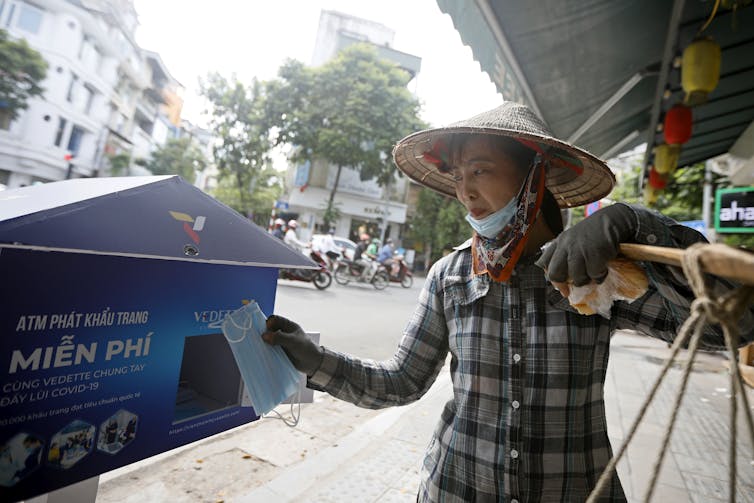
A woman wearing a pointed hat collects a mask from a street machine.
Free masks have been a significant feature of Vietnam’s coronavirus response. They are distributed with various means, from simple boxes, as shown, to remotely operated dispensers. Luong Thai Linh/EPA

During both waves, we have been struck by how grassroots innovators and socially minded entrepreneurs have helped to soften the blow of the pandemic. Here, we want to share some of these good news stories, drawing on our research into how inclusive innovation has meant that society’s most vulnerable have had access to sustenance, testing, tracing and treatment throughout the crisis.

Prevention, identification and awareness

Some pandemic innovations have been aimed at preventing further infections. In the centre of the outbreak, Danang, local tech startup BusMap has worked with the authorities to create  an infection map to help locals avoid hotspots and to find the nearest medical facility.

Meanwhile, newly designed robots have been given the job of disinfecting hospitals and public spaces, with different models developed by a military hospital in Saigon, students at a  private university in Hanoi and students at a public university in Saigon.
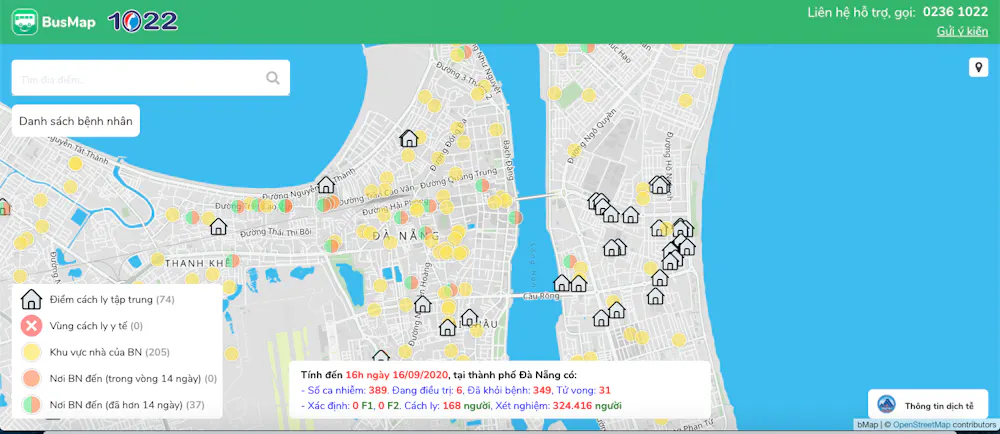
A map of Danang with circles showing COVID-19 hotspots
BusMap uses government data to help people avoid COVID-19 hotspots in Danang. BusMap

Various automatic hand-sanitiser dispensers have been assembled by school students around the country, using commercially available parts. On being discharged from hospital, the country’s 687th coronavirus case even gathered his friends to produce disinfectant and sanitising booths, which he donated to hospitals, including the one that had treated him.

In the early days of the outbreak, the Ghen Co Vy, or Washing Hand Song, composed by local musicians in collaboration with the Ministry of Health went viral around the world for its quirky message and dedicated choreography. Since then, ordinary people have written their own COVID-19 songs, including one by an adorable father-child duo, titled Worry Not, Danang Will Overcome COVID. The lyrics are about the second wave in Danang and remind people to take precautionary measures.

Alleviating the negative social impact

While the above interventions were mainly dedicated to prevention and control, another group of innovators has focused on alleviating the negative social impact of COVID-19.

A famous baker in Saigon by the name of Kao Sieu Luc has used dragon fruit to make bread, sharing his recipe with the country. His intent is to help dragon fruit farmers who cannot export their crops due to Vietnam’s strict travel restrictions. The recipe has been taken up not only by ordinary people but also by other businesses, resulting in the creation of KFC dragon fruit burger. During the second wave, Kao is making  dragon fruit mooncakes as the annual autumn festival draws close.

In Hanoi, doctor Khuat Thi Hai Oanh has set up a charity called An Egg A Day to provide food, masks and essential goods for the homeless and extremely poor families throughout northern Vietnam. The charity also helps people in need to find work and accommodation, and it subsidises their rent.

Saigon businessman Hoang Tuan Anh has built a mask ATM  for his community during the second wave. The machine dispenses free, individually wrapped masks, with a remote operator to ensure fair distribution and to remind recipients to wash their hands before touching the dispenser. During the first wave, Hoang set up the first rice ATM in front of his office. The ATM provides free 1.5kg of rice and was reported to have dispensed 5 tonnes of rice in its first two days. Hoang’s rice and mask dispensers have been replicated by entrepreneurs and charities across the country.
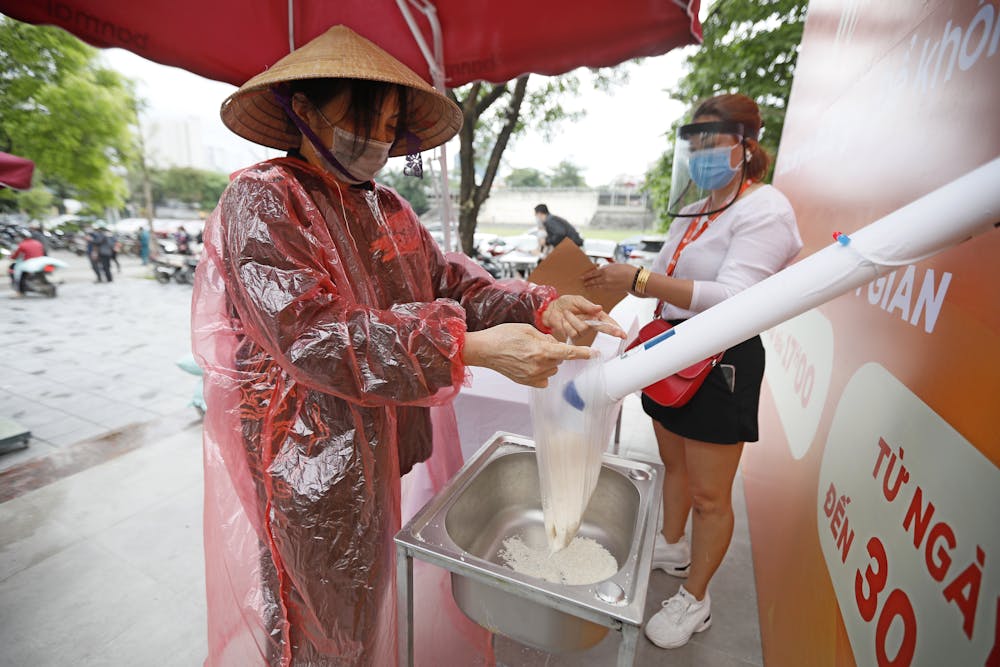
A woman in a pointed hat and rain poncho collects rice from a dispensing machine.
Free rice for those who need it, thanks to a Vietnamese rice ATM. Luong Thai Linh/EPA

Finding humanity in a pandemic

When we started this research, we set out to conduct interviews and fieldwork to track how inclusive innovation is advancing productivity, and more broadly, striving to benefit society in Vietnam. Our fieldwork in 2019 revealed amazing examples of this happening around the country.

Since February 2020, our interviews have become virtual (usually conducted over Skype), and the focus of the innovators and social entrepreneurs we interview has shifted to stop the spread of the virus or to alleviate the social impact of lockdowns.

Over the past seven months, we’ve been struck by the range and speed of innovations, and awestruck by the people and companies who are working for the greater good. This pandemic is harrowing for all of us, and it’s important to stay up to date on daily figures on infections and deaths. But each interview we have conducted in Vietnam has also reminded us of humanity’s virtues. These heartening examples of solidarity can help us all get through this crisis.

Friday, September 2, 2016

Reclaiming Friendship: A Visual Taxonomy of Platonic Relationships to Counter the Commodification of the Word 'Friend'

by M Sendak from a vintage ode to friendship by J M Udry
by Maria Popova, syndicated from brainpickings.org, Daily Good: http://www.dailygood.org/story/1373/reclaiming-friendship-a-visual-taxonomy-of-platonic-relationships-to-counter-the-commodification-of-the-word-friend-maria-popova/

What is a friend? A single soul dwelling in two bodies - Aristotle

Friendship, C.S. Lewis believed, “like philosophy, like art, like the universe itself … has no survival value; rather it is one of those things which give value to survival.”

But the poetic beauty of this sentiment crumbles into untruth for anyone who has ever been buoyed from the pit of despair by the unrelenting kindness of a friend, or whose joys have been amplified by a friend’s warm willingness to bear witness.

I often puzzle over the nature, structure, and function of friendship in human life - a function I have found to be indispensable to my own spiritual survival and, I suspect, to that of most human beings. But during a recent interview on Think Again, I found myself concerned with the commodification of the word “friend” in our culture.

We call “friends” peers we barely know beyond the shallow roots of the professional connection, we mistake mere mutual admiration for friendship, we name-drop as “friends” acquaintances associating with whom we feel reflects favorably on us in the eyes of others, thus rendering true friendship vacant of Emerson’s exacting definition. We have perpetrated a corrosion of meaning by overusing the word and overextending its connotation, compressing into an imperceptible difference the vast existential expanse between mere acquaintanceship and friendship in the proper Aristotelian sense.

In countering this conflation, I was reminded of philosopher Amelie Rorty’s fantastic 1976 taxonomy of the levels of personhood and wondered what a similar taxonomy of interpersonhood might look like. I envisioned a conception of friendship as concentric circles of human connection, intimacy, and emotional truthfulness, each larger circle a necessary but insufficient condition for the smaller circle it embraces.“I live my life in widening circles,” Rilke wrote.

Friendship_BrainPickingsWithin the ether of strangers - all the humans who inhabit the world at the same time as we do, but whom we have not yet met - there exists a large outermost circle of acquaintances.

Inside it resides the class of people most frequently conflated with “friend” in our culture, to whom I’ve been referring by the rather inelegant but necessarily descriptive term person I know and like.

These are people of whom we have limited impressions, based on shared interests, experiences, or circumstances, on the basis of which we have inferred the rough outlines of a personhood we regard positively.

Even closer to the core is the kindred spirit - a person whose values are closely akin to our own, one who is animated by similar core principles and stands for a sufficient number of the same things we ourselves stand for in the world. These are the magnifiers of spirit to whom we are bound by mutual goodwill, sympathy, and respect, but we infer this resonance from one another’s polished public selves - our ideal selves - rather than from intimate knowledge of one another’s interior lives, personal struggles, inner contradictions, and most vulnerable crevices of character.

Some kindred spirits become friends in the fullest sense - people with whom we are willing to share, not without embarrassment but without fear of judgment, our gravest imperfections and the most anguishing instances of falling short of our own ideals and values. The concentrating and consecrating force that transmutes a kinship of spirit into a friendship is emotional and psychological intimacy.

A friend is a person before whom we can strip our ideal self in order to reveal the real self, vulnerable and imperfect, and yet trust that it wouldn’t diminish the friend’s admiration and sincere affection for the whole self, comprising both the ideal and the real.

It is important to clarify here that the ideal self is not a counterpoint to the real self in the sense of being inauthentic. Unlike the seeming self, which springs from our impulse for self-display and which serves as a kind of deliberate mask, the ideal self arises from our authentic values and ideals.

Although it represents an aspirational personhood, who we wish to be is invariably part of who we are - even if we aren’t always able to enact those ideals. In this sense, the gap between the ideal self and the real self is not one of insincerity but of human fallibility. The friend is one who embraces both and has generous patience for the rift between the two.

A true friend holds us lovingly accountable to our own ideals, but is also able to forgive, over and over, the ways in which we fall short of them and can assure us that we are more than our stumbles, that we are shaped by them but not defined by them, that we will survive them with our personhood and the friendship intact.

For a complementary perspective, see poet and philosopher David Whyte on the true meaning of friendship and John O’Donohue on the ancient Celtic notion of “soul-friend.”

Maria Popova is a cultural curator and curious mind at large, who also writes for Wired UK, The Atlantic and Design Observer, andis the founder and editor in chief of Brain Pickings (which offers a free weekly newsletter).