Showing posts with label Sense of Purpose. Show all posts

Sunday, October 4, 2020

A wellbeing economy is more than a green, social sticking plaster

WEAll Scotland response to the Programme for Government in Scotland

by Lukas Hardt and Katherine Trebeck; 28 September 2020


Earlier this month, the Scottish government published its Programme for Government, setting out its plans until the election for the Scottish parliament next year and explicitly committing to building a wellbeing economy in Scotland; an economy that is “fairer, greener, more prosperous”.

We welcome that commitment. And lot of the measures go in a promising direction.

For example, the government recognises that rebuilding the economy after COVID needs to simultaneously contribute to climate change mitigation and other environmental goals. The promised investment in energy efficient buildings, green sectors, tree planting and peatland restoration is important and to be welcomed, even if it still falls short of the scale necessary.

There are nods to the importance of social enterprises, community wealth building and the 20-minute neighbourhood. Some money is provided for cycling infrastructure. The emerging Scottish National Investment Bank could be used to provide the long-term investment we need for a just and green transition. The Youth Guarantee could be a great way to provide meaningful, well-paid job opportunities (although it could also become another way to subsidise poverty wages). Adopting the UN Convention on the Rights of the Child into Scots law gives society real power to hold the government to account.

But, despite the promising direction, the Programme for Government doesn’t live up to the ambition of a wellbeing economy. Building a wellbeing economy is about transforming our economic system so that it delivers social justice on a healthy planet, the first time round. That last phrase is important, because the Programme for Government, and much of our social policy debate in Scotland, is still too much about cleaning up and redistributing after the fact.

What do we mean by that? Our current socio-economic model is failing because it tries to deliver good lives, but does so by taking the long way round. The approach can be described in three steps1:

  1. Get the economy to grow bigger, but don’t fret too much about the damage to people or the environment that this does.
  2. Second, sequester a chunk out of this economy via taxes.
  3. Third, channel some of this money into helping people and the planet to cope with step number 1.

The limits of this approach are clear – it implicitly concedes to damage and harm being done to people and planet by stage 1; such damage is now so great that actions in Step 3 cannot keep up, so people and planet are inadequately repaired; and in a world of finite resources and ever-more apparent limits to growth, the risks of step 1 are mounting.

Unfortunately, the main thrust of the Programme for Government seems largely confined to such a model. Step 1 policies include the £100 million “Green Jobs Fund” or the “Inward Investment Plan” aimed to boost GDP. Yes, the government is now putting a strong green slant on such policies, which is good, but fundamentally such policies are still about stimulating more growth within the current system. That won’t work.

On the other end, the government needs to spend heavily on Step 3 policies to patch up social inequalities and environmental damage.

Consider the high-profile announcement of a Scottish Child Payment and Child Winter Heating Assistance; or the Tenant’s Hardship Loan facility, which will help tenants, but is only shifting their debt from landlords to the government; or the £150 million of additional funding quietly earmarked for additional flood protection measures (and, while you’re at it, compare the latter amount to the Green Jobs Fund – telling isn’t it?). Such policies are good and important if we are to take care of people in the face of an economic system that generates inequality, financial insecurity and poverty and climate chaos.

But the real tragedy is that they are necessary in the first place.

Heralding redistribution as progress and patting ourselves on the back for helping people survive and cope with the current system is a sad reflection of how low our ambitions are.

A wellbeing economy is about attending to root causes – looking upstream. Designing the nature and configuration of the economy so it enables people to live good lives first time around rather than allowing so much damage to be done – often in some outdated and misguided pursuit of growth – and then thinking we’ve done well when we patch up that damage. A wellbeing economy agenda asks more of the economy. It starts from the premise we can no longer be content to patch and heal and repair – we need to construct the economic system in a way that delivers social justice on a healthy planet. From the outset.

Building a wellbeing economy requires changing the rules of the game and redesigning our institutions, our infrastructure and our laws. It means embracing the potential of pre-distribution rather than re-distribution and measuring our progress in a way that is better aligned with what is really needed. We already have lots of ideas on how to do this.

Some of what is needed is already being done in Scotland – just too tentatively. Take support for alternative business models that put people and planet before profits, such as worker-owned cooperatives or social enterprises. There are good steps towards community wealth building to keep wealth in the place where it is created and reform of land ownership rules (and that of other assets). The National Performance Framework is starting to broaden goals away from simply GDP growth – but hasn’t yet knocked GDP off its ill-deserved pedestal.

While the Scottish government’s powers are limited, it could use planning and procurement and business support much more proactively to cultivate the sort of business activities required for a wellbeing economy. Radical transformative action can be done in small steps. It is time that it takes its own rhetoric on the wellbeing economy seriously and initiates transformative change.


[1]Trebeck, K., and Williams, J., 2019. The economics of arrival: Ideas for a grown up economy. Policy Press, Bristol, p. 86

Sunday, June 7, 2020

Why children need to be taught more about their human rights

Many children have an innate sense of equality, fairness and justice and know how these concepts relate to their day-to-day lives. A lot of children also have the confidence to voice their opinions when they feel a lack of justice. But unfortunately, this is not always that case – especially for children whose personal rights are violated and who face mistreatment, often behind closed doors.
A recent report from the Office of the Children’s Commissioner estimates that 2.3 million children in England are living with risk because of a vulnerable family background. This includes children in the care system and children known to have experienced personal harm as well as those living in families where there is a high likelihood of harm.
Worryingly, an estimated 829,000 of these children are not known to social services or to children’s mental health services so are not receiving any support. Added to this, since the beginning of the COVID-19 pandemic, rates of domestic abuse have increased, meaning even more children may be living in homes where they are at risk of witnessing, or being on the receiving end of, violent behaviour.
Children need to know how to get help when they feel at risk. They also need to understand how rights apply to them and their lives – and while a limited amount of this is done in schools, it currently doesn’t go far enough.

Children’s rights

Children’s rights are a subset of human rights. The United Nations Convention on the Rights of the Child sets out the rights that all children worldwide should have access to and is one of the most widely adopted international treaties of all time.
In England, specific teaching about human rights is included in Relationships Education for primary age pupils and in Relationships and Sex Education for secondary age pupils. Both primary and secondary pupils also learn about human rights in Health Education and in Citizenship education.
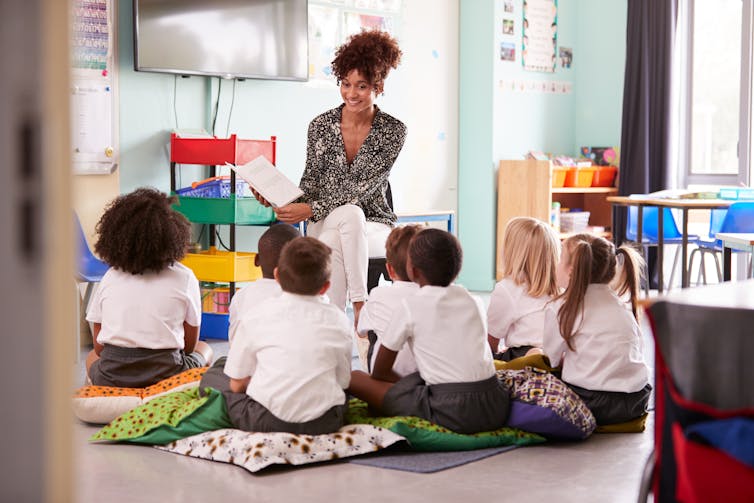
Schools already teach some elements of human rights, but more needs to be done. Monkey Business Images/Shutterstock
As part of these subjects, in primary schools, aspects relating to rights education includes pupils learning to recognise if relationships make them feel unhappy, unsafe or uncomfortable. Pupils also learn how to report any concerns or abuse and where they can get help.
In secondary schools, pupils are taught about issues such as how to recognise when a relationship is unsafe, what constitutes sexual harassment and sexual violence and why these are unacceptable. They are also taught about legal rights and responsibilities regarding equality, online rights, as well as how to report and get advice if needed for themselves or others. Civil liberties enjoyed by the citizens of the UK are also looked at, as are the nature of rules and laws and the justice system.
These subjects include some important teaching about rights, but the focus is on factual information about rights and the help available. What’s lacking is teaching children specifically about children’s rights and how these rights apply to their own situations. More also needs to be done to empower children with the confidence to voice concerns in cases where their rights are not respected.

Rights Respecting Schools

Unicef UK has developed a Rights Respecting Schools Award. In working towards this award, schools use the Convention on the Rights of the Child to teach pupils about their rights and how these apply in terms of their own lives.
Around 5,000 schools are working through the Unicef award, which equates to about 1.6 million children becoming more aware of their rights. Research shows that children in schools working toward this award develop the confidence to disclose instances where their rights have been disrespected. And this has led to safeguarding issues being identified.
A senior manager in one of the primary schools explained the impact it has made:
We always get some disclosures when we talk about rights at the beginning of the year … the [children] feel empowered to tell someone and that is something that probably wouldn’t have happened if it wasn’t for this [the award].
But not all children attend schools where the award is on offer. And even when they do, insufficient emphasis is placed on ensuring all pupils are not only made aware of rights and how these apply to them, but have the skills and confidence to act and get help in cases where rights are not respected.

‘Know your rights’

Given that under lockdown many children may be spending longer periods of time with adults who may make them feel unsafe and have fewer opportunities to voice these concerns, the need for children’s rights education to be incorporated into all levels of schooling is urgent.
The focus needs to be not only on the transmission of knowledge and facts about children’s rights but, as asserted by the United Nations World Programme for Human Rights Education, it must also ensure children acquire the skills to apply their rights in a practical way in daily life. And this means teaching children how to take action to defend and promote their rights as and when needed.

Saturday, February 8, 2020

Bernie Sanders’ Economic Adviser Has a Message for Australia we Might Just Need

by Steven Hail, The Conversation:  https://theconversation.com/bernie-sanders-economic-adviser-has-a-message-for-australia-we-might-just-need-130182

Debate over what the Reserve Bank governor and the treasurer should do usually runs along familiar lines.
The bank is supposed to set its cash rate to keep inflation low and stable, while the government is supposed to avoid deficits, at least on average, over the economic cycle and preferably run surpluses.
We have heard it so often that it seems like common sense. So when a famous economist comes along and contradicts it - an advisor to a US presidential contender no less – it’s understandable that people are shocked.
Yet that’s the message of Stephanie Kelton, a senior economic adviser to Bernie Sanders, and before that chief economist on the US Senate Budget Committee.
Professor Kelton, a leading modern monetary theorist, is the 2020 Visiting Harcourt Professor at the University of Adelaide, and during her visit in January was interviewed by most Australian newspapers, and many radio and TV outlets.

Professor Stephanie Kelton, “The Deficit Myth” University of Adelaide, January 15, 2020.

According to modern monetary theory (MMT), the narrative we have become used to is based on an outdated and misleading description of monetary systems. The key thing that’s been missing is an appreciation of the difference between a currency issuer and a currency user.
You and I, along with businesses and not-for-profits, local councils, state governments, governments with foreign currency debts, and even governments within the Eurozone, are currency users.
Before we can spend money, we need to find it – either by earning it, begging for it, digging into savings, or borrowing it.

Governments create, rather than raise, money

If we borrow money, we need to repay it at some point in the future or risk going broke.
The Australian Commonwealth government, and other national governments that issue currencies in the same way that our government does, are in a completely different position.
They have nothing in common with currency users. They can’t go broke, ever. It isn’t even possible, given the way our system works.
Our government is the monopoly issuer of the Australian dollar. Every dollar that it spends is a new dollar. It doesn’t need to raise taxes or or borrow before it can spend, although that is what it appears to do to those who don’t know how our monetary system works.
In reality, it is the other way around. Governments like ours need to spend dollars into existence before they can be used to pay taxes or to buy newly issued bonds. We need the government’s money - they don’t need ours. They issue the dollar. We use dollars.

Think of the economy as a bath


The economy is like a bath. It needs to be pretty full, but not too full. Shutterstock

Think of the economy as a bath, with government spending being the water coming out of the tap into the bath, and taxation and saving being the water that goes down the drain.
The spending comes first.
The macroeconomic role of taxation is to stop the bath overflowing – to stop total spending in the economy going beyond the productive capacity of the economy and creating the risk of accelerating inflation.
Taxation limits the spending power of the private sector, creating room for the government to spend on public goods and services and investments without driving prices up.
A budget deficit is simply the government making a net contribution of dollars to the economy, putting more dollars into the bath (into private bank accounts) than it is taking out in tax. It needs to, when the bath isn’t full enough. Its deficit is our surplus.
It isn’t a problem in an environment of unemployed resources and low and stable inflation where the bath isn’t full. It is a way of supporting the economy, and of adding to business sales and profits.
When the government runs a surplus, it puts less into the private sector than it takes out in tax. It vacuums up dollars and destroys them. It runs the risk of either driving economy into recession (as happened under Paul Keating) or driving households into debt (as happened under Peter Costello). Its surplus is our deficit.
There may be times when government surpluses are appropriate, but in a country not running large trade surpluses, those times will be rare indeed and won’t last for long. Australia has never run surpluses for long.

Governments choose to borrow, but needn’t

As for government debt – so often misnamed the national debt – it is better described as dollars that have been spent into existence and not yet taxed away. It might be better to call it the net money supply, than to label it as a debt.
The government chooses to issue bonds to the private sector and foreign investors also choose to buy them. But it needn’t. It could fund itself without borrowing. It issues the currency. It can’t go bust. And when there is spare capacity it won’t cause inflation.
There is of course a great deal more to MMT than I can fit into 800 words. It is based on more than 25 years of detailed research by many economists, including Australia’s Bill Mitchell and Kelton herself. But I hope there’s enough here to show you why it has become the first serious challenger to the narrative we have become so used to in decades.
You can learn more about it by watching Stephanie Kelton’s recent Harcourt Lecture at the University of Adelaide, or by reading her new book, The Deficit Myth, which will be published in June.

Wednesday, January 22, 2020

How to Manage a 30-person Housing Cooperative

by Emily Bender, Shareable: https://www.shareable.net/blog/how-to-manage-a-30-person-housing-cooperative


I have continually been fascinated by the question of how to build a strong community through collaboration, especially in shared housing spaces. I live in San Francisco, California, which has one of the country's largest gaps in economic inequality. This in turn is fueling gentrification and community displacement. 
In response, people are turning to shared living communities such as the 30-person Chateau Ubuntu, a housing cooperative that I'm a part of. As opposed to traditional top-down hierarchy that incentivizes competition, our house is a complex series of "networks" that depend on the participation and collaboration of everyone. Untangling this complicated web of networks is key to understanding how we function together.
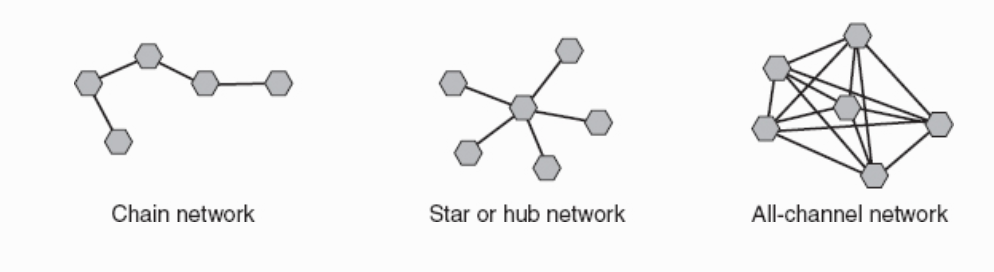
Our structure includes three distinct frameworks: the star, chain, and all-channel networks. As the most centralized, the star network acts as a central hub that all nodes of the network are connected and communicate through. While lacking a central hub, each node along the highly stratified chain network is connected along a predetermined path that obscures associations between nodes. 
Finally, the all-channel network is completely decentralized where all nodes are connected and can freely interact with each other. A visual representation of the three network styles is demonstrated below by John Arquilla and David Ronfeldt in their 2001 book on networks: 
We manage ourselves through seven decentralized working circles that (mostly) have free association with one another — like the all-channel network above. All circles are open for any housemate to join, and everyone must be a part of at least one circle. However, looking closer at circle operations reveal different degrees of centralized decision-making and chain communication. 
For example, all circles have rotating "lead" position, some of which are paid. The lead circle is responsible for facilitating that circle's tasks alongside acting as the circle's primary representative with the larger community. But beyond this each circle's structure diverges, and a brief overview of each is necessary in understanding how they work together:
Recruitment: The recruitment circle manages the task of bringing new people into our home. This group acts as a star network, where the individual tasks carried out by members of the circle, such as interviewing applicants, are all communicated back through the circle's lead. The recruitment lead then acts as a liaison between potential applicants, exiting house members, and the rest of the community.
Food: The task of sharing food — one of the powerful ways we connect and collaborate — is carried out through an "all channel" network, which helps us navigate complex logistics. All housemates pay a fee towards buying groceries in bulk — together accessing cheaper prices for groceries than we would ever find individually. The majority of our food is delivered through two local food distributors, Veritable Vegetable and Imperfect Produce. We also have deals at the Sunday farmers' market.
Labor: The labor circle oversees our chore system to make sure the common spaces are tidy. This includes facilitating monthly deep cleaning sessions, ensuring appliances and other things in the household are functioning well, and, in conjunction with the recruitment circle, onboarding new house members.
Events: The events circle, an entity without a rigid form, organizes fun gatherings like talent shows, live music, dance classes, game nights, writing workshops, and even a live dating game show. Living together with a multitude of people from a diversity of places and cultures opens incredible opportunities for continuous education, sharing, and fun.
Sustainability: The sustainability circle, like the events circle, doesn't have specific day-to-day tasks, but is instead responsible for lowering our household's environmental impact.   
Finances: Besides overlooking the house budget and rent collection, the finances circle is crucial for other working groups that make regular purchases — such as food and labor. While the circle itself manages the flow of funds, the whole community determines the allocation. In this sense, this circle most resembles a chain network, carrying out the decisions made by the larger community.   
Community Wellness: This circle, in which I currently serve as the lead, serves as a support system that bridges the working circles and the larger community together. We act as first-line mediators in interpersonal conflict issues. If initial mediation is unsuccessful, then the issue is brought to the rest of the wellness team, and if escalation continues, it's brought to the larger community.
Integrating all three network styles allows us to successfully maneuver the tension between having an organized framework to maintain a cohesive, happy household and one that is dynamic and open to changing needs of our housemates. However, to make this function smoothly requires buy-in from all members. We aim to reaffirm our commitment at our bi-monthly, all-house meetings, where the circles report on their progress to the entire community. 
We find that this is usually when most conflict arises — but we work together to address triggers and fill in gaps in our structure. Doing this ensures that we're all taking responsibility for each other's well-being and creating experiences that wouldn't be possible if we went at it alone.
All images provided by Emily Bender

Saturday, September 8, 2018

Creating a Sense of Village in Your Neighbourhood

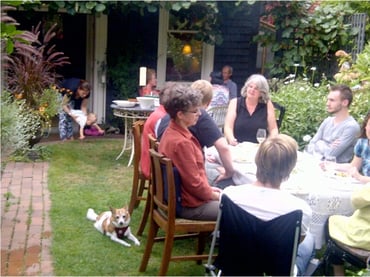
garden party
There is a growing understanding about the richness of life that has been lost with our fragmented and isolated lives, and attention is now being given to restore the historic nature of neighbourhoods.
The close proximity and frequency to run into neighbours is what builds social capital - that relational fabric in a community. 
Sociologists have been sounding the alarm regarding our plummeting social capital; the absence of it is impoverishing our lives and communities. It is what builds civil society. This social connectedness is a primary contributor to a person’s sense of wellness and it is shaped by our local, daily life.
How do we combat the trends of ‘living above place’ versus being rooted, the trend of valuing the private over the common, and of the increasing isolation, fragmentation and speed of life? How do we live out our values – not as professionals – but as neighbours? I have become convinced that it is the local neighbourhood that is the best context for people to thrive.
Several years ago, I began a process of reorienting my entire way of life within the proximity of the neighbourhood, out of a longing for a more integrated way of living and a deeper experience of community. I began deceptively simple practices (that I now think have the potential to be staggering in its scope in helping us and others live well). My imagination was sparked for another way of living and being.
I moved into a 100-year-old house with six bedrooms and began offering a few rooms to rent. In the process, I discovered a need to hold space for people in transition, what some call the post-modern homeless. I eventually opened all the rooms for whosoever and invited them to stay as long as they wanted. There has now been over 200 that have lived in my house. It is a miracle of grace that I love this! I have moved away from a privatized way of living where your home is seen as a sanctuary, to the place of making your personal possessions more public, as Augustine argued for.
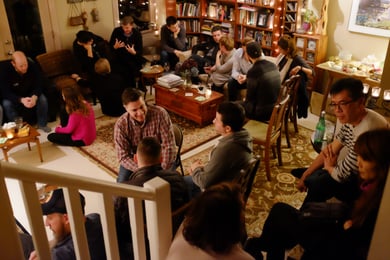
I quickly learned you couldn’t be present and be busy, so I spent the first year learning a radically foreign rhythm that had enough margin. I stopped using the word busy so as to not increase its value (my life is people, intense and full, but I no longer live on adrenaline and deadlines which I did most of my life). A culture built on speed tends to neglect relationships - especially those deemed optional - and the simple, ordinary practices that enable a community to flourish tend to diminish in value when we don’t depend on each other practically, and productivity and dehumanizing efficiency dominate our lives. It takes time to get to the place where you know your neighbours and can experience connection as a neighbourhood.House gathering
Alan Hirsch reminds us that to connect in our neighbourhood we need proximity, frequency, and spontaneity. For most of my life, I embraced the value of self-sufficiency and independence (what a delusion they are). Now, most of my life is shared - not with family, but with strangers; my home, car, food, resources, possessions, and time. It is wonderful, hard and beautiful, and I would never go back. 
I’ve also discovered how food builds relationship! Simple hospitality, around good food – and hosted regularly in homes - provides the best foundation for developing a social fabric in a neighbourhood. I moved from a compartmentalized practice of entertaining just friends and family – to a lifestyle of radical hospitality - to strangers and neighbours.
Eight years ago, I started hosting regular Sunday Soup Nights for the neighbours. In wanting to make it easy for people to come, I kept the barriers low; they didn’t need to RSVP, they could come late and leave early and didn’t need to bring anything (except their own drinks). I made a pot of homemade soup and some bread. We now average 45-55 neighbours coming, made up of every decade, from 20-70 years old and their children. Most people tend to only gather with their tribes, so people have loved it! Where else like the neighbourhood can diversity gather? Neighbours who have lived next door to each other for 15+ years and had never met till they came to our house, have now exchanged emails and even house keys. I think this is a taste of living well! We now have over 100 people on our neighbourhood email list.

Soup Night
Several women have shown up at the door on Soup Nights saying they wanted to meet the woman who invites strangers into her home. Even though many people are entrenched in fear and isolation, I have found how hungry people are for another way of being human. These very simple, ordinary practices that we do – have profound impact. Neighbourliness seems to have become a lost art. The idea of neighbourhood helps me think about fostering a sense of village, where as Peter Blocks suggests: every gift can be given.
After a few years of building relational connection in the neighbourhood, we put our hand to work together toward sponsoring a family from Syria. Together we raised $40K and welcomed our family to live in a suite on our street. What a gift they have been to our neighbourhood. We are now working toward a second sponsorship. Working together really deepens connection!
I’ve sought to root deeply into my neighbourhood seeking to be a faithful presence. I am not advocating that everyone lives at this level of intensity. GK Chesterton once said that we are to exaggerate what the world has neglected. I am seeking to exaggerate what has been neglected in the area of generous hospitality to maybe spark a few others to imagine with me ...
  • What if every neighbourhood had a catalyst for inclusive hospitality? A lifestyle that nurtured a web of care in their place. What would it look like for your neighbourhood to thrive? 
    One neighbour asked me to be her executor. It prompted me to dream about my neighbourhood functioning like extended family.
  • What would it take to develop enough connection and shared life, that you cared about each other like a healthy extended family?
  • What if we didn’t think as professionals providing services and didn’t see our neighbours as projects or people to be served, but simply invited them into our life as friends?
What if we all lived well by loving our neighbours well?

Monday, August 6, 2018

Meet The Island Communities Fighting Back Against Wealthy, Absent Landlords: These Tiny Scottish Communities are Taking Control of Their Own Destinies

by Adam Weymouth, Huffington Post:  https://www.huffingtonpost.com.au/entry/island-communities-scotland-fighting-back-wealthy-absent-landlords_us_5b6038f3e4b0de86f49abf6f

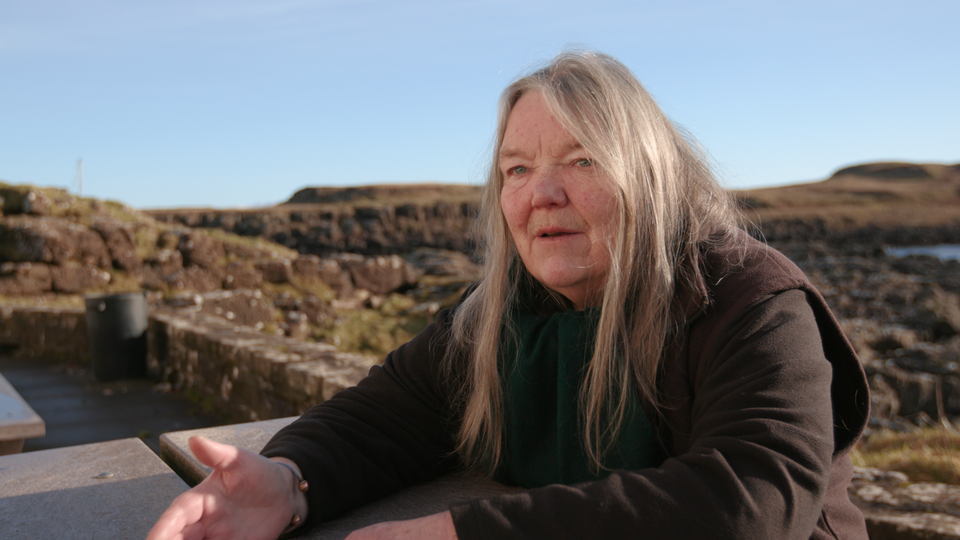
Maggie Fyffe was 28 when she arrived on the Isle of Eigg, Scotland, in 1976. She came with her husband and her infant son, having been invited by the island’s owner to start a craft workshop on the island. Eigg is one of the Scottish Small Isles, an archipelago of islands a few miles off the country’s west coast, and when Fyffe arrived, the population was at an all-time low of 39. 

The island was owned by businessman and former Olympic bobsleigher Keith Schellenberg. Schellenberg had bought Eigg in 1975 for the equivalent of $360,000 (274,000 pounds), and despite some initial investment, things had progressively declined. In an interview with the West Highland Free Press in 1991, he enthused that under his ownership the island had kept its “slightly rundown ... Hebridean feel.”

Fyffe and her neighbors saw it differently. “We were in extreme circumstances,” she says. “With no security of tenure, no one was investing; the community hall was falling apart; the only shop was in a corrugated shed with no water or electricity.”
ELEANOR CHURCH
Maggie Fyffe moved to the Isle of Eigg in the 1970s and is secretary of the Isle of Eigg Heritage Trust.
Fed up and desperate for change, the community decided to do something about it. When Schellenberg’s divorce led to the island being put on the market, Eigg passed briefly to a German artist, before the newly formed Isle of Eigg Trust raised $1.97 million to buy it ― one-third from hundreds of small donations and two-thirds from a woman who has remained anonymous to this day. Last year, Eigg celebrated its 20th anniversary of community ownership. 
While not the first community land purchase in Scotland, the high-profile buyout of Eigg in 1997 made headlines around the world and reignited debate and activism around land reform in the country.
Vast estates and whole islands are traded between millionaires on the international property market, while those who live and work in those places are forced to watch mutely, dealing with the whims and changing fancies of one new landlord after another.
The country’s gross imbalance of land is the result of a system of feudal tenure along with antiquated inheritance laws. In the 18th century, after the end of the clan system in Scotland ― where communities of people lived together under a chief ― much of the land was parceled up and given away or taken by those who had no right to it.
Absent landlords quickly came to realize that their new acquisitions could turn more of a profit if they got rid of tenants in favor of livestock. People were cleared from land that they had known for generations in a legacy that persisted through the centuries.
But things are changing. A string of community purchases followed Eigg, facilitated by new laws introduced by the Scottish government. More than 560,000 acres of Scotland now rest in community ownership, with the government aiming to increase that figure to 1 million acres by 2020.
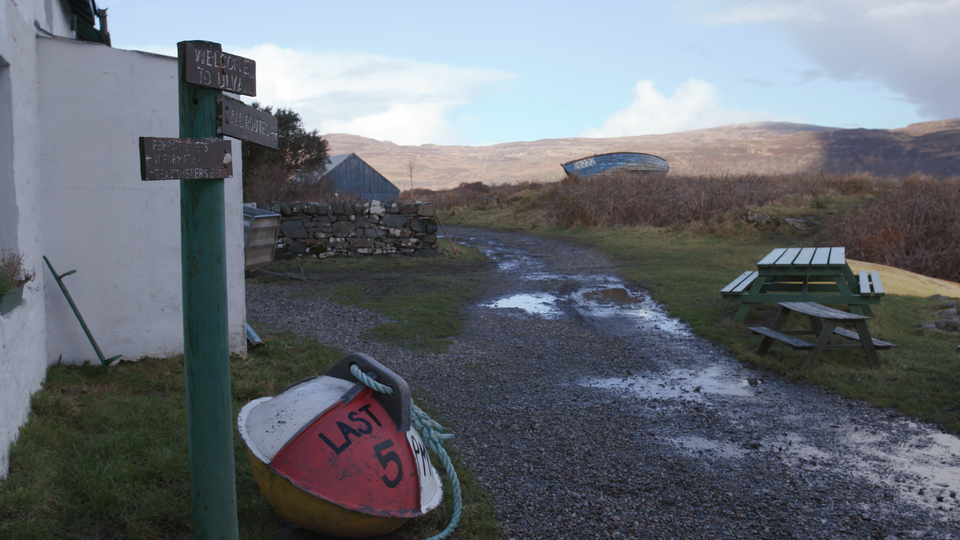
The Isle of Ulva, in the Inner Hebrides, which has a population of just six (down from 570 in the 1840s) is the most recent to pass out of private ownership and into the hands of the community for a total of $6.1 million earlier this year.
ELEANOR CHURCH
The Isle of Ulva, which currently has a population of just six people, has recently been purchased by the community.
Those who live on community-owned land are already showing another world is possible. Since the buyout, the population of Eigg has risen to 105 and a baby is due next week. The number of visitors to the island has doubled, homes have been built, a development at the new pier houses three businesses, including a shop and a tearoom, and the island is powered almost entirely by renewables.
Fyffe, who is secretary of the Isle of Eigg Heritage Trust, acknowledges the hard work needed with democracy happening at this extremely grassroots level, and the tensions that flare up have been well-documented. But conflict is part of community, and Fyffe would not have it any other way.
Fyffe’s daughter, who had left the island along with many of her generation, has since returned because she “saw that things were happening” and because she wanted to be able to provide for her own children the sort of childhood she had known.
This story is being repeated across Scotland. Barney Higgins, 32, moved from Glasgow to the Isle of Gigha, off Scotland’s west coast, five years ago. That Gigha was community-run was a direct influence on his move, not only ideologically but for the basic fact that both his job at Achamore Gardens and the rental accommodation he lives in had been created as a result of the purchase. He is heavily involved in the life of the island, from sitting on the board of directors for the Gigha Heritage Trust, which purchased the island in 2002, to volunteering in the tearoom.
JOHN SHORT VIA GETTY IMAGES
The Isle of Gigha in Scotland was purchased by the community in 2002.
“It’s a thriving, growing, developing, challenging little place,” he told HuffPost. “I just don’t see how that could happen without that new vision that community ownership brings.”
The population growth experienced on these islands is something that many communities on the mainland would like to replicate. A 2018 report on Scotland’s sparsely populated areas found that half of the country contains just 2.6 percent of the population and that, if current trends continue, that figure will drop by almost a third by 2050.
In Sutherland, a region in the north of the Scottish mainland, for example, three-quarters of the land is in the hands of 81 families and just one person is employed for every 1,800 acres. 
“What these areas need are young people, families,” according to David Cameron, a director of Community Land Scotland. “And you need jobs and housing to bring in families.”
Freeing up land from private hands, says Cameron, would bring in the homes and jobs so sorely needed. The community buyout in June 2018 of the 3,000 acre West Helmsdale crofting estate in East Sutherland has led to the creation of the first job in the area for a century, in the form of a part-time development officer, and the community says it is just the beginning.
Andy Wightman, member of the Scottish Parliament for Lothian, in the Scottish Lowlands, has dedicated much of his life to questions of land reform. He is enthusiastic about community buyouts but sees the need for them as symptomatic of still deeper structural problems.
“If our local police are not catching criminals, they don’t tell us to run the police ourselves,” he says. “So why’s our land system failing? Why had it led to this situation where the only option we have is to own this land ourselves?”
He believes, above all, that tax reforms are needed to remove the tax exemptions that large Scottish land holdings currently enjoy. That could force the land to be divided up and sold in smaller parcels that would be more economic to run, changing the current pattern of land ownership into something more widely accessible. As Cameron of Community Land Scotland puts it: “Why do people need to own so much land when they do nothing with most of it?”
Such far-reaching changes require “political bravery,” Wightman acknowledges. And yet, their ultimate aims are not as radical as they might initially appear. At the end of the 16th century, about half of Scotland was held in common ownership. 
“There’s often a misapprehension that this is something new when in fact common ownership of land is a very, very old thing,” Wightman says. “We’re in effect trying to restore an older, more normal order of things, rather than creating a new order where private land ownership is the norm.”
Back on Eigg, Fyffe says she has witnessed an important shift over the past two decades. “Twenty years ago it took a long time for people to start talking about ‘we’ rather than ‘them,’” she tells HuffPost. “It was such a mindset that you had an owner, and ‘they’ were doing this or ‘they’ were doing that. It took quite a long time to become ‘we’ are doing this, ‘we’ could do that.”
For more content and to be part of the “This New World” community, follow our Facebook page. 
HuffPost’s “This New World” series is funded by Partners for a New Economy and the Kendeda Fund. All content is editorially independent, with no influence or input from the foundations. If you have an idea or tip for the editorial series, send an email to thisnewworld@huffpost.com