Showing posts with label What the?. Show all posts

Sunday, January 10, 2021

QAnon and the storm of the U.S. Capitol: The offline effect of online conspiracy theories

by Marc-Andre Argentino, The Conversation: https://theconversation.com/qanon-and-the-storm-of-the-u-s-capitol-the-offline-effect-of-online-conspiracy-theories-152815


What is the cost of propaganda, misinformation and conspiracy theories? Democracy and public safety, to name just two things. The United States has received a stark lesson on how online propaganda and misinformation have an offline impact.

For months, Donald Trump has falsely claimed the November presidential election was rigged and that’s why he wasn’t re-elected. The president’s words have mirrored and fed conspriacy theories spread by followers of the QAnon movement.

While conspiracy theorists are often dismissed as “crazy people on social media,” QAnon adherents were among the individuals at the front line of the storming of Capitol Hill.

QAnon is a decentralized, ideologically motivated and violent extemist movement rooted in an unfounded conspiracy theory that a global “Deep State” cabal of satanic pedophile elites is responsible for all the evil in the world. Adherents of QAnon also believe that this same cabal is seeking to bring down Trump, whom they see as the world’s only hope in defeating it.

The evolution of QAnon

Though it started as a series of conspiracy theories and false predictions, over the past three years QAnon has evolved into an extremist religio-political ideology.

I’ve been studying the movement for more than two years. QAnon is what I call a hyper-real religion. QAnon takes popular cultural artifacts and integrates them into an ideological framework.

QAnon has been a security threat in the making for the past three years.

The COVID-19 pandemic has played a signficant role in popularizing the QAnon movement. Facebook data since the start of 2020 shows QAnon membership grew by 581 per cent - most of which occurred after the United States closed its borders last March as part of its coronavirus containment strategy.
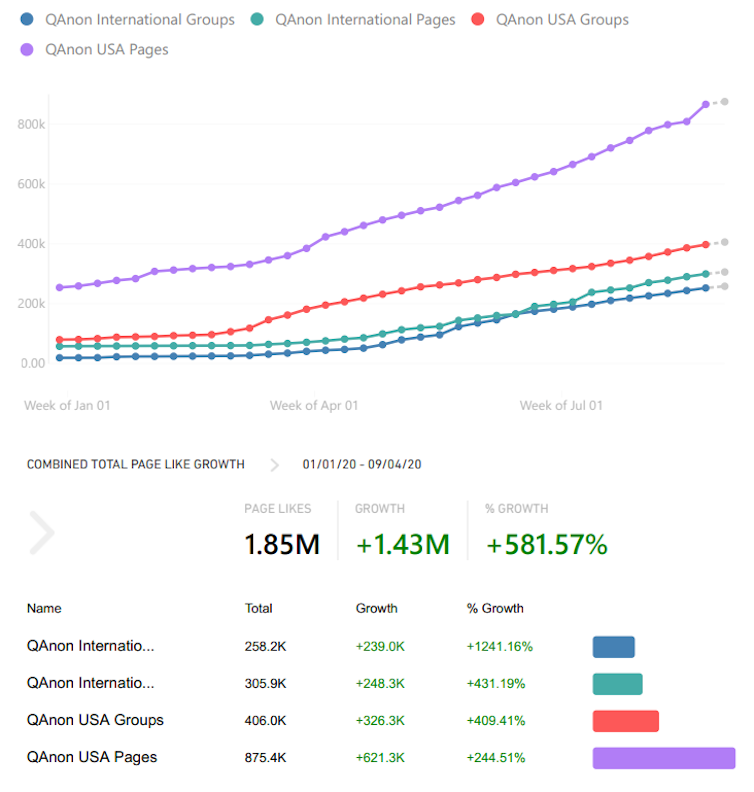
Aggregate growth of QAnon membership in Facebook groups and pages between January and September 2020. Data collected and visualized September 4, 2020 courtsey of CrowdTangle.

As social media researcher Alex Kaplan noted, 2020 was the year “QAnon became all of our problem” as the movement initially gained traction by spreading COVID-related conspiracy theories and disinformation and was then further mainstreamed by 97 U.S. congressional candidates who publicly showed support for QAnon.

Crowdsourced answers

The essence of QAnon lies in its attempts to delineate and explain evil. It’s about theodicy, not secular evidence. QAnon offers its adherents comfort in an uncertain - and unprecedented - age as the movement crowdsources answers to the inexplicable.

QAnon becomes the master narrative capable of simply explaining various complex events. The result is a worldview characterized by a sharp distinction between the realms of good and evil that is non-falsifiable.

No matter how much evidence journalists, academics and civil society offer as a counter to the claims promoted by the movement, belief in QAnon as the source of truth is a matter of faith - specifically in their faith in Trump and “Q,” the anonymous person who began the movement in 2017 by posting a series of wild theories about the Deep State.

Trump validated theories

The year 2020 was also Trump finally gave QAnon what it always wanted: respect. As Travis View, a conspiracy theory researcher and host of the QAnon Anonymous podcast  recently wrote: “Over the past few months … Trump has recognized the QAnon community in a way its followers could have only fantasized about when I began tracking the movement’s growth over two years ago.”

Trump, lawyers Sidney Powell and Lin Wood, and QAnon “rising star” Ron Watkins have all been actively inflaming QAnon apocalyptic and anti-establishment desires by promoting voter fraud conspiracy theories.

Doubts about the validity of the election have been circulating in far-right as well as QAnon circles. Last October, I wrote that if there were delays or other complications in the final result of the presidential contest, it would likely feed into a pre-existing belief in the invalidity of the election - and foster a chaotic environment that could lead to violence.
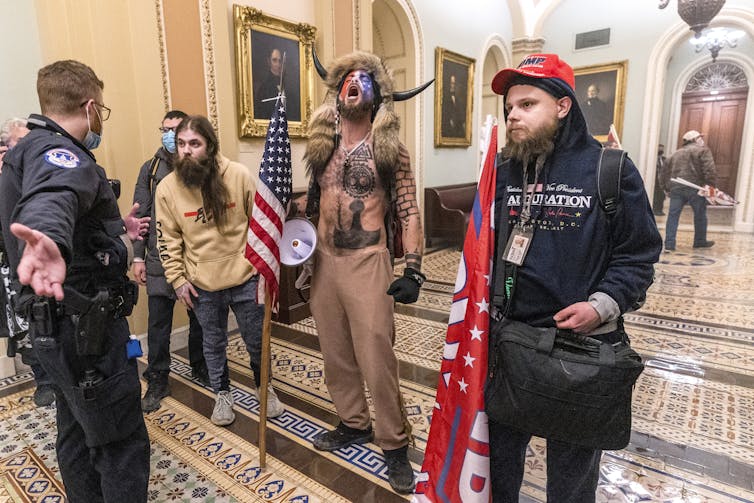
Several protesters, including a shirtless man wearing a fur hat with horns, confront a security guard at the U.S. Capitol.
A shirtless man known as the ‘QAnon Shaman’ was one of the high-profile members of Trump supporters who invaded the U.S. Capitol. (AP Photo/Manuel Balce Ceneta)

Hope for miracles

The storming of the U.S. Capitol saw the culmination of what has been building up for weeks: the “hopeium” in QAnon circles that some miracle via Vice-President Mike Pence and other constitutional witchcraft would overturn the election results.

Instead, QAnon followers are now faced with the end of a Trump presidency - where they had free rein - and the fear of what a Biden presidency will bring.

We have now long passed the point of simply asking: how can people believe in QAnon when so many of its claims fly in the face of facts? The attack on the Capitol showed the real dangers of QAnon adherents.

Their militant and anti-establishment ideology - rooted in a quasi-apocalyptic desire to destroy the existing, corrupt world and usher in a promised golden age - was on full display for the whole world to see. Who could miss the shirtless man wearing a fur hat, known as the QAnon Shaman, leading the charge into the Capitol rotunda?

What will happen now? QAnon, along with other far-right actors, will likely continue to come together to achieve their insurrection goals. This could lead to a continuation of QAnon-inspired violence as the movement’s ideology continues to grow in American culture.

Monday, May 5, 2014

The Commission of Audit Wants to Rip Up Australia's Social Contract

by Veronica Sheen, Monash University

The recommendations in the Commission of Audit’s report, which was released yesterday, would, if implemented, erode the fundamental building blocks of Australia’s social contract.

The social contract - the suite of policies, legislation, programs, health care and social services - has served to ensure that every Australian is able to have a basic but decent standard of living.

It has been carefully crafted over the 20th century since Federation.

The social contract has also served to ensure that extremes of poverty and inequality have been largely avoided, with some important exceptions.

Growth of the working poor

The Commission of Audit believes that the minimum wage should be set at 44% of average weekly earnings (AWE), which is a measure of average earnings across both part-time and full-time employment.

Using AWE as a benchmark, rather than full-time average earnings, significantly erodes the value of the minimum wage because it includes the wage of people who are either underemployed (around 7% of the Australian workforce) or who choose to work in part-time jobs.

If the Commission of Audit’s recommendation is implemented, the current minimum wage of A$622.20 per week would be reduced to A$488.90 per week.

Of great concern would be its effect on people in part-time, casual jobs. It would reduce the current hourly rate of $16.37 to $12.80 per hour (plus a casual loading). For many people, including the 10% of the female workforce that is underemployed, this would be a large loss of income.

The recommendation on the minimum wage would shift the foundation of adequacy in wage setting as enshrined in the 1907 Harvester Judgment. It would take us down the track of an American-style working poor with all the negative social and economic consequences for society.

Big holes in the social safety net

The recommendation for reducing the minimum wage also needs to be set in the context of recommendations across the income-support system. There was no attempt to address the low level of unemployment payments in the form of the Newstart Allowance.

However, the Commission of Audit wants to make life harder for people forced to live on these low payments. Currently, earned income between $100 and $250 per fortnight reduces fortnightly payment by 50 cents in the dollar. The Commission of Audit recommendation means it would be reduced by 75 cents in the dollar.

This undermines efforts of people to sustain themselves while on low Newstart payments through a small amount of part-time work. This new taper rate would apply across the board to all benefits and pensions.

If implemented, the recommendation means that there will be a greater disincentive for people to take on any work as it will be more trouble than what it’s worth.

It is exactly counter to the type of help a government would want to give people to get off income-support payments. It erodes people’s capacity to help themselves through paid work and will increase poverty. It could also extend participation in the grey or black economy.

The recommendation that young people on unemployment payments will eventually be required to move to areas with higher employment opportunities sounds like a bit of nasty social engineering.

Historically, young people have moved to areas with greater opportunities and they don’t need a government regulation to do so. But they do need jobs with decent wages to go to.

A squeeze on age pensions

The change to indexing arrangements in the age pension, as recommended by the Commission of Audit, will erode the pension’s value if implemented. The current arrangements ensure a modest but adequate standard of living for Australia’s older population.

The erosion of adequacy sets the ground for the pauperisation of some groups of older people, especially single women (a group highly reliant on the full age pension) and those in rental accommodation.

There is a case for high-value housing to be included in the assets test. However, there would need to be a very careful assessment of the level at which this is set.

The Commission of Audit also recommends raising the pension eligibility age to 70 to take effect by 2053, linking the pension eligibility age to life expectancy. This long lead time is better than a transition as early as 2030 as some reports suggested.

However, other factors still need to be taken into account, particularly the health status of workers in occupational and industry sectors where working to 70 will be very difficult to achieve.

Altogether, the recommendations across social welfare would create big holes in the Australian social safety net - one that has been carefully crafted since Federation. The fact that Australia has a well-targeted and efficient social welfare system is entirely overlooked.

The Commission of Audit, chaired by Tony Shepherd, ignored that Australia has a well-targeted and efficient social welfare system. AAP/Lukas Coch

The end of universal health coverage

The Commission of Audit recommendations on Medicare would fundamentally change the basis of our universal, publicly funded health system. The recommended GP co-payments are large at $15 and would be very hard on low-income earners. If implemented, this would undermine one of Medicare’s chief goals: to ensure everyone could see a doctor when they needed to.

However, it is also alarming that the Commission of Audit thinks that the well-off should be entirely out of Medicare for basic health services and should pay for them through the private system.

This recommendation would lead to Australia having a dual health-care system - one for the well-off and one for everyone else. This sets up the conditions for the higher-income groups to continually contest expenditures on a health system that they do not have access to themselves.

This is why a universal system works so well. It ensures social solidarity on the provision of health care. The Commission of Audit’s recommendation has the potential to set up the type of inequalities in health care combined with the exorbitant costs of the system that we see in the US.

Conclusions

The Commission of Audit has made much of the affordability of Australia’s core areas of social spending.

But it might also have considered whether Australia can afford to rip up its long-standing social commitments on decent wages, an adequate social safety net and a universal health-care system. The costs of many of its recommendations may ultimately be too high.
The Conversation

Veronica Sheen does not work for, consult to, own shares in or receive funding from any company or organisation that would benefit from this article, and has no relevant affiliations.

This article was originally published on The Conversation. Read the original article.