Monday, August 6, 2018

Meet The Island Communities Fighting Back Against Wealthy, Absent Landlords: These Tiny Scottish Communities are Taking Control of Their Own Destinies

by Adam Weymouth, Huffington Post:  https://www.huffingtonpost.com.au/entry/island-communities-scotland-fighting-back-wealthy-absent-landlords_us_5b6038f3e4b0de86f49abf6f

Maggie Fyffe was 28 when she arrived on the Isle of Eigg, Scotland, in 1976. She came with her husband and her infant son, having been invited by the island’s owner to start a craft workshop on the island. Eigg is one of the Scottish Small Isles, an archipelago of islands a few miles off the country’s west coast, and when Fyffe arrived, the population was at an all-time low of 39. 

The island was owned by businessman and former Olympic bobsleigher Keith Schellenberg. Schellenberg had bought Eigg in 1975 for the equivalent of $360,000 (274,000 pounds), and despite some initial investment, things had progressively declined. In an interview with the West Highland Free Press in 1991, he enthused that under his ownership the island had kept its “slightly rundown ... Hebridean feel.”

Fyffe and her neighbors saw it differently. “We were in extreme circumstances,” she says. “With no security of tenure, no one was investing; the community hall was falling apart; the only shop was in a corrugated shed with no water or electricity.”
ELEANOR CHURCH
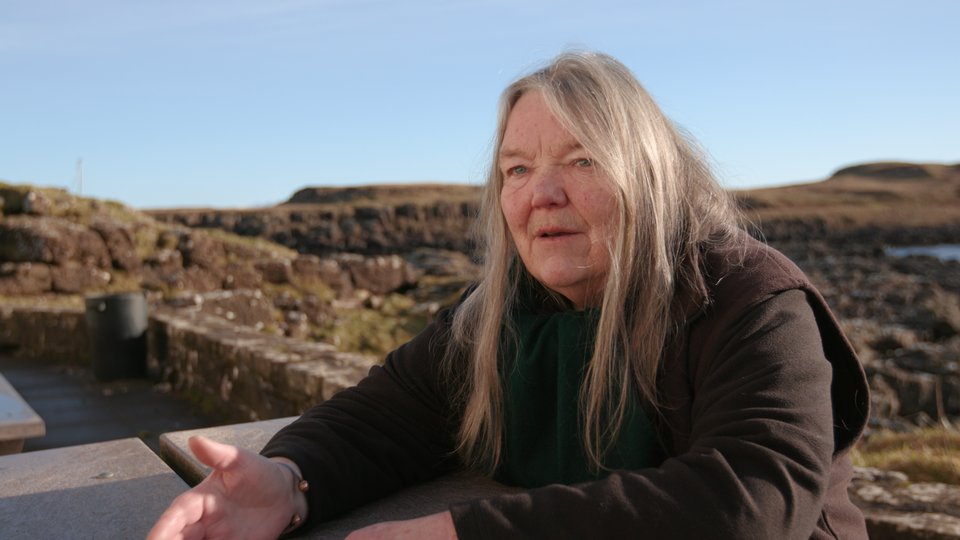
Maggie Fyffe moved to the Isle of Eigg in the 1970s and is secretary of the Isle of Eigg Heritage Trust.
Fed up and desperate for change, the community decided to do something about it. When Schellenberg’s divorce led to the island being put on the market, Eigg passed briefly to a German artist, before the newly formed Isle of Eigg Trust raised $1.97 million to buy it ― one-third from hundreds of small donations and two-thirds from a woman who has remained anonymous to this day. Last year, Eigg celebrated its 20th anniversary of community ownership. 
While not the first community land purchase in Scotland, the high-profile buyout of Eigg in 1997 made headlines around the world and reignited debate and activism around land reform in the country.
Vast estates and whole islands are traded between millionaires on the international property market, while those who live and work in those places are forced to watch mutely, dealing with the whims and changing fancies of one new landlord after another.
The country’s gross imbalance of land is the result of a system of feudal tenure along with antiquated inheritance laws. In the 18th century, after the end of the clan system in Scotland ― where communities of people lived together under a chief ― much of the land was parceled up and given away or taken by those who had no right to it.
Absent landlords quickly came to realize that their new acquisitions could turn more of a profit if they got rid of tenants in favor of livestock. People were cleared from land that they had known for generations in a legacy that persisted through the centuries.
But things are changing. A string of community purchases followed Eigg, facilitated by new laws introduced by the Scottish government. More than 560,000 acres of Scotland now rest in community ownership, with the government aiming to increase that figure to 1 million acres by 2020.
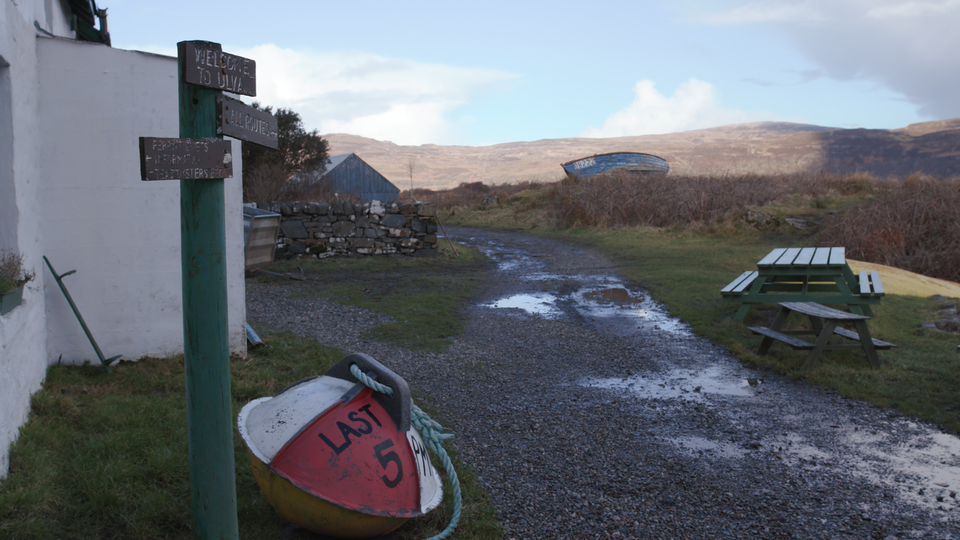
The Isle of Ulva, in the Inner Hebrides, which has a population of just six (down from 570 in the 1840s) is the most recent to pass out of private ownership and into the hands of the community for a total of $6.1 million earlier this year.
ELEANOR CHURCH
The Isle of Ulva, which currently has a population of just six people, has recently been purchased by the community.
Those who live on community-owned land are already showing another world is possible. Since the buyout, the population of Eigg has risen to 105 and a baby is due next week. The number of visitors to the island has doubled, homes have been built, a development at the new pier houses three businesses, including a shop and a tearoom, and the island is powered almost entirely by renewables.
Fyffe, who is secretary of the Isle of Eigg Heritage Trust, acknowledges the hard work needed with democracy happening at this extremely grassroots level, and the tensions that flare up have been well-documented. But conflict is part of community, and Fyffe would not have it any other way.
Fyffe’s daughter, who had left the island along with many of her generation, has since returned because she “saw that things were happening” and because she wanted to be able to provide for her own children the sort of childhood she had known.
This story is being repeated across Scotland. Barney Higgins, 32, moved from Glasgow to the Isle of Gigha, off Scotland’s west coast, five years ago. That Gigha was community-run was a direct influence on his move, not only ideologically but for the basic fact that both his job at Achamore Gardens and the rental accommodation he lives in had been created as a result of the purchase. He is heavily involved in the life of the island, from sitting on the board of directors for the Gigha Heritage Trust, which purchased the island in 2002, to volunteering in the tearoom.

JOHN SHORT VIA GETTY IMAGES
The Isle of Gigha in Scotland was purchased by the community in 2002.
“It’s a thriving, growing, developing, challenging little place,” he told HuffPost. “I just don’t see how that could happen without that new vision that community ownership brings.”
The population growth experienced on these islands is something that many communities on the mainland would like to replicate. A 2018 report on Scotland’s sparsely populated areas found that half of the country contains just 2.6 percent of the population and that, if current trends continue, that figure will drop by almost a third by 2050.
In Sutherland, a region in the north of the Scottish mainland, for example, three-quarters of the land is in the hands of 81 families and just one person is employed for every 1,800 acres. 
“What these areas need are young people, families,” according to David Cameron, a director of Community Land Scotland. “And you need jobs and housing to bring in families.”
Freeing up land from private hands, says Cameron, would bring in the homes and jobs so sorely needed. The community buyout in June 2018 of the 3,000 acre West Helmsdale crofting estate in East Sutherland has led to the creation of the first job in the area for a century, in the form of a part-time development officer, and the community says it is just the beginning.
Andy Wightman, member of the Scottish Parliament for Lothian, in the Scottish Lowlands, has dedicated much of his life to questions of land reform. He is enthusiastic about community buyouts but sees the need for them as symptomatic of still deeper structural problems.
“If our local police are not catching criminals, they don’t tell us to run the police ourselves,” he says. “So why’s our land system failing? Why had it led to this situation where the only option we have is to own this land ourselves?”
He believes, above all, that tax reforms are needed to remove the tax exemptions that large Scottish land holdings currently enjoy. That could force the land to be divided up and sold in smaller parcels that would be more economic to run, changing the current pattern of land ownership into something more widely accessible. As Cameron of Community Land Scotland puts it: “Why do people need to own so much land when they do nothing with most of it?”
Such far-reaching changes require “political bravery,” Wightman acknowledges. And yet, their ultimate aims are not as radical as they might initially appear. At the end of the 16th century, about half of Scotland was held in common ownership. 
“There’s often a misapprehension that this is something new when in fact common ownership of land is a very, very old thing,” Wightman says. “We’re in effect trying to restore an older, more normal order of things, rather than creating a new order where private land ownership is the norm.”
Back on Eigg, Fyffe says she has witnessed an important shift over the past two decades. “Twenty years ago it took a long time for people to start talking about ‘we’ rather than ‘them,’” she tells HuffPost. “It was such a mindset that you had an owner, and ‘they’ were doing this or ‘they’ were doing that. It took quite a long time to become ‘we’ are doing this, ‘we’ could do that.”
For more content and to be part of the “This New World” community, follow our Facebook page. 
HuffPost’s “This New World” series is funded by Partners for a New Economy and the Kendeda Fund. All content is editorially independent, with no influence or input from the foundations. If you have an idea or tip for the editorial series, send an email to thisnewworld@huffpost.com

Tuesday, July 31, 2018

CASE STUDY - Remembering 1968: The Hackney Centerprise Co-operative

by Tom Woodin, History Workshop: http://www.historyworkshop.org.uk/remembering-1968-the-hackney-centerprise-co-operative/#more-8593

There has been a tendency to downplay the significance of the radical claims of the 1960s, not least among those in that age group who feel estranged from the ‘1968 generation’. On one episode of the BBC’s Strictly Come Dancing, for example, judge Len Goodman repeated an expression I have heard many times, that ‘I was born in the war,’ followed by a poignant silence, a means of asserting continuity, even though the 1939-45 conflict had nurtured social change. 
In reality, we are still living with the complex implications of the explosive impact of the 1960s. The changes permeated social, political, economic and cultural forces, and, after the visible demonstrations against Vietnam and other issues died down, many radical ventures were seeded that would set down roots in the 1970s. One of these ventures was Centerprise, a voluntary association which engaged with working class communities in Hackney, London.
           Centerprise photographed by Sherlee Mitchell. © Sherlee Mitchell / Bishopsgate Institute
Centerprise started working with young people and provided a safe space where they could play chess, write poetry, socialise, form bands and publish books. The impulse rapidly proliferated into welfare rights, childcare, adult literacy, community writing and publishing, a bookshop, coffee bar and meeting rooms, all under the one roof on Kingsland High Street in Hackney – a lime green building. Centerprise welcomed gardeners, Black power groups, Leninists, Conservative Party members who turned up their noses at workers as well as the ‘scowling’ left-wing groups who had their eyes on state power rather than community organising.

Left; Centerprise drawn by Doffy Weir in the 1970s, © Doffy Weir / Bishopsgate Institute | Right; A meeting held in the unfinished coffee bar at 34 Dalston Lane, early 1970s. © Tom Wilson / Bishopsgate Institute

In a book published in 2017, The Lime Green Mystery; an oral history of the Centreprise co-operative, Rosa Schling has captured the feelings, emotions, experiences and dilemmas of the people who created this social experiment. The book takes the reader on a guided tour of the building, visiting rooms where many different activities and relationships were developed. The book is an outcome of the project A Hackney Autobiography run by On the Record and funded by the Heritage Lottery Fund. The Centerprise archive, including oral histories by On the Record trained volunteers, is now housed at the Bishopsgate Institute; audio tours bringing the archive to life are freely accessible online and on iTunes & Android app;  events and workshops were held; and learning resources developed.
Despite the thematic organisation, the book betrays a chronological trajectory familiar to voluntary groups. The early phase was characterised by an assortment of anarchic and charismatic individuals who campaigned and brought the thing into being, imbuing it with a vision and purpose. For co-founder Margaret Gosley, one starting point was sitting in a bus shelter in Brighton with pioneering publisher Glenn Thompson, denouncing the wealthy and putting the world to rights. The towering figure of Thompson cast a long shadow over Centerprise, importing ideas from the USA civil rights movement, not least the mix of coffee shop and bookshop. 
Richard Gray, who went on to form the Peckham Publishing Project, was awe-struck on first meeting Glenn: ‘his Afro… his Cuban heels, cool jeans and leather jacket… He was like I imagined Malcolm X or Stokely Carmichael…’. One commentator noted how leaders could emerge naturally at Centerprise, like one who ‘strode into Hackney much as his ancestors had gone off into distant parts of the empire to bring the British way of life to the natives’ – reminiscent of ‘Barrington’ in Robert Tressell’s Ragged Trousered Philanthropists. Despite a suspicion that some saw themselves as ‘intellectually superior’, over time, sympathetic relations developed and, for people such as the author Roger Mills who frequented Centreprise in the mid-1970s, it represented a university experience which nurtured a new way of thinking.

Young customers of Centerprise outside the entrance, early 1980s. © Wendy Pettifer / Bishopsgate Institute

The powerful individuals of the initial phase gave way to a collective working pattern in the second which fostered a symbiotic relationship between self-help and campaigns for change. For instance, while a playgroup was organised along lines of parity with council services, Centerprise simultaneously agitated for better facilities elsewhere. Smalley Road Estate residents were supported in collating their experience of living in poorly built new flats, organising meetings, arranging technical surveys and publicising the results through the papers and TV. 
A sense of professionalism meant that Centerprise treated residents more like customers than clients, breaking out of a social services typology. There was also a strong vein of opposition to staff becoming famous or gaining kudos from their work. Janet Rees was absolutely forbidden from appearing on TV in relation to her work on the Smalley Road campaign. The resistance to ‘personality politics’ echoed her Baptist childhood in Wales, ‘you work hard, you’re very self-effacing, you’re very modest, you put yourself to the back of the queue.’ 
Dedication to this quasi-religious cause was shown by workers putting in 70 hour weeks, which nurtured a form of hermetic living that took its toll on personal relationships while giving rise to new ones: ‘We were just always there. It was like joining a monastic order, except that you could still have sex…’ As a collective, Centerprise was inevitably torn betweeen prioritising the needs of the wider community and those of staff working in the collective. Working relations were to prefigure broader social change, yet the politicisation of everyday life, which allowed people to raise important issues, could be wearing when acrimony and scapegoating infused meetings. The impulse to include everyone also became testing in dealing with the glue-sniffers and other difficult characters who made Centerprise their home.

Centerprise coffee bar, 1980s. © Maggie Hewitt / Bishopsgate Institute

Crucially, Centerprise championed the democratisation of history and literacy, which built upon the early work of the History Workshop movement. Researching worker writers and community publishers, I found Centerprise to be one of the most significant examples in Britain and internationally. The Hackney Reading Centre, which ran from the mid-1970s to the 1990s in a room at the top of the Centerprise building, organised adult literacy classes with a focus on writing and publishing about student experience. The learner’s experience helped to locate them as expert and stimulated many debates with tutors and workers. It paralleled the impressive work of the publishing project that promoted local writers in a wide range of publications. The scale and scope of publishing required a lot of investment but emerged out of a desire to represent sympathetically and promote the lives of local people – the ‘irrepressible beauty’ in Vivian Usherwood’s poems, the still vibrant poetry of Hugh Boatswain or the autobiographical work of Ron Barnes and others.
Alongside widespread debates over the representation of class, race, gender, disability and sexuality, simple but poignant memories relate to the smells, sights and feel of participating in this cultural democracy. As the magic of printing became available for popular consumption, recalling the paper and the whiff of glue evoked the magic of creation arising from a physical process. Neil Littman recalled: ‘I remember Letraset type. I seem to remember it involved some type of carbon paper impression on it and paper being churned through a roller. I remember the pasting up of the artwork was done with little bits of paper and glue. I remember the smell of it.’ Taste was also a cue to conjure up the characters who worked in the café, especially when staff roles were rotated which meant that mediocre cooks exchanged places with skilled ones – red snapper roti and jerk chicken on the good days, less appetising fayre on others.
In the early 1990s, following financial irregularities, the collective arrangements ceased and a manager was appointed. Centerprise activity would also be re-directed to serving the black community more explicitly. This is an aspect of the history into which this book does not really delve in great depth and it creates the feeling that there was more than one Centerprise. The project is now closed, a loss which coincides with a period of greatly rising inequality and social cleansing. Centerprise was a space where new relationships, identities and practices were constructed. The Lime Green Mystery repopulates this rich history on the page. It remains a resource for thinking about the future.
Rosa Schling’s The Lime Green Mystery: an Oral History of the Centerprise Co-operative was published in 2017 by On the Record. 
Tom Woodin is a reader in the social history of education at the UCL Institute of Education. He has written about history of education and the co-operative movement and, most recently, is the author of Working-class writing and publishing in the late twentieth century: literature, culture and community, Manchester University Press, 2018. He also writes about the co-operative movement and the history of education and coedits the journal History of Education.