Showing posts with label Scientific Evidence. Show all posts

Wednesday, October 28, 2020

New polling shows 79% of Aussies care about climate change. So why doesn’t the government listen?

by Rebecca Colvin, The Conversation: https://theconversation.com/new-polling-shows-79-of-aussies-care-about-climate-change-so-why-doesnt-the-government-listen-148726

We will remember 2020 as a year of crisis. COVID-19 hit Australia just as we were beginning to make sense of the horror bushfires and smoke of last summer, a sinister illustration of global warming’s threats.

Since then, the news media has given centre stage to COVID-19 and its cascading impacts on society, shifting climate change to a relatively minor role in our narrative of this year’s crises. So, have Australians forgotten about the urgency of climate change? No. 

Polling released today by The Australia Institute shows climate change and its impacts remain a prominent concern to Australians, even amid the upheaval and uncertainty wrought by COVID-19.
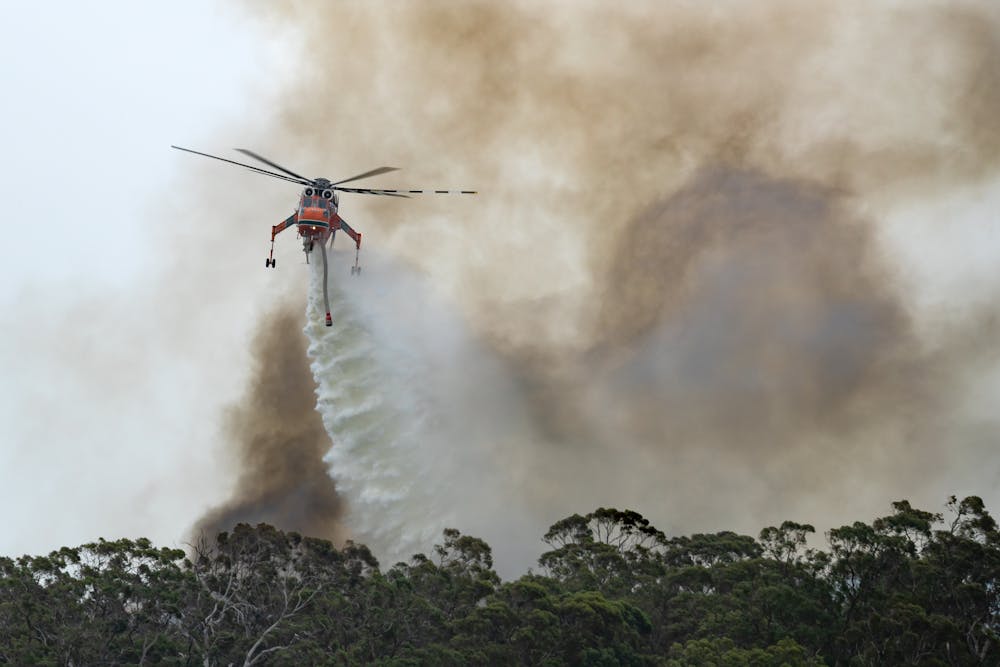
Helicopter dumping water over bushfires
The majority of Australians (57%) experienced some form of direct impact from last summer’s bushfires or smoke. Shutterstock

82% of Aussies worry about climate-driven bushfires

The Climate of the Nation report has tracked Australian attitudes to climate change for more than a decade.

This year, it polled 1,998 Australians aged 18 and over, and found the vast majority (79%) hold views in line with the best available scientific evidence. That is, four in five Australians agree climate change is occurring. This is the highest result since 2012.

An even greater majority, 82%, is worried climate change will result in more bushfires, up from 76% in last year’s report. This is perhaps unsurprising, given the record-breaking fires of last summer and the threat of longer and more ferocious fire seasons.

The bushfire royal commission is due to release its report today, and will likely highlight climate change as an amplifier of bushfire risk. This was foreshadowed in the commission’s  interim observations in August.

The report also showed Australians believe the post-pandemic economic recovery is not a time to further entrench fossil fuels. Only 12% of Australians want to see Australia’s economic recovery led by investment in gas, a plan the Morrison government is set on carrying out.

In contrast, a majority (59%) would like to see the recovery driven by renewables.

Australia: an international laggard

The level of scientific consensus on climate change is remarkable. Urgent action on climate change is recommended by scientists and desired by the overwhelming majority of the public. Yet, Australia remains an international laggard in this area.

The Climate Change Performance Index evaluates 57 countries plus the European Union, which together are responsible for more than 90% of global emissions. This year, Australia ranked last on climate policy.

The reasons include Australia’s absence from the UN Climate Action Summit in 2019, and withdrawal of contributions to  international climate funding programs.
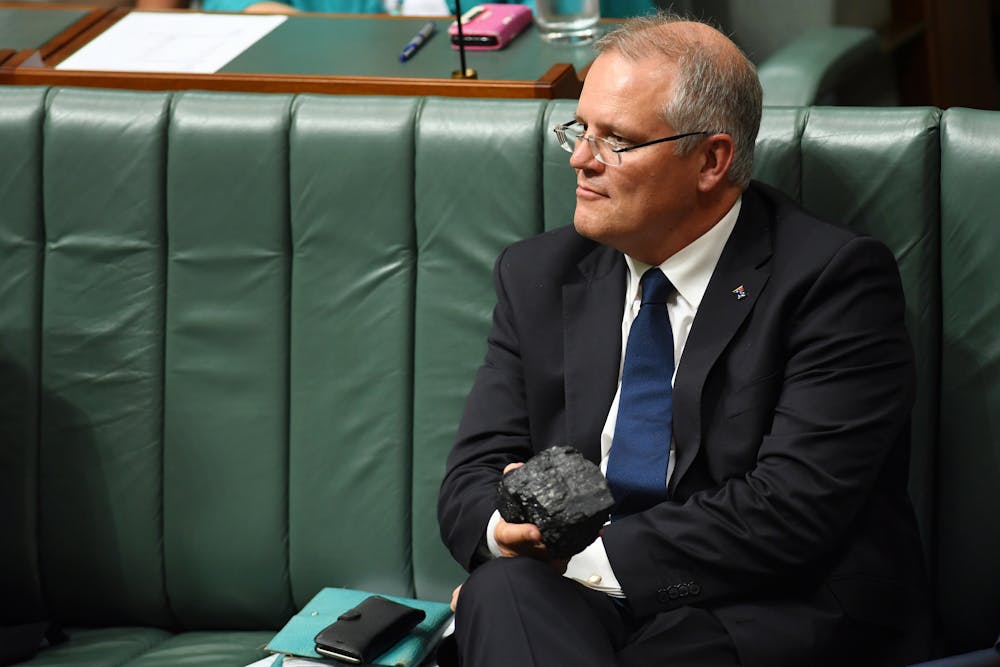
Scott Morrison holds a lump of coal
Australia’s inaction on climate change has made the country an international laggard. AAP Image/Lukas Coch

For many years, denial, delay and division over climate change was the norm in Australian politics. This is still the case among some media and political elites, and is no more pronounced than in debates over the future of coal in the domestic energy mix and for export.

Our energy sources play a big role in our overall contribution to climate change, with electricity generation contributing  32.7% of Australia’s emissions.

For everyday Australians, the solution is clear. The Climate of the Nation report shows the vast majority (83%) want to see coal-fired power stations phased out. Some 65% want the Australian government to stop new coal mines from being developed.

Toxic politics limit constructive conversations

For many, particularly those living in Australia’s coal production regions, the prospect of shifting from coal to renewables raises legitimate concerns about their futures.

However, the ability for people and policy to engage constructively with concerns over jobs and climate is limited by toxic politics.

An important culprit is the pervasive “us versus them”  narrative that dominates political and media discourse. The narrative repeatedly – but erroneously – signals to people in coal production regions that the rest of the country doesn’t care about them.

Coal production is also pitted against climate action in the “climate versus jobs” debate. But the polling shows such binaries are false: most Australians do care what happens in coal production regions. In fact, three-quarters of Australians want governments to plans and manage an orderly shift from coal to renewables.

The Australian people, by a large majority, care for those living in coal production communities and want to secure a safe climate.

68% of Aussies support an ambitious climate target

Australians recognise our country can make a disproportionately large and positive contribution to international efforts to mitigate climate change.
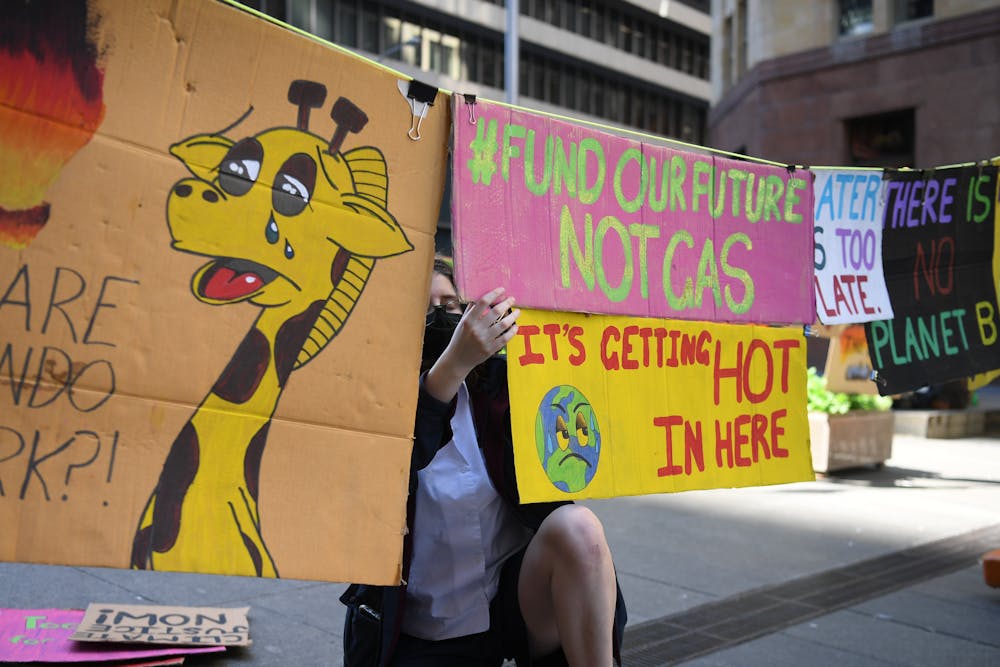
Students at a rally holding a sign against gas.
Most Australians want to see a renewables-led economic recovery from COVID-19. AAP Image/Dean Lewins

Seventy-one per cent want Australia to be a global leader in finding solutions to climate change, while 77% recognise tackling climate change can create opportunities for new jobs and investment in clean energy.

While all Australian states and territories have committed to net-zero emissions by 2050 or sooner, the federal government has not. But, once again, a majority of people would like to see otherwise: 68% support a net-zero by 2050 target for Australia. This is four percentage points higher than last year.

If we don’t implement meaningful and ambitious climate policy, Australia risks becoming even more of a climate outlier in the  international community than we already are.

The Climate of the Nation results clearly shows this goes against the will of the Australian people. Australia has a voting base that will support and reward ambitious climate action. Now is the time for political leaders to reflect this in the nation’s climate policy.

Sunday, August 23, 2020

We pieced together the most precise records of major climate events from thousands of years ago. Here’s what we found

by Ellen Corrick, John Hellstrom, and Russell Drysdale, The Conversation: https://theconversation.com/we-pieced-together-the-most-precise-records-of-major-climate-events-from-thousands-of-years-ago-heres-what-we-found-144575

Between 115,000 and 11,700 years ago, the Earth would have been almost unrecognisable. Massive ice-sheets covered northern Europe and northern Asia, and about half of North America, and global sea-levels were as much as 130 meters lower than today.

In this period, known as the “last glacial period”, the climate was much cooler and drier than today. It was punctuated by some of the largest and most rapid climate change events in Earth’s recent geological history.

For a long time, scientists have pondered how closely timed these abrupt climate change events were between Greenland and other regions of the world — far beyond the Arctic.

In our research, published today in Science, we’ve shown abrupt climate changes across the Northern Hemisphere and into the southern mid-latitudes occurred simultaneously, within decades of each other, throughout the last glacial period. We’ve also determined exactly when the abrupt changes occurred, much more precisely than before.

This can help us predict how abrupt climate changes might play out in the future.

A series of abrupt climate changes

Scientists can peer into Earth’s climate history through long ice cylinders, called “ice cores”, drilled from the Greenland ice sheet. Changes in the chemical composition of these ice cores reveal that the surrounding atmospheric temperature repeatedly warmed by 8-16℃, and each time within just a few decades.

A cylinder of ice sticks out of a long metal tube.
An ice core. Ancient ice can reveal what the surrounding climate was once like. AAP Image/ACECRC

Each warming event was followed by a more gradual period of cooling. These abrupt warming and cooling events happened more than 25 times throughout the last glacial period, and are known as Dansgaard-Oeschger events. They reflect changes in circulation patterns of the Atlantic Ocean.

While we have records of climate changes from many regions, the relative timing of these changes between Greenland and across the northern hemisphere into the southern sub-tropics is not well understood.

This has been difficult to resolve because we need very precisely dated records to make exact comparisons in timing. Ice cores provide a wealth of information about Dansgaard-Oeschger events. But while they faithfully reproduce the patterns of past climate, they are difficult to date very precisely.

Crystal time capsules beneath our feet

For our study, we turned to more precisely datable climate records: those from cave stalagmites.

Stalagmites are cave mineral deposits, which build up layer-by-layer on the cave floor. Their growth is fed by water dripping from the cave ceiling, which carries with it a chemical signal of temperature and rainfall conditions above the cave at that time. This signal is trapped in the crystal structure of the growing stalagmite.

Stalagmites can be dated very precisely, by measuring the decay of minute amounts of uranium trapped in them. This key feature enables us to compare the timing of climate events from place to place.

A group of stalagmites illuminated in a cave.
Stalagmites hold chemical signals that reveal what the climate above the cave was like thousands of years ago. Shutterstock

However, long, high-quality stalagmite records are rare. Scientists from around the world have been working for more than 20 years to produce these records. Only now that enough records are available, we are able to make precise comparisons of the timing of Dansgaard-Oeschger events between different regions.

We collated and compared 63 published stalagmite records from caves in Asia, Europe and South America, and we determined the timings of abrupt climate changes in each.

What we found

Our results show that during each Dansgaard-Oeschger event, climate changes felt in Asia, South America and Europe occurred within decades of one another. Being able to determine this level of synchrony is remarkable, given we are looking at events that occurred many tens of thousands of years ago.

This means that as large temperature increases were occurring in Greenland, abrupt changes were also occurring in air temperature and rainfall in Europe, and in the monsoon systems in Asia and South America.

So why is this important? First of all, finding that climate change events occurred in lots of different parts of the world within decades provides clues as to how they started in the first place.

It tells us the changes were likely propagated from the North Atlantic region to these locations through the re-organisation of patterns in atmospheric circulation. And knowing this can help scientists narrow down the underlying triggers, which are still not conclusive.

And our findings mean the precise ages from the stalagmites can be used to better date ice cores, enhancing one of the most important records we have of the last glacial climate.

An ice sheet over Greenland
In the last glacial period, vast ice sheets covered much of the world. Shutterstock

Implications for the future

The abrupt climate changes we studied occurred under very different conditions compared to the climate of today.

While our ancestors lived through the last glacial period, humans are unlikely to experience Dansgaard-Oeschger events for many thousands of years, until the earth has again cooled to glacial temperatures.

However, piecing together the puzzle of how abrupt climate changes took place in the past will help us to understand how abrupt climate changes might occur in the future. For example, our findings will help validate climate models used to predict climate changes.

Showing that profound changes in climate can occur simultaneously across large regions of the Earth highlights just how unstable and interconnected our climate system can be.