Showing posts with label Climate Denial. Show all posts

Wednesday, October 28, 2020

New polling shows 79% of Aussies care about climate change. So why doesn’t the government listen?

by Rebecca Colvin, The Conversation: https://theconversation.com/new-polling-shows-79-of-aussies-care-about-climate-change-so-why-doesnt-the-government-listen-148726

We will remember 2020 as a year of crisis. COVID-19 hit Australia just as we were beginning to make sense of the horror bushfires and smoke of last summer, a sinister illustration of global warming’s threats.

Since then, the news media has given centre stage to COVID-19 and its cascading impacts on society, shifting climate change to a relatively minor role in our narrative of this year’s crises. So, have Australians forgotten about the urgency of climate change? No. 

Polling released today by The Australia Institute shows climate change and its impacts remain a prominent concern to Australians, even amid the upheaval and uncertainty wrought by COVID-19.
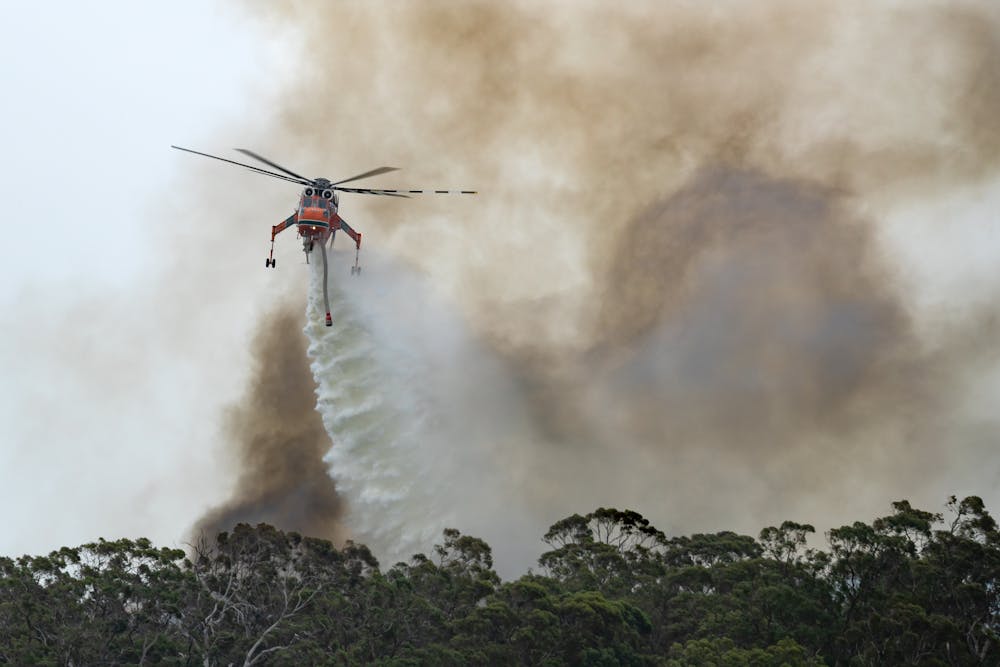
Helicopter dumping water over bushfires
The majority of Australians (57%) experienced some form of direct impact from last summer’s bushfires or smoke. Shutterstock

82% of Aussies worry about climate-driven bushfires

The Climate of the Nation report has tracked Australian attitudes to climate change for more than a decade.

This year, it polled 1,998 Australians aged 18 and over, and found the vast majority (79%) hold views in line with the best available scientific evidence. That is, four in five Australians agree climate change is occurring. This is the highest result since 2012.

An even greater majority, 82%, is worried climate change will result in more bushfires, up from 76% in last year’s report. This is perhaps unsurprising, given the record-breaking fires of last summer and the threat of longer and more ferocious fire seasons.

The bushfire royal commission is due to release its report today, and will likely highlight climate change as an amplifier of bushfire risk. This was foreshadowed in the commission’s  interim observations in August.

The report also showed Australians believe the post-pandemic economic recovery is not a time to further entrench fossil fuels. Only 12% of Australians want to see Australia’s economic recovery led by investment in gas, a plan the Morrison government is set on carrying out.

In contrast, a majority (59%) would like to see the recovery driven by renewables.

Australia: an international laggard

The level of scientific consensus on climate change is remarkable. Urgent action on climate change is recommended by scientists and desired by the overwhelming majority of the public. Yet, Australia remains an international laggard in this area.

The Climate Change Performance Index evaluates 57 countries plus the European Union, which together are responsible for more than 90% of global emissions. This year, Australia ranked last on climate policy.

The reasons include Australia’s absence from the UN Climate Action Summit in 2019, and withdrawal of contributions to  international climate funding programs.
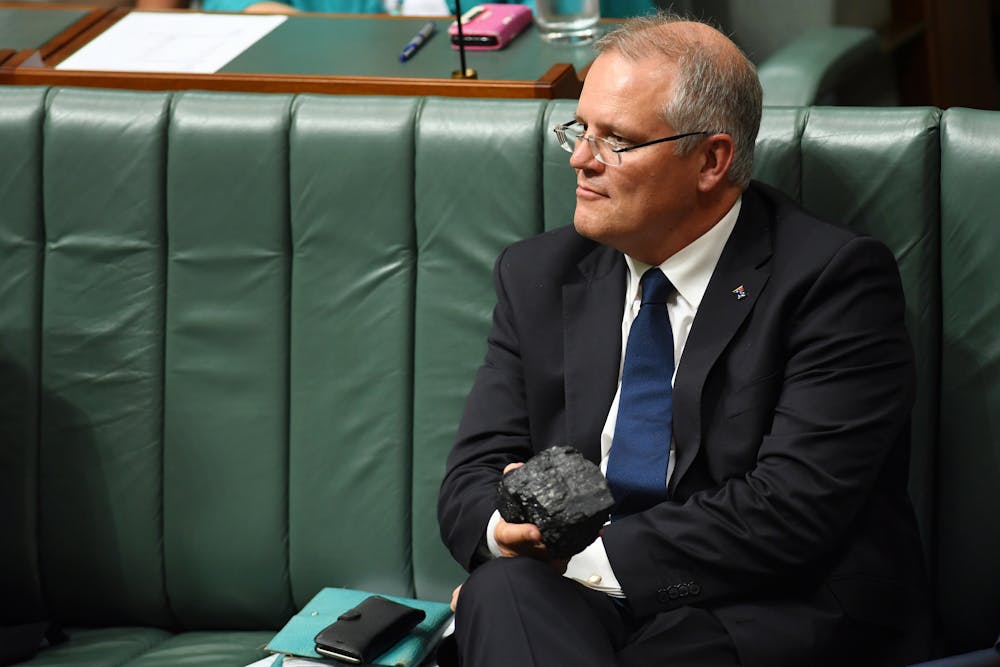
Scott Morrison holds a lump of coal
Australia’s inaction on climate change has made the country an international laggard. AAP Image/Lukas Coch

For many years, denial, delay and division over climate change was the norm in Australian politics. This is still the case among some media and political elites, and is no more pronounced than in debates over the future of coal in the domestic energy mix and for export.

Our energy sources play a big role in our overall contribution to climate change, with electricity generation contributing  32.7% of Australia’s emissions.

For everyday Australians, the solution is clear. The Climate of the Nation report shows the vast majority (83%) want to see coal-fired power stations phased out. Some 65% want the Australian government to stop new coal mines from being developed.

Toxic politics limit constructive conversations

For many, particularly those living in Australia’s coal production regions, the prospect of shifting from coal to renewables raises legitimate concerns about their futures.

However, the ability for people and policy to engage constructively with concerns over jobs and climate is limited by toxic politics.

An important culprit is the pervasive “us versus them”  narrative that dominates political and media discourse. The narrative repeatedly – but erroneously – signals to people in coal production regions that the rest of the country doesn’t care about them.

Coal production is also pitted against climate action in the “climate versus jobs” debate. But the polling shows such binaries are false: most Australians do care what happens in coal production regions. In fact, three-quarters of Australians want governments to plans and manage an orderly shift from coal to renewables.

The Australian people, by a large majority, care for those living in coal production communities and want to secure a safe climate.

68% of Aussies support an ambitious climate target

Australians recognise our country can make a disproportionately large and positive contribution to international efforts to mitigate climate change.
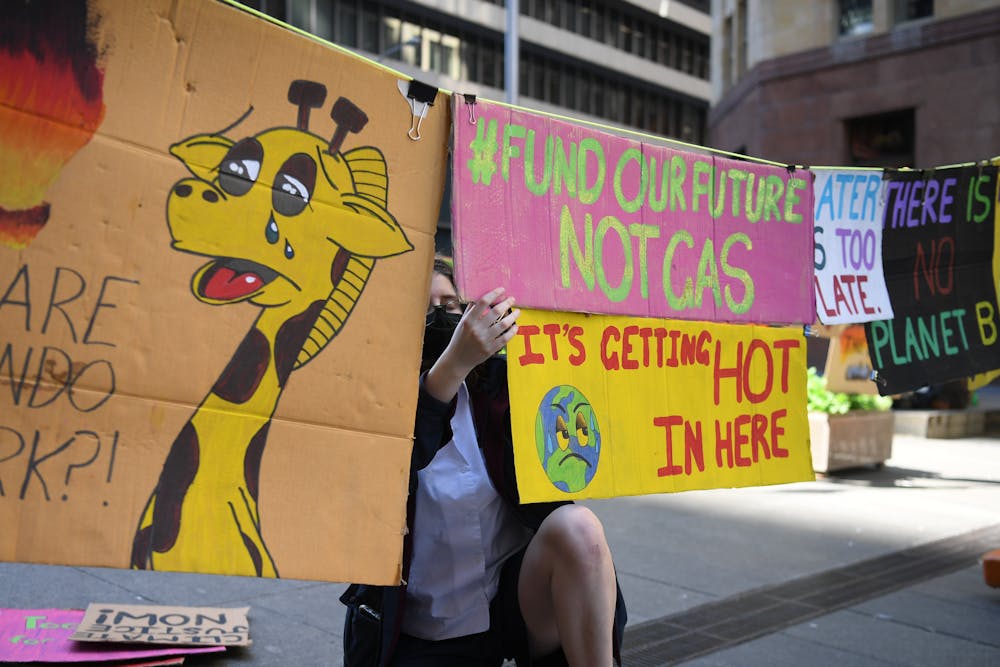
Students at a rally holding a sign against gas.
Most Australians want to see a renewables-led economic recovery from COVID-19. AAP Image/Dean Lewins

Seventy-one per cent want Australia to be a global leader in finding solutions to climate change, while 77% recognise tackling climate change can create opportunities for new jobs and investment in clean energy.

While all Australian states and territories have committed to net-zero emissions by 2050 or sooner, the federal government has not. But, once again, a majority of people would like to see otherwise: 68% support a net-zero by 2050 target for Australia. This is four percentage points higher than last year.

If we don’t implement meaningful and ambitious climate policy, Australia risks becoming even more of a climate outlier in the  international community than we already are.

The Climate of the Nation results clearly shows this goes against the will of the Australian people. Australia has a voting base that will support and reward ambitious climate action. Now is the time for political leaders to reflect this in the nation’s climate policy.

Sunday, September 6, 2020

Why do we still have climate crisis denial?

by Nick Huisman, European Wilderness Society: https://wilderness-society.org/why-do-we-still-have-climate-crisis-denial/

Image: European Wilderness Society

If there is one thing that we recognised from the COVID-19 pandemic, it is the unwillingness of people to accept reality. Several months into the situation, there are still large groups of people who live in denial that the virus is a threat to our health and lives. The denial is visible on the streets, as people refuse to wear masks when told to do so, or large groups of people gather for anti-corona demonstrations. How come that these people cannot accept reality? And what can we learn from this in a far more important crisis that is unfolding while we look the other way?

Handling your own truth with denial and rationalism

CNN recently published an article on the psychological reasoning of people in Covid-19 denial. An interview with two psychologists addresses the issue of denial, and why people develop such a viewpoint. As the psychologists state, denial is a way for people to deal with constructs of reality. It is simply a defence mechanism of our mind to avoid anxiety. In uncertain periods, people perceive anxiety and pressure. In order to reduce that, the body develops a way to feel more secure and safe. One of these ways is by simply denying the existence of the threat. This leads to statements such as: “…this pandemic is a hoax.” Others accept that the threat exists, but convince themselves that the severity of the threat can be neglected. This form of rationalisation can lead to statements like: “…the corona virus is just another flu.”

A crisis beyond our understanding

This form of denial is also recognisable when we talk about a crisis much worse than corona, the climate crisis. The current trends of climate change are clearly indicating that the earth’s temperature is rising. In itself not a bad thing, some might say. Rationalised arguments could be that it’s warmer in summer indeed, but also colder in winter in other places. Yet, the fact that our overheating climate results in these extreme weather conditions is not accepted as reality by some. And the situation is not becoming easier, when conflicting research is showing opposite results. Its is therefore very understandable that people cannot begin to image the impact climate change will have on our future, let alone our daily lives. But by simply denying or rationalising climate change, we create a dangerous situation for ourselves.

How can we turn the tides?

A question with a double meaning, as our sea levels continue to rise. As the psychologists explain to CNN, it is important to provide people in denial fact-based information that contradict their viewpoint. Bit by bit, starting with information that is not immediately threatening people. Important is to also provide information on what to do about it. This will help the people to learn about the reality and to accept it.

The young generation is asking more questions than ever before, and information is available when one looks. It has become cool to want to know where our clothes are made, where our food comes from, and potentially who or what has been damaged in the development process. Because of the complicated state of affairs, we’re simply forced to ask questions.

Another thing that will help in this process is optimism. We often have a tendency to present climate change as an inevitable, dark future that lies ahead of us, which we cannot escape. If we manage to rephrase this into positive messages  that encourage people to take action to mitigate climate change, it will become much easier to overcome the climate crisis denial phase. So let us share the positive news and help others to understand the need to act against climate change. Let us have a thirst for knowledge, and an interest to understand the world as it truly is. This is the only way to bring positive change for the sake of us and all the future generations.

Sunday, August 2, 2020

Climate denial hasn’t gone away – here’s how to spot arguments for delaying climate action

Stop me if you’ve heard this one before.
The UK and many other rich countries have set ambitious targets for emissions cuts to tackle climate change, and have already made much headway in recent years. Further progress can be achieved while making sure that fossil fuels are used responsibly, and with promising new technology such as aircraft powered by batteries.
The UK should not do more though, while countries like China and the US continue to emit far more than we do. It’s hard to see why hard-working families should be denied simple pleasures either, like flying on foreign holidays.
In fact, why should we limit emissions at all, since the worst of climate change is already looking inevitable?
If these sorts of claims sound familiar – reasonable even – that’s because they are some of the most common ways of arguing for less ambition on tackling the climate crisis. Outright denial of climate change is becoming rarer, but is simply being replaced by more subtle ways of downplaying the need for urgent and far-reaching action.
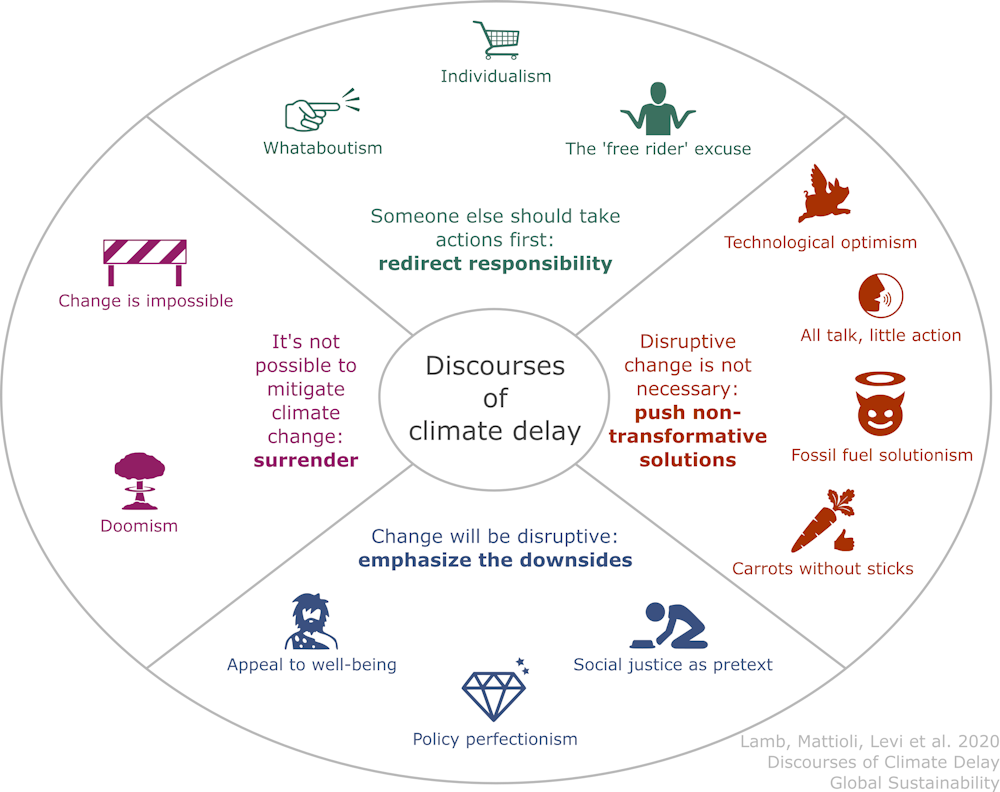
In new research, we have identified what we call 12 “discourses of delay”. These are ways of speaking and writing about climate change that are commonly used by politicians, media commentators and industry spokespeople. Though they shy away from denying the reality of climate change, their effect on the collective effort to respond to it is no less corrosive.
A graphic depicting the 12 different types of 'delay' arguments, grouped into four categories.
Delay arguments are often different in type, but have the same desired effect – to undermine action on climate change. William Lamb, Author provided

Delay is the new denial

Some of these arguments direct responsibility to others (“what about China?”) or stress the supposed downsides of taking action (“why should ordinary people pay?”). At other times, past achievements or future plans may be emphasised when pushing solutions that aren’t likely to make a dent in greenhouse gas emissions (“we have world-beating climate targets”), or it may simply be argued that it is now too late to do anything anyway (“the climate apocalypse is coming”).
When people make appeals to delay or limit action on climate change, it is often couched in the language of optimism and progress. Take the remarks on aviation by UK health minister Matt Hancock in January 2020. He said that there is no need to reduce how much we fly because electric planes are on the horizon (disclaimer: they aren’t). On the other hand, tackling climate change can just as easily be undermined by a sense of futility or hopelessness in the potential for meaningful action.
It’s important to appreciate that many of these arguments contain at least a grain of truth – and may be used by people in good faith. After all, who hasn’t wondered at some point whether cycling to work instead of driving has much bearing on a vast global problem?
Likewise, it’s not fair to expect those who have contributed the least to climate change to be held back from attaining a decent standard of living. Nor is it reasonable to expect someone in rented housing to pay to upgrade a poorly insulated property in the UK. Genuine concerns about the wider impacts of climate policies become delay arguments only when they are used to downplay the scale of the problems we face, or to obscure the need for immediate and radical cuts to greenhouse gas emissions.

How to respond

By defining the most common delay arguments, we can better understand the obstacles being placed in the path of tackling the climate crisis. They are part of a wider range of  stories used to describe climate change that act as important influences on public opinion. They can make the difference between engendering a resolve to act and spreading disgruntled resignation.
A clearer understanding of these arguments also forces us to engage with and find better responses to them. For instance, it’s convenient to view action on climate change as a situation where one country determined to continue polluting can take advantage of the goodwill of others who reduce their emissions. The argument that if I take action it will be exploited by someone else unwilling to do the same (which we call the “free rider” excuse) has been used by the US president, Donald Trump, to pit developing countries against the US on emissions reductions, and to press the case for  withdrawal from the Paris Accord.
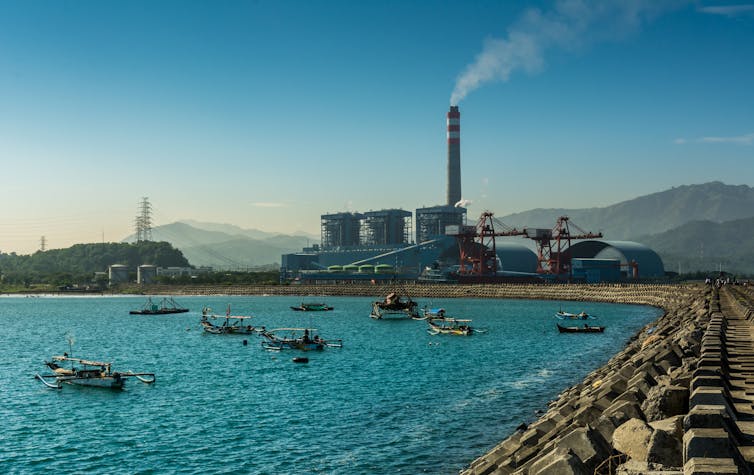
A coastal coal fired power station in Indonesia surrounded by small boats in the bay.
All nations bear responsibilities for eliminating greenhouse gas emissions – some greater than others. Ares Jonekson/Shutterstock
It is also an argument used to dispute the value of action at the individual level. An emphasis instead on emissions reduction as something for which we all have shared responsibility and obligations – as citizens, communities and countries – is one response to this type of claim. Another is to highlight the opportunities for fairer and better societies  that can flourish with the right sort of climate action.
Now that the human hand in climate change is recognised by most people, debate should concern where we are headed as societies, how fundamental are the changes that we need to make, how to compel the vested interests of fossil-fuelled industries to make those changes (whether they want to or not), and how to wrestle with the worrying signs of a changing climate without abandoning our resolve to prevent it worsening. Discourses of delay risk obscuring this essential conversation. We must learn to recognise and answer them with confidence.