Wednesday, August 12, 2020

We know how to fix student debt: The U.S. government spends more on higher education than many countries where students graduate with far less debt. Is there a better way?

by David Byrne, Reasons to be Cheerful:  https://reasonstobecheerful.world/we-know-how-to-fix-student-debt/

In 2019, researchers from Harvard Business School, Indiana University and Georgia State University took advantage of a fortuitous court ruling to find out what happens when you get rid of student debt. A judge had ruled that National Collegiate, a company that bought up student debt and treated it as an asset, actually didn’t have a valid claim to much of that debt. So the debt was cancelled. How much? 800,000 individual loans amounting to $12 billion. A lot of students and their parents were very happy.

The researchers realized this was a golden opportunity. By tracking other graduates who lived in the same zip codes with similar amounts of debt as the lucky 800,000, they could  compare the outcomes of the still-indebted control group with the suddenly debt-free students. Before this ruling, comparing students with debt to those without had always been complicated. Now it was easy.

What they found was that students whose debt was erased ended up with incomes that were 12.5 percent higher than their indebted peers in the years following graduation. Why? Not just because they had more immediate cash on hand — that difference was taken into account. The extra income often derived from changes in their behavior. The debt-free graduates could take more career risks. They were more mobile, able to move to where the higher paying jobs were. They could also pay off other debts — credit cards, car loans, mortgages — which improved their credit ratings and prevented defaults.

Removing college debt, the researchers found, improved these students’ financial outcomes in all sorts of unexpected ways. More of them got married and had kids, for example. Their improved circumstances benefit the entire economy.

blackboard
Credit: Oliver Knill

The debt problem

Some 44.7 million American adults are saddled with student debt totaling $1.6 trillion. That’s more than all U.S. credit card debt combined. This didn’t happen overnight. In the 1980s, the government began to replace student grants (which are essentially gifts) with loans, shifting the financial costs of higher education to students and their parents. Meanwhile, state governments cut the budgets of state colleges. The cost of higher education in the U.S. has surged more than 500 percent since 1985. A $10,000 education 35 years ago would cost over $50,000 today. The costs are rising faster than inflation, which makes for a dicey investment.

Student debt has quadrupled in the last 15 years, leading many high school graduates to wonder if an investment in higher education is still worthwhile. For the most part, it is. With a college education, you stand to make 84 percent more money  than someone with just a high school diploma. In the U.S., this gap between earnings for college grads and high school grads keeps growing, mostly because wages for high school grads are declining, and wages for college grads, even if they haven’t skyrocketed, continue to rise. 

Still, as we saw, all that student debt can hold folks back well beyond college. It’s a drag on the entire economy. Eliminating it is a worthy goal, which is why there have been proposals to cancel student debt. But simply canceling it doesn’t deal with the root of the problem: the high cost of college in the U.S. Until we deal with that, the next crop of students will simply rack up huge debts all over again.

Can this be fixed? Yes, it can. If we look at other countries, many have solved the problem of crazy-expensive higher education, and by extension, the student debt problem. 

blackboard
Credit: Oliver Knill

Free and cheap tuition is good, but that is only part of the solution

College tends to be very affordable in Europe. Top universities are tuition-free in Finland, Norway, Denmark, Iceland, Ireland, Czech Republic, Greece and Scotland. Sweden now charges a nominal fee of E500 for undergraduates. Germany charges for graduate programs, but undergraduate education is free. Austria and France are almost free for EU citizens — they charge a few hundred Euros. 

It’s not just European universities. Mexico and Brazil have extremely cheap higher education options. Argentina is tuition-free, as is Kenya, Morocco, Egypt, Uruguay and Turkey.
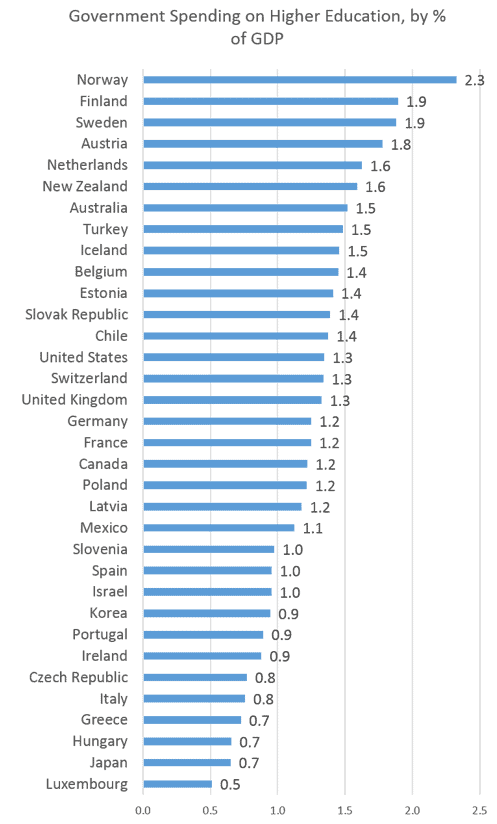
education spending
Credit: Mises Institute

A typical American response to this might be, “Oh, those countries simply have high taxes, so that’s how they subsidize colleges.” But it’s not as simple as that. The U.S. is 73rd in the world in spending on higher education as a percentage of GDP —  below Sweden, New Zealand and Norway, but ABOVE Germany, France and Canada, all of which have college options that are far more affordable. So it’s not a simple matter of tax more, spend more, problem solved. 

In many cases it’s not just the tuition that is the burden, but the cost of housing and eating for four years. Some places have come up with creative approaches.

blackboard
Credit: Oliver Knill

New Zealand

In New Zealand, the first year of college is free, but tuition can be as high as NZ 10,000 ($6,600 USD) a year after that. So, not exactly free at all. However, government student loans are interest-free, and students don’t have to begin paying them back until their post-graduation income rises higher than NZ 20,000 ($13,300 USD). The loans are also interest-free for as long as you stay in New Zealand. This system has allowed a lot more kids to go to college — three years after these loans were introduced in 1992, university enrollment went up 49 percent. 

New Zealand also offers a Student Allowance — basically, grants to cover the cost of living expenses. Whether or not you have to pay these back depends on your parents’ income, your age and whether you are married or have a child.

Norway

Similarly, in Norway tuition is completely free, but the cost of living is high. This is a problem in the U.S., too. Part of what makes American colleges so expensive are all the extras that come with it — the dorms, the food halls, the football stadiums, the fundraising departments. And because American students often don’t live at home, add-ons like housing, food and transportation can be as expensive as tuition. 

Norway solves this problem by making state loans available that can be used by students to cover living expenses. These loans are interest-free until graduation, and some students can convert up to 40 percent of them into grants that don’t have to be paid back.

Denmark

In Denmark, tuition is free, and the cost of living is not as high, but even so there are grants to cover expenses depending on parental income. I’m seeing a pattern here.

South Korea

In South Korea, tuition is about one-third as high as in the U.S., which is still much higher than a lot of other countries. But some 18 percent of these costs are covered by private companies and foundations. I’m not sure how one prevents undue influence from corporations on the syllabus, but one hopes that the companies realize that even without influence an increase in graduates benefits them all.

Germany

The German system is unique. Early in life, kids are placed into one of three tracks: college preparatory, vocational training, or something in between. This means a lower percentage of folks go to university than in similar countries — even though it’s tuition free! This early-stage sorting means that those who do go to college tend to get masters or doctorates, while those on the vocational track get training and go into the job market. One has to make this choice early on — in high school or even earlier — which, for some of us, seems a bit young to commit to one’s life path. It’s not impossible to jump over to the university track later, but not many do.

Like in other countries, to cover the costs there are government interest-free loans for which repayment depends on post-graduation income. This model — repayment based on later income — seems to be a common and successful means of greatly reducing the burden of student debt.

Higher education as a public good?

The countries mentioned above don’t completely subsidize every higher education cost, but they have eased the burden by lowering or eliminating tuition and making loan paybacks flexible. These policies have proven successful and have lessened the crippling effects of student debt. We can learn from their examples. 

We accept lots of things as public goods and happily pay for them: drinking water, fire and police departments, sewage and garbage disposal, roads and bridges. I pay for roads even though I don’t own a car because, well, that’s how my groceries get to the local store. And folks would go nuts if the fire department only served those who paid for the service, though that is actually the case in some communities.

In many countries, higher education is viewed this way, too — as a public good, a basic right (in the U.S., that concept is wholeheartedly embraced up through high school, so the idea of education as a right does exist — it just stops short of college). It would be unthinkable to defund grade schools and high schools (though austerity budget cuts amount to the same thing). The question is, do we accept the idea that, in the contemporary world, college might be essential as well? The bar has been raised. Education fosters resilience, which, as recent events have shown, is something the U.S. needs more than ever. 

Sunday, August 9, 2020

How Rights of Nature victories in Colombia’s rainforests can inform shared knowledge systems globally

by Daniel Henryk Rasolt, Shareable:  https://www.shareable.net/how-rights-of-nature-victories-in-colombias-rainforests-can-inform-shared-knowledge-systems-globally/

Wounaan Indigenous community of Union Balsalito along the San Juan River in Colombia’s Choco. Photo by D.H. Rasolt

Rights of Nature is a movement that has been fortifying itself around the world as an antithesis to the dominant paradigm of limitless growth and extractivism. Firmly grounded in holistic Indigenous worldviews, this ecocentric paradigm could be a global game changer if a coordinated and adaptable effort — based on shared knowledge systems and accountability — is established.

Colombia, with its biological, cultural and hydrological richness, has become a trailblazer in legally formalizing Rights of Nature, beginning with the 2017 Judgement of the Atrato River, but to what end? Who will defend these rights against powerful legal and illegal natural resource exploiting interests in such a conflicted country, and how can these formal voices for nature be strengthened by tools of modern science and technology, as opposed to repressed by them? 


Colombia’s Choco: Illegal gold mining, conflict and a river with rights

The Choco Rainforest along Colombia’s Pacific Coast pulsates with life. Thousands of endemic species call this dense forest  home, while expansive rivers empty out into the ocean through extensive deltas and mangrove forests. Afro-Colombian and Indigenous communities live side-by-side — or, more frequently, face-to-face — along the rivers of the Choco.

The isolated rivers and forests of the Choco have also been hotspots of conflict, illicit activity and state neglect, facilitated by their strategic access to the coast. Illegal gold mining in particular — along with drug, arms, timber and wildlife trafficking — has run the illegal economy and fueled conflict in the Choco for decades, making its Rivers of Blood the harsh, semi-literal inverse of the Indigenous interpretation of rivers as Mother Earth’s lifeblood. 

While artisanal mining for alluvial gold was — and remains — a relatively low-impact livelihood for the Choco’s many descendents of African slaves, semi-industrial mechanized mining has deforested, degraded and contaminated the rivers and riverine habitats of the Choco for the past 20-30 years. Both the open-pit mines and dredges along the rivers have used mercury in copious quantities, poisoning the drinking water and fish species. The ecological and health crisis is devastating Afro-Colombian and traditional Indigenous riverine communities. 

The Embera Dobidá — which literally means people of the river — live along the 416 mile, south-to-north flowing Atrato River and its tributaries, and have been actively protesting the exploitation of the Atrato and its surroundings for decades.

Embera Dobidá leader Belarmino Tunay told me in December 2019, “For us, the people of the river, the Atrato is everything. It is the origin, the provider of life and the extension of Karagabí [a holistic conception of a cosmic world and creator] … The Atrato speaks to us, and it is suffering. The damage being done affects our health and threatens to destroy our culture.” Studies have shown dangerously high levels of mercury in the water, in fish species and in the people living along the banks of the Atrato, including members of the Embera Dobidá.

How Rights of Nature victories in Colombia’s Choco and Amazon rainforests can inform shared knowledge systems globally
Illegal gold mine in Colombia’s Choco Rainforest. Photo by D.H. Rasolt

South of the Atrato River Basin lives the Wounaan Indigenous ethnic group, principally concentrated along the San Juan River within the Choco. 

The San Juan has its source along the Andean slopes then flows west-southwest-west before draining 240 miles downstream into an impressive delta full of rich mangrove forests that depend on nutrient-rich sediments  accumulated throughout the San Juan’s journey. Many fish species spawn within these mangrove forests, and just off the coast are  breeding grounds for humpback whales, whose dances and songs inspire awe above and below the surface. It is a beautiful area at the confluence of different ecosystems, where Indigenous communities lived in harmony with this diverse ecological milieu for millennia.

The Wounaan — sometimes referred to as Embera Wounaan — are closely related to the Embera Dobidá (as well as other Embera such as the Chamí and Katío), in genealogy, linguistics and many traditions, though they subscribe to a number of distinct beliefs and practices specific to their biogeography. The Wounaan base their worldview around a “Supreme Father” known as Inwadam, who created all living beings in, along, and including the San Juan River, the less voluminous but ecologically unique Baudó River, and the limitless Pacific Ocean that they flow into. 

Respected Wounaan teacher and werregue artisan Yenny Cardenas spoke to me in her community of Union Balsalito on the northern bank of the lower San Juan River. “The river provides us with our livelihoods and our food, but more importantly it allows us to preserve what our ancestors have taught us about Inwadam and to practice our traditional crafts and medicine,” she said. “We live in constant fear though, knowing that someday soon we may be forced to leave our homes on the river permanently.” 

Tragically, the last few decades have brought strife and degradation to the idyllic river and riverine communities of the San Juan River Basin. And like the Atrato River, the San Juan River is believed to be contaminated with mercury from illegal gold mining upstream.

How Rights of Nature victories in Colombia’s Choco and Amazon rainforests can inform shared knowledge systems globally
“Weaving Tradition” – Vannessa Circe – Oil on Canvas – 24” x 30”

Within this complex socio-economic and environmental context, Colombia’s Constitutional Court gained international notoriety in 2017 for granting legal biocultural rights of “personhood” the degraded Atrato River. Local “guardians”  —  including members of Embera Dobidá and Afro-Colombian communities — are now responsible for being the legal voice of the river, in order to ensure its conservation, restoration and dynamic evolution.

Beyond symbolic legal victories

How can we turn this potentially revolutionary ecocentric framework of Rights of Nature from eloquent legalese, symbolic victories and often misunderstood traditional Indigenous worldviews, into pragmatic action in high-risk areas dominated by extensions of the modern world, such as rivers and riverine communities impacted by illegal gold mining and conflict?

To begin with, ways must be found to ensure the health and security of those individuals and local communities who speak in defense of rivers, forests, coral reefs, individual animal species and other designated legal persons within the Rights of Nature paradigm. Eliminating the existential threats to the Embera Dobidá and Wounaan, for example, is essential to protecting and restoring the diverse ecosystems of the Choco. 

To bolster formalized legal Rights of Nature in general and enforce accountability, culturally appropriate tools for monitoring, communicating and incontrovertibly documenting violations of nature’s rights are also needed. For off-grid communities, integrated solutions for connectivity and access to energy sources are also important, to coordinate monitoring efforts between themselves, and to share and receive vital information in real-time with the outside world.

Adaptable complex frameworks, such as the Multiple Evidence Base (MEB) approach and Mixed-method bicultural research, can help guide the formation and evolution of resilient, shared-knowledge initiatives around the world. “Using water as a central point of multidisciplinary, intercultural and educational collaboration, we can develop new ways of understanding our surroundings and place within them,” says professor Rafael Hurtado, a physicist from Colombia’s National University. Professor Hurtado leads REMONA, a community-based water quality monitoring network built around principles of complex systems science, that has recently been introduced to several isolated Indigenous communities in Colombia.

How Rights of Nature victories in Colombia’s Choco and Amazon rainforests can inform shared knowledge systems globally
A young Arhuaco man analyzes a sample of water from a sacred river within his territory in the Sierra Nevada de Santa Marta. Photo by V. Circe.

These kinds of multidisciplinary and intercultural shared knowledge approaches between integrated science and traditional knowledge can produce mutual understanding and evidence considered concrete within modern judicial structures; they may, in fact, form the foundational structure for upholding the rights of rivers and other dynamic ecosystems to “exist, thrive and evolve.”

Progress in Colombia since the Judgement of the Atrato River

The Judgement of the Atrato River set a strong precedent for Rights of Nature in Colombia, and along with some celebrated rulings granting personhood to sacred rivers in New Zealand  and India, for further Rights of Nature advancements around the world. 

Between 2018-2020 there have been a number of local court rulings in Colombia, mostly at the municipal level, that have given nominal legal rights to some of Colombia’s rivers: the Cauca River, La Plata River and Pance River, for example. Rivers connect diverse ecosystems, and damage in one or multiple sections of a river can have cumulative impacts downstream, so — in reality — coordinated international, national or at least regional efforts are needed to effectively enforce Rights of Nature for rivers. 

The big post-Atrato victory for the Rights of Nature movement in Colombia, and potentially for our highly stressed living planet, was a 2018 ruling by the Colombian Supreme Court  granting legal rights to the entire Colombian Amazon region. The proclamation builds off of the Judgement of the Atrato River, and is a rather beautifully crafted and comprehensive  document. How Rights of Nature for the Colombian Amazon will formally and effectively be implemented remains to be seen, as deforestation, land grabbing and illegal gold mining  have rapidly expanded throughout the entire Amazon region, including in several parts of the post-conflict Colombian Amazon. Illegal actors have also become further emboldened by the uncertainty surrounding the COVID-19 pandemic and  rising global gold prices. 

An integrated, multidisciplinary and intercultural evidence-based system is needed to support the newly designated legal voices of Colombia’s rich ecosystems. A successful framework for enforcing Rights of Nature for the Choco and the Colombian Amazon could lay the groundwork for coordinated, interconnected efforts for the entire Amazon, and other  bioculturally rich areas globally.