Monday, January 13, 2020

How Lebanese Environmentalists Helped Spark Revolution: Activists Work to Chart a Greener Path for Lebanon

By Alexandra Talty, Sierra:  https://www.sierraclub.org/sierra/how-lebanese-environmentalists-helped-spark-revolution

A BEACH IN KESEWAN, NORTH OF BEIRUT, LEBANON, WHERE HEAVY WINDS AND STRONG WAVES WASHED PILES OF GARBAGE ASHORE. | PHOTO BY MARWAN NAAMANI/PICTURE-ALLIANCE/DPA/AP IMAGES
Five Gen-Zers crouched around a small pile of trash in the center of Martyr’s Square in downtown Beirut in the early November sun. Wearing white gloves, they sorted bottle caps, cigarette butts, hookah mouthpieces, ticker tape, and plastic food packaging: all detritus from the previous day’s protests.

Though the five were students, they hadn’t been in class for 26 days. Some of their teachers were getting upset, but the activists considered cleaning up after the protests that had been roiling the country since mid-October more important than studying. 

They wanted to show the country how to take care of itself, said Paul Hanna, 17, pausing her sorting. “Without recycling, most of the trash goes into the sea.”

“We don’t want to see trash in the street,” said Mira Raheb, also 17. “If we clean here, it will change [the mentality].”

Like youth activists around the world, Lebanese environmentalists are objecting to the status quo, which in Lebanon means protesting against rampant government corruption, a faltering economy, and a long list of environmental problems that dominate daily life. Hoping to capitalize on the current unrest, they are also working to set the country on a greener path.

Since the Civil War ended in the 1990s, Lebanon has been unable to consistently provide 24/7 electricity, a functioning public transit network, proper waste management, or drinking water for its citizens. The lack of basic services impacts poor and working-class families especially hard, and the environment also suffers, with people turning to diesel-powered generators and relying on plastic water bottles.

This past October, a wildfire erupted in a forested area south of Beirut and quickly got out of control, burning more than 3,000 acres. Hot, windy conditions played a role, but so did government incompetence (three privately donated firefighting helicopters sat in disrepair at a nearby airport). 

Five days later, over 1 million Lebanese were in the streets demanding that the members of the government step down. By the end of October, Prime Minister Saad Hariri had resigned.

“The forest fires were a major precursor to the revolution,” said Adib Dada, 36. An environmental architect and biomimicry specialist, Dada has led a guerilla gardening project as part of the protests, planting 30 native trees and shrubs in downtown Beirut with a group called Regenerate Lebanon. 

The NGO has been fundamental in galvanizing the public around collective green solutions for the country’s environmental problems. “It is about continuous actions, really protesting the change we need to see,” said Joslin Kehdy, the group’s founder.

As the protest centralized around Martyr’s Square this past fall, Regenerate Lebanon set up an encampment there. It includes a kitchen that serves around 250 locally sourced meals daily without using any plastic (organizers rely instead on stainless steel kitchenware or the briq, a traditional Lebanese water jug). It has a maker space that boasts a living wall as well as a library and an area to collect donations like clothes and foodstuffs. Citizens can stop by a "cafe," where there is potable filtered water and solar-powered recharging stations. Kehdy sees the encampment as a micro-model that is already being replicated in some villages.

One of the biggest environmental issues that has brought Lebanese from all religious sects together to protest is the garbage that for years has been piling up on the streets and beaches.

Since 2015, the country has spent at least $430 million on landfill contracts that went to business associates of politicians in power. According to reports, landfill operators have not been recycling despite mandates to do so and have been dumping trash and toxic waste directly into the Mediterranean. 

“People are demanding a right to live in a country that manages its waste in a sustainable way,” said Julien Jreissati, campaigner at Greenpeace Middle East and North Africa. Pointing out that there are both political and environmental slogans at the protests, Jreissati believes that the waste problem could easily be solved if the government created a proper strategy. As of now, Greenpeace Middle East and North Africa estimates that only 10 percent of trash in Lebanon is recycled.

An environmental organization known as the Green Tent, which coordinated the Gen-Zers' trash sorting in downtown Beirut, was established largely in response to this crisis. When a group of friends saw the mountain of trash left behind by the protests, they began cleaning it up. 

“We decided to take this initiative to act physically instead of shouting and swearing,” said Karmal Charafeddine, 34. “It’s paying back our civil duties.”

After a night of protests, whoever was available would meet at 8:00 A.M. to begin collecting and sorting. Volunteers started showing up, and the Green Tent began coordinating with other environmental groups like Regenerate Lebanon to come up with creative solutions for reusing waste—for example, collecting glass and donating it to traditional blowers to make new glassware. Over half a million cigarette butts were handed to local shaper Paul Abbas, who is turning them into surfboard mats.

As protests have become more decentralized, the Green Tent has “decided to go mobile,” said Charafeddine. The group is no longer doing cleanups in Martyr’s Square, but has organized two outside of Beirut and is in the process of planning a country-wide cleanup. 

Now nearing the end of December, the unrest in Lebanon shows no signs of stopping, but one thing is certain: The Lebanese refuse to go back to the status quo.

“I used to think the problem was so big—waste, the water crisis,” said Joanne Hayek, a member of Regenerate Lebanon. “For me, the biggest change is that we realized in fact we all had the same dream of a clean Lebanon. That has aligned us.”

AUTHOR

A New York native, Alexandra Talty is an award-winning journalist based in Lebanon. Covering social and political topics in the region, she writes for Playboy, Outside, Forbes, and The National. She was the founding Editor-in-Chief of StepFeed in the Middle East and in 2019 was named a National Press Foundation fellow.

Climate Change: COP26 Glasgow will Provide World Stage for Scotland's Green Innovation

by Christopher J White, University of Strathclyde; Francesco Sindico, University of Strathclyde, and Keith Bell, University of Strathclyde

Every year since 1994, the UN has gathered together the world’s governments at its Framework Convention on Climate Change (UNFCCC) conference of the parties (COP), held in a different country each time. The convention’s ultimate aim is to prevent “dangerous” human interference with the climate system. The onus is on developed countries to lead the way and the convention directs funds to developing countries to help them in their efforts.

COP25, held in Madrid at the beginning of December 2019, did not end well. Swedish youth activist Greta Thunberg’s solemn speech gave short shrift to countries neglecting their responsibilities, and the likes of the US President, Donald Trump, and Brazil’s President, Jair Bolsonaro, responded with personal attacks.

Tensions ran high when climate justice activists were barred from entering the venue and talks stalled, and negotiations ending two days late with a compromise deal on cutting global carbon emissions. Given the raised status of the world’s climate emergency, it was a disappointing end to a conference for which many had high hopes.

In the cold light of a new year, everyone from activists to world leaders are reflecting on COP25’s ultimate failure to set down rules on creating a carbon market between countries. But already, behind the scenes, the UK is looking to the next summit – because this year COP26 will be pitching its tent in Glasgow.

More than 30,000 people are expected to descend on the city in November 2020. For those who live and work in Glasgow it will be a chance to experience being part of an important climate action event. People from around the country will be able to participate in hundreds of events that will be happening across the city. So why will COP26 be such a big occasion for Glasgow, and what will the city itself bring to the mix?


Why hosting COP26 is a big deal

The world’s governments have met every year for nearly three decades to (try to) agree how to stop – or at least reduce the impacts of – climate change. But the fact that these nations have not been able to meet the overall UNFCCC objectives is one of the reasons we now face a global climate emergency.

As world summits go, they don’t get much more important than the UN’s climate change convention. In those three decades, this will be the first time a COP summit has been held in the UK. From a policy perspective, COP26 will be important for at least four reasons:

1. It will take place in the year when all countries are asked to submit their new long-term goals – so ambition to address the global climate emergency will be high on the agenda.
2. It will have to finish the work that COP25 was unable able to conclude – setting out the rules for a carbon market between countries.
3. From Glasgow onwards, the implementation of the 2015 Paris Agreement will be the key driver of international climate action.
4. COP26 will come just weeks after the US presidential election with the potential implications this will have for US climate policy and US participation in COP26.
Come November 2020, the eyes of the world will be firmly on Glasgow.

Glasgow on show

The Scots have always been keen innovators.

Scotland has a long and rich history of discovery and innovation, including Glasgow’s past as a world-class centre of shipbuilding, trade and industrial production – a legacy that has contributed to greenhouse gas emissions but has also added much to the quality of human life. From pioneering work on the steam engine and wind turbines, to the invention of television and the life-saving discoveries of penicillin, gin and tonic and Billy Connolly’s shipyard humour, Glasgow has helped shape the modern world.

Glasgow and its history can also shed light on how cities, societies and people can reinvent themselves from a former industrial workhorse to a city of culture, services and new green technologies. Scotland’s collective commitment to net-zero emissions of all greenhouse gases by 2045 now puts the country at the forefront of real action on the climate emergency. During COP26, Glasgow’s research and innovation will be on show to the world.

Engineers are leading the development of renewable technologies such as tidal energy and floating offshore wind turbines. Scotland is at the forefront of establishing hydrogen as a viable energy source, providing hubs for related skills and knowledge-sharing, to ensure that new technologies can be integrated into the grid and controlled.

Scotland also leads the way not only on the science innovation, but on ways in which research and development can provide community-informed solutions to sea and climate change challenges, and on how climate change relates to Scotland’s coastline and islands.

Researchers in Scotland are also at the forefront of the science-policy-practice interface, working with people in the field to deliver climate change risk and adaptation policies. And with climate change already a reality, Glasgow is also producing science that helps communities become more prepared and resilient.

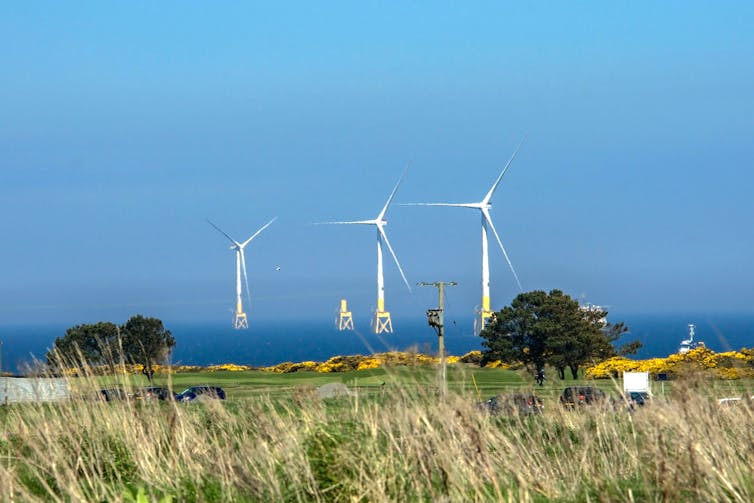
Scotland is at the forefront of offshore wind turbine technology. Shutterstock

More than a political event

Glasgow’s experts and innovators will have their moment to shine at COP26 – a once-in-a-lifetime opportunity to connect with those deciding the direction and effectiveness of the global debate on climate change action. COP26 Glasgow can also be an inspirational event for Scotland’s young people, the generation which will inherit both the burden of climate change and the means to address it.

As we build up to COP26, the Scottish government and Glasgow City Council, alongside the universities of Strathclyde, Glasgow and Glasgow Caledonian, will be planning numerous events that will run alongside the main COP26 activities.

The countdown has begun. Glasgow will seek to demonstrate to the world how Scottish research and innovation is playing an important role in tackling the global climate emergency.The Conversation

Christopher J White, Senior Lecturer in Water & Environmental Engineering, University of Strathclyde; Francesco Sindico, Director of the Strathclyde Centre for Environmental Law and Governance, University of Strathclyde, and Keith Bell, Professor of Smart Grids, University of Strathclyde

This article is republished from The Conversation under a Creative Commons license. Read the original article.