Showing posts with label Individualism. Show all posts

Friday, January 29, 2021

From Kings and Religion to Corporate Elites and Positive Psychology

by Dr Robert Muller, Medium: https://medium.com/@DrRobertMuller/from-kings-and-religion-to-corporate-elites-and-positive-psychology-b8bd0c1ae779

(image: factmyth.com)

Considering that modern western democracies are undoubtedly moving backwards in many areas, including women’s rights, the rights of minorities, social justice and welfare, and a host of other issues, due to the overwhelmingly powerful discourse of neoliberalism, and the actions that flow from this discourse, I would like to propose an interesting analogy which may not be too far from the truth in the near future.

Firstly, let us look at the ruling classes and their main social control mechanism in the feudal era. In what we now know as western societies, the feudal era was ruled by royal families, large landowners, and the church. In this period, the population was largely dependent on the rulers who provided ‘employment’ and possibly a small piece of land to create produce, in return for taxes. These taxes were very onerous, taking the bulk of the people’s earnings and leaving just enough to survive on.

We ask the question today of why ‘the poor’ are so acquiescent to the powers that be — but this has always been the case, mostly because of the power of the social control mechanisms that are utilized. In the feudal era, it was the power of religion that controlled the people (in addition to the fear of execution by the royals or the large landowners for doing something wrong).

As outlined earlier in this document, the work of Max Weber shows how the Protestant Church “teaches” people to regulate themselves, so religious teachings do have major social consequences. Of course, the Protestant Church was established in the post-feudal era; however, let us look at the social consequences of the teachings of the Catholic Church. Firstly, there is the idea of the all-powerful and vengeful god that people lived in fear of. They (the general public) believed that if they did something wrong that god would punish them through some terrible form of revenge. This was the stick for widespread social control through religion. But … there was also a carrot — if one was to behave oneself and do good deeds, then they may just be saved by god. So, these three forms of social control, the fear instilled by the kings and the large landowners, the revenge reeked by god, and the belief that one may be saved by god, was a very basic and direct mechanism of social control.

The mechanisms of social control are vastly more subtle and complex in the present age. Let us begin by making an analogy that the new ‘kings and large landowners’ of the present day are the members of the corporate elites whose needs are very well served by “democratic” governments across the western world. The other side of the equation is that the religion of the present-day is positive psychology and the ‘new-age’ spiritualism that has become so prevalent.

The analogy is continued in looking at the corporate elites. The overwhelming majority of the population is dependent in some way or other on the corporate sector, particularly in terms of employment, the food we eat, the clothes we wear, the houses we live in, the cars we drive, and so on. Except for the VERY few people who live off the land, build their own homes out of scrap, and who make their own clothes from raw materials, almost 100% of us are completely dependent on the corporate sector for everything — this is the way modern society has been organized. The level of dependency is possibly greater than it even was in the feudal era.

The most interesting aspect of the present era is the question of why ‘the poor’ aren’t more disillusioned and angry at the current set-up. After all, it is they who suffer the most, as anyone in current-day Greece (and may other countries) can tell us. There is a highly insidious and very controlling set of methods that are in place in modern western societies that have a large measure of control over the population. But … this control is not as direct and obvious as in the feudal era. There is more a sense of evolution, and then, opportunism by the elites in the development of these forms of social control.

The timeline really starts in the mid-1970s with the rise of the neoliberal ideology. Out of the remnants of the hippy era of the late 1960s, came the new-age era of self-help and positive psychology. It is no accident that these ‘technologies’ under individualizing tools that say to the individual “if I think positively, I can achieve anything” or “if I follow [guru’s] ideas, I’ll be successful”, through to the present-day ‘business’ seminars that tell us that with a ‘wealth mindset’, we can achieve great wealth. Right through the self-help literature, there is very little on the power of community; the focus is almost exclusively on the empowerment of the individual. The solutions are also couched as if there is always something wrong with the individual and that if they could only do ‘x’, then they will achieve their goals. This coincides very closely to the individualizing power of the neoliberal ideology who brands anyone who cannot achieve as a ‘loser’ or a ‘leaner’.

These self-help and positive psychology technologies only hold out false hope as very few people can make it on their own in such a complex and inter-dependent society such as todays. But … you hear these utterances everywhere, and they just serve to make people passive and accepting and unaware of the true barriers to their success — the corporate elites.

The analogy holds up well. Just as religion made the population passive, accepting and unaware of their true oppressors, so does positive psychology and the new-age individualising beliefs that the corporate elites, our new rulers, have used to their own advantage to enhance THEIR Levels of success and control over the direction of society. The class struggle is alive and well. It has been initiated by the corporate elites and is backed up all the way by present-day, apparently democratic governments, while the people are largely unaware what has actually changed.

Thursday, January 28, 2021

What is neoliberalism and how does it work?

by Dr Robert Muller, Medium: https://medium.com/@DrRobertMuller/what-is-neoliberalism-and-how-does-it-work-34c6e6e96030

(Image: uncomputing.org)


We are currently living in a neoliberal era, but what does this actually mean? We need to differentiate neoliberalism from what came before; so this paper is an attempt to clarify this issue.

Firstly, let us say for the sake of the argument that the neoliberal ascendancy started in around 1974, just after the oil shock. This date gives us the generation of approximately 30 years of development of the ideas of Hayek and the Austrian School of Economics before the ideas started to gel into a dominant discourse in the mid-1970s.

In terms of neoliberal political figures, we can say that Margaret Thatcher was the first of the significant neoliberals; however, there were still significant opposing currents of thought. Today, we have what I would characterise as a neoliberal western world which has the ideological power to have an enormous imperialist influence over much of the global south (or the developing world). This can be seen in the push for the developing nations to take on board policies to ‘reform’ their public services through outsourcing, privatisation, the expensive application of outside consultancies, and so on, all to gain access to loans by global neoliberal agencies such as the World Bank, the IMF, and the European Central Bank, in the case of the ‘European south’.

Secondly, one can say that neoliberalism is an ideology that combines personal technologies with governmental technologies. These personal technologies are concerned with regulating the self, while the governmental technologies are concerned with regulating the state.

It is the intersection of these two sets of technologies that characterises neoliberal capitalism and that I will explain in some detail below.

Personal technologies

The particular personal technologies of the neoliberal era have deep roots in history, stemming from what Max Weber called the Protestant Ethic. According to Weber, in the early stages of capitalism, Protestants worked hard (hence the Protestant work ethic) and lived frugally, seeing this as a sign that they were good and righteous, and therefore, that this MIGHT be a further sign of being one of the chosen few to be taken up to heaven after they die. Of course, there was no guarantee of this, but Weber says that they constantly worked hard and looked for these signs. This was what set Protestantism apart from Catholicism and, according to Weber, led to the development of Capitalism. This was also a very strong manifestation of self-regulation. They curbed their desires and appetites and lived very sober, frugal, hard-working lives.

It is these attempts at self-regulation that we call ‘personal technologies’. They are techniques employed to ‘work on the self’ and to continuously improve oneself.

Governmental technologies

If we take the state in its widest possible sense, then we can talk about, not only the government as part of the state, but also many other institutions of society, such as corporations, trade unions, banks, the parliament, and so on. In fact, any institution that is in negotiation with others to ‘govern’ or ‘manage’ the population can be considered to be part of the modern western state.

This was not necessarily as apparent prior to the neoliberal era, as previously, it appeared that the state was ‘the government’, whatever that actually means. In the neoliberal era, after the mass privatizations, the public-private partnerships, and the outsourcing of public services, there has been a blurring of the notion of what constitutes ‘the state’.

The neoliberal era

What sets the neoliberal era apart from previous political and social configurations is the combining of personal and governmental technologies. Some examples here will be instructive:

  1. There is a constant discourse emanating from ‘the state’ that individuals (the building block of a society) should (which is a moral term) improve themselves and that those who don’t are users, bludgers, or even worse, criminals. We can see this in the language used in the 2014 Australian federal budget in which the Treasurer used the terms “lifters” and “leaners” and “the deserving” and “the undeserving” when referring to basically the middle-classes and the working classes (of course, there was no word for the rich because they, apparently do not require one, because who they are, is apparently, obvious). This is an example of the state stepping in to label various sectors of the population, ‘assisting’ them to regulate their own behaviours. This, of course, is not a conscious thought process, but is more of a manifestation of the ‘conscience collective’, as Emile Durkheim would have put it.
  2. There has also been a ‘psychologisation’ of society in the neoliberal era which has facilitated the process of self-regulation. We see the explosion of self-help books and resources, and the proliferation of coaches, with so much of the population wanting to coach the rest of the population who have little desire to be coached. We see a huge proliferation of psychologists in all companies and organisations, and we see thriving schools of psychology propping up entire collapsing faculties of social sciences in our universities. And we see the state using this psychologisation as a convenient way to label people as failures or winners. Those who can regulate themselves and compete as time-crazed producers and consumers are the apparent winners, while those who can’t are the losers. This labelling results in our elected representatives justifying the cutting of services that affect those labelled as ‘losers’ the most.
  3. Finally, neoliberalism is also perversely associated with neoclassical economics, even though this link is contingent on a number of factors rather than a link made of necessity. Again, the sense of self-regulation moves across to the realm of economics in which people, as individuals, are expected to operate their lives as if they were running a business. This, of course, is also linked to the notion of avoiding any sense of subsidisation. Thus, in the economy, every service or good must “stand alone” and not be subsidised by any other part of the organisation or of the economy. If IT does not make a profit, then IT must be left to fall over at the whim of the market. In the personal economy of the neoliberal world (that is, in the life of the individual), one must not be subsidised (or propped up or helped) by the collective (by public services for example) — if one succeeds, then one is contributing; if one fails, then they must be left to fall through the cracks.

Hedonism: what it really means

by Dr Robert Muller, Medium: https://medium.com/@DrRobertMuller/hedonism-what-it-really-means-1f0768742594

(Image: classicalwisdom.com)

The philosophy of bourgeois society, after the rise of the middle-classes, was based on utilitarianism, which, according to Daniel Bell, is ‘a hedonistic calculation of pleasure and pain’. Such beliefs and ways of conduct partly paved the way for modern-day hedonism. Such hedonism is characterised by Bell as “the idea of pleasure as a way of life”. Furthermore, Bell argues that hedonism now provides the basis for the cultural justification of capitalism. Bell calls such hedonism ‘fun morality’.

In the contemporarera, if a person is not having fun, there is a period of soul-searching in which the individual attempts to establish what the problem is. Such ‘fun morality’ stands in stark contrast to the ‘goodness morality’ promoted within the Protestant ethic in which impulses must be controlled and resisted. Within such fun morality, instinct has become the basic justification for life in the contemporary era. Pleasure and the release of impulse become the priorities of living.

For Bell, hedonism is a ‘world of make-believe’ in which one lives for the future, dreaming of what will happen rather than what is happening. In this way, Bell’s conception of hedonism represents the idea of ‘self-autonomous illusory hedonism’ in which illusions are created in the mind of the individual, dwelt upon and often dreamed of.

Social Changes Leading to Hedonism

Bell points out the social changes which occurred throughout the 20th century which have helped to usher in the hedonistic ethic. He argues that the demographic changes that occurred in the first decades of the 20th century resulted in the rapid growth of American cities and a resultant decline in influence of ‘small-town’ lifestyles and mentality. 

Furthermore, this period saw the emergence of an economy based increasingly on consumption. Such a change, according to Bell, was in direct contrast with the Protestant ethic and as a result, began to undermine the older tradition. The emphasis on consumption saw priorities move towards ‘spending and material possessions’ and away from ‘thrift, frugality, self-control and impulse renunciation’. On top of these changes, the automobile, and the spread of media, particularly the increasing popularity of movie theatres and radio, helped to lessen the isolation of rural communities and to create a national culture with more homogeneous goals.

Further social change occurred throughout the 20th century, acting to undermine the last vestiges of the Protestant ethic. Bell cites changes in banking as a significant step towards the cultural inculcation of hedonism. With credit and overdraft facilities becoming commonplace by the end of the 1960s, the consumer no longer saw the need to delay gratification through the curbing of impulse. Instead, those impulses could now be given free rein when they arose. With credit, the longing of the consumer could be satisfied immediately. 

Throughout the 20th century, the shift in emphasis from an economy based on production to one based on consumption, saw consumer durables and the invention of credit and installment plans, together with the growth of marketing and advertising, which promoted spending and instant gratification, leading to the undermining of the Protestant ethic. Ultimately, these transformations brought about the end of Puritanism as the moral underpinning of American life. American capitalism, ‘the new capitalism’, claimed to produce abundance, and the fruits of the system were promoted as ‘the glorification of plenty’. A higher standard of living, not work as an end in itself, then becomes the engine of change.

Replacement of the Protestant Ethic by Hedonism

Bell’s thesis is that the Protestant ethic has been undermined and displaced by an ethic of hedonism or a ‘pleasure ethic’, as a culture based on consumerism took hold. The Protestant ethic had provided a transcendental justification in people’s lives and had served to place limits on the accumulation and experience of luxury. On the other hand, capital accumulation was not subject to these same limitations, as long as such accumulation was sober, rational, and responsible. Bell argues that once the Protestant ethic began to fade as an influence upon modern society, all that was left was hedonism.

Such private wants and unlimited ends with which to attain them (due to the burgeoning of the ‘new’ capitalism of America), had a belief in individualism as their underlying justification. According to Bell, bourgeois middle-class society had incorporated strands of both Protestantism and individualism. On the one hand, the Puritan style of capitalism which emphasised a certain type of character based on ‘sobriety, probity, work as a calling’ in a particular form of capitalist economic activity, contrasted and acted in tandem with a secular Hobbesianism, a radical individualism which saw humans as unlimited in their appetite, which was restrained in politics by a sovereign but ran fully free in economics and culture. Gradually, the relationship between these two sets of ethics weakened. Secular individualism gained in strength at the cost of the Protestant ethic, a situation continuing into the present.

Ultimately, the changes that were wrought by the transformations of the early decades of the 20th century, heavily promoted hedonism but could not provide any justification for it. Hedonism lacked a value system with which to replace the old one.

Friday, January 31, 2020

Climate Crisis: We are not Individuals Fighting a Faceless System – We are the System That Needs to Change

Climate change no longer seems just a future threat. In 2019, major fires iAustraliaRussia and California burned over 13.5 million hectares of land - an area four times greater than the size of Belgium. Major floods and cyclones displaced over four million people in Bangladesh, India and Iran, while entire townships were laid to waste by storms such as hurricane Dorian in the Bahamas.
This year, things show no sign of letting up: the Australian fires continue, Greenland ice sheets are expected to lose another 267 billion tonnes of ice and thawing Arctic permafrost is causing positive feedback effects that will intensify climate heating and future impacts.
In the face of such a global catastrophe, it can seem futile to take any action, individually. Over 36 billion tonnes of CO₂ are emitted globally every year, with each of us responsible for a fraction of this (for example, each person in the UK is responsible for around 5.8 tonnes; each person in India 1.8 tonnes). Even if we reduce personal CO₂ emissions, there are billions of other people who might not, plus a vast global economic system whose trajectory seems immovable. It seems unlikely that our lone actions and voices can really make a difference.
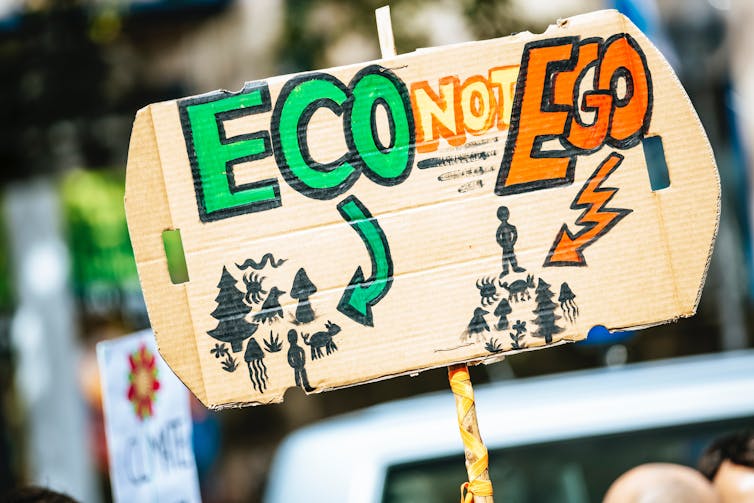
A sign at the global climate change strike. Markus Spiske/UnsplashFAL
But our actions do matter. The global environment is withering from the accumulation of billions of small impacts. Each of our individual purchases or travel choices is a vote for how we treat other people and the natural world, and even if we don’t directly see the results, our votes do count.
Our choices ripple across the surface of the globe and accumulate to create seemingly unstoppable tidal waves of destruction. And those big global institutions that seem so powerful are actually just made up from our collective worldviews (past and present). We are not individuals fighting against some kind of faceless system: we are the system that needs to change.

Do individuals exist?

As I explore in my new book The Self Delusion, scientific evidence from a wide range of disciplines shows that we are not isolated individuals, despite often perceiving ourselves this way.
There are many ways in which this can be observed. To start with, most of our 37 trillion human cells have such a short lifespan that we are essentially made anew every few months, directed by a genetic code that is a shared heritage not just of humanity but all life on Earth.
Our minds, meanwhile, are deeply influenced by other people - every word, touch, pheromone received from others alters  the neural network in your brains, so you cannot really call yourself the same person you were when you woke up this morning. And the new science of social networks shows that we are linked together so closely that ideas, behaviours and preferences flow between us in a way that makes it unclear where one mind ends and another begins.
What’s more, new research in the field of environmental psychology finds that when we acknowledge this interconnectedness, we care more for others and the natural world. This idea was first speculated by “deep ecology” philosophers such as Arne Naess and has now been confirmed through modern quantitative surveys.
The world is far more intricate and interconnected than we think. Markus Spiske/UnsplashFAL
When people feel more connected to nature according to various metrics, they tend to have greater happiness, autonomy and personal growth, as well as stronger attitudes and behaviours towards protecting the environment. Similarly, when people score highly on metrics assessing social connectedness, they tend to have lower anxietygreater wellbeing and more empathy.

Collective change

To gain all these benefits, we need a change of mindset. It is often said that when we are young and optimistic, we strive to change the world around us, but when we are older and wiser, we realise the futility of this and aspire to change ourselves instead.
Yet to solve the major environmental problems the world now faces, we actually need to do both - to change the world and ourselves. In fact, it is even more nuanced than that - because changing ourselves is a prerequisite for changing the world. Realising the true nature of our human connectedness actually engenders more ethical and environmentally responsible behaviours.
So how do we achieve this? Once again, recent scientific research can help by identifying the most effective approaches. Outdoor community activities and environmental education increase both our psychological connectedness to others and the natural world, as do meditation and similar practices. Even computer games and books can be designed to increase empathy. These offer empowering ways to become part of something bigger, to overcome the delusion of individual isolation.
Community projects outdoors foster connection with one another and the natural world. Daniel Funes Fuentes/UnsplashFAL
So although the impact of a lone individual to tackle climate change is negligible, fortunately, you are not just a lone individual - you are part of something much greater. We are deeply connected to one another at both a physical and psychological level, and when that truth is genuinely acknowledged, we act differently, becoming more compassionate and caring for each other and the environment.
Our interconnectedness also means that positive behaviours can cascade to influence many others. When we consider ourselves part of a collective, we can tackle the climate crisis.