Tuesday, October 30, 2018

Crowd-Mapping Gender Equality: A Powerful Tool for Shaping a Better City Launches in Melbourne

by Nicole Kalms, Monash University, The Conversation: https://theconversation.com/crowd-mapping-gender-equality-a-powerful-tool-for-shaping-a-better-city-launches-in-melbourne-105648

File 20181026 107670 1h0sotz.jpg?ixlib=rb 1.1
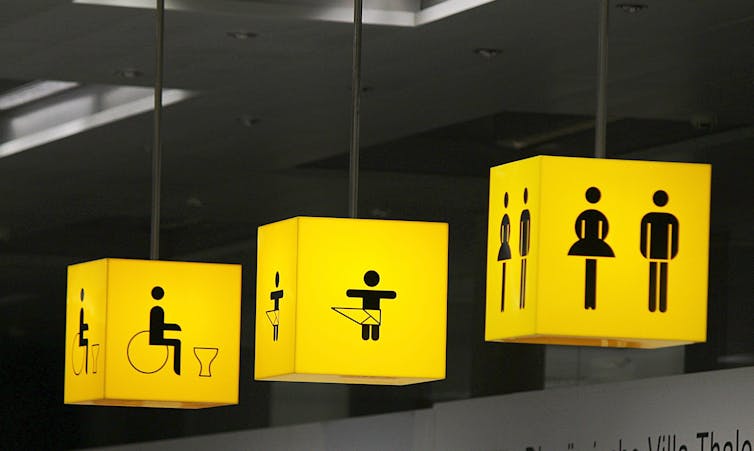
Ensuring both men and women have access to baby changing facilities is one of many issues that gender equality mapping can help tackle. Pixabay, CC BY

Inequity in cities has a long history. The importance of social and community planning to meet the challenge of creating people-centred cities looms large. While planners, government and designers have long understood the problem, uncovering the many important marginalised stories is an enormous task.

Technology – so often bemoaned – has provided an unexpected and powerful primary tool for designers and makers of cities. Crowd-mapping asks the community to anonymously engage and map their experiences using their smartphones and via a web app. The focus of the new Gender Equality Map launched today in two pilot locations in Melbourne is on equality or inequality in their neighbourhood.


Read more: To design safer parks for women, city planners must listen to their stories

How does it work?
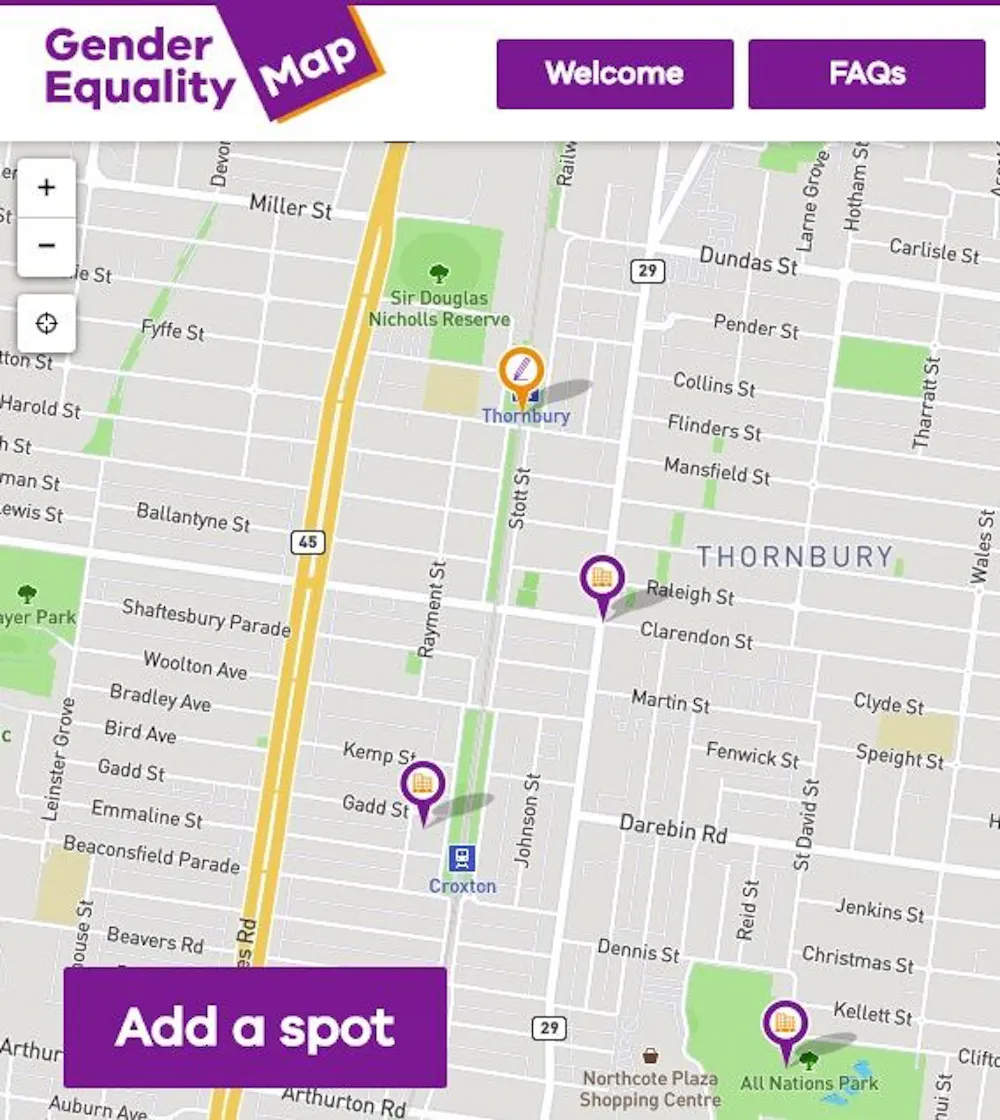
Participants can map their experience of equality or inequality in their neighbourhood using locator pins. Author provided

Crowd-mapping generates geolocative data. This is made up of points “dropped” to a precise geographical location. The data can then be analysed and synthesised for insights, tendencies and “hotspots”.

The diversity of its applications shows the adaptability of the method. The digital, community-based method of crowd-mapping has been used across the globe. Under-represented citizens have embraced the opportunity to tell their stories as a way to engage with and change their experience of cities.

CrowdSpot and Monash University have developed the Gender Equality Map with support from the Victorian government. It will enable local government to tackle the issues of socio-cultural exclusion that have proven so elusive. The map will help uncover real experiences of gender inequality in public places, from local sports facilities to public transport, community services and infrastructure, to simply walking down the street.

Read more: Gender makes a world of difference for safety on public transport

How will the data be used?

Melton and Darebin city councils will pilot the project. These councils are committed to engaging with the data in future decision-making with direct impacts on their communities and neighbourhoods.

The map is open to all genders with residence of Darebin and Melton encouraged to use the web app to tell their story. While we expect to see stories from women and men of a range of ages, the Gender Equality Map is also an opportunity to hear about the nuanced experiences of LGBTIQ+ people.

More than a new narrative of city life, the Gender Equality Map and crowd-mapping projects more broadly reflect a shift in how we understand cities, architecture and urban planning. To understand patterns of inclusion and exclusion, to consider individual perceptions of cities – ones that may not align with our own – is one of the greatest challenges place-makers face.

Trained as an architect and landscape architect and as the director of a university research lab, my research is committed to understanding the nexus of urban place and gender inequity. My recent research focuses on the possibilities and power of crowd-mapping as a method for shaping urban space. Recognising that cities need to be gender-sensitive, I seek to understand the stories of gender, equity and identity in cities – not fictional ones but real-life stories of individual people.


Read more: Safe in the City? Girls tell it like it is

Leading to more inclusive urban design

As a democratic process, crowd-mapping can lead to action that helps solve real-world issues. To design “inclusively” is more than a matter of providing community buildings, public transport and amenity. It’s about the determination to seek out the tricky stories of social justice – those of access, equity and diversity – and to actively shape our cities with these goals as our priority.

Considering how communities can advance agendas and unlock many of the complex and diverse needs of cities requires a tactical approach. Feminist architect and activist Lori Brown states:
Design is not a passive act. It is a critical engagement with community and you have to be cognisant of the power that you have and how you use it.
Crowd-mapping engages with community but also brings with it a particularly powerful form of activism – especially when it comes to gender inequity. Projects such as Everyday Sexism in the UK; Safetipin in New Delhi, Jakarta, Bogota and Nairobi; Harassmap in India; and Free to Be in Australia and internationally, have publicly charted the ways women, in particular, experience inequity in cities.


Read more: Sexism and the city: how urban planning has failed women


One obvious advantage is that web-based crowd-sourcing can challenge the historically disproportionate contribution of usually male voices in urban policy and design. One of the reasons crowd-mapping has been successful at engaging with women and girls is that it allows them to report when and where it suits them. What more will we learn about inclusion when we open up the tool to all genders?

The ubiquity of smartphone technology over the past decade has driven exponential growth in the volume of data about cities and their citizens. We have less data, however, about gender and inequity. More data and deeper insights will make these issues central to the design and strategy of local, urban decision-making.


Read more: Mansplaining Australian cities – we can do something about that The Conversation


Nicole Kalms, Director of XYX Lab + Senior Lecturer in the Faculty of Art, Design and Architecture at Monash University, Monash University

This article is republished from The Conversation under a Creative Commons license. Read the original article.

Tuesday, October 23, 2018

The City as a Commons

The disaster with Flint, Michigan’s drinking water, incited by political leaders more devoted to fiscal austerity than the common good, illuminates why it’s important to think of our cities as commons — human creations that belong to all residents, not just the wealthy and politically well-connected.
The commons itself means all the many things we share together rather than own privately — a list that starts with air, water, parks and streets and expands to include more complex entities such as the Internet, civic organizations and entire communities.
Typically the commons evokes images of the countryside: sheep grazing on communally-tended pastures, people frolicking on a town green, untrammeled wilderness open to all. Even in the modern context, commons champion (and Nobel Prize winner) Elinor Ostrom is best known for research on the management of forests, fisheries and agricultural irrigation systems even though one of her important studies focused on police departments in metropolitan St. Louis.
Sheep
Despite pastoral images of the commons, urban commons are much more widespread now.
Yet the recent resurgence of commons projects is happening in urban as well as rural areas, witnessed by the City as a Commons: Reconceiving Urban Space, Common Good and City Governance  conference held last November in Bologna, Italy — a city taking big steps to integrate commons-based collaboration into its own policies and operations (more on this below).
The strong pastoral association with the commons makes sense from an historical perspective. Individualism and market economics were embraced first in urban areas as enlightenment philosophies and industrialization spread throughout Europe and eventually the whole planet. It was in rural communities where cooperative traditions endured and in some cases expanded, said Dutch historian Tine De Moor, president of the International Association for the Study of the Commons, one of the conference sponsors. Cooperatives, for instance, grew up in the countryside of many nations during the 19th and 20th centuries because many rural communities’ needs could not be profitably met by private businesses.
In England, many villages once held Beating the Bounds parties in which folks hiked the boundaries of their local commons together, ripping out private encroachments on their collective land. US commons scholar David Bollier suggested urban and digital activists might update this custom to preserve commons of our own time.
The social alienation and crushing poverty associated with early industrial cities can be explained by the sudden loss of commons connections and resources by rural refugees forced off the land into factories, said Michel Bauwens, founder of the Foundation for Peer-to-Peer Alternatives, based in Thailand. Cities lacked the free common spaces where people could raise food, gather firewood or gather outside with their neighbors. These human necessities must all be purchased.

The Rise of Urban Commons

Urban commons like parks, sanitation systems, public schools, public transit, libraries, hospitals, labor unions, private and public social welfare agencies emerged throughout the 19th century in response to squalid urban conditions. And the commons movement today stands on the shoulders of people’s continuing efforts to improve urban life by addressing issues like racial and economic inequality, environmental problems, neighborhood vitality, community organizing, walkability and biking.
City
Does a city belong to its business owners and legislature, to its people, or to a mixture of both?
“The city as a commons is designed to be disruptive — to question who owns and controls the city,” explained Sheila Foster, Fordham University Law Professor at a post-conference conversation convened in a bustling Bologna park by Shareable.net magazine. “It’s a claim that the city is open to how we exchange goods and services. It’s not just elites who should have power.”
“The idea of the urban commons is still very much in development,” said Foster, who wrote a groundbreaking paper on the city as commons with her conference co-chair Christian Iaione.
Foster outlined four major tenets of the city as commons in conference’s closing session:
• The city is an open resource where all people can share public space and interact.
• The city exists for widespread collaboration and cooperation.
• The city is generative, producing for human nourishment and human need.
• The city is a partner in creating conditions where commons can flourish.

What Does the Future Look Like?

The form urban commons might take over the next 25 years was vividly sketched by Berlin activist Silke Helfrich. She described a convivial community living according to the African philosophy of ubuntu (“I am because you are”). Many people live in cooperative co-housing communities, and work at home or co-working spaces. The streets are alive with people on foot, bike, transit and in shared cars. Every neighborhood proudly sports community vegetable gardens, fruit orchards, flower patches, herb commons, sanctuaries for birds and bees, greenspaces, cafés, a cultural center, library, ballroom and open source hub.
“The space of the commons will expand, and the space of the market will shrink,” Helfrich envisions, because systems are designed to allow commons to happen. Commoning will be as easy to do then as shopping is today.
The conference’s workshops zeroed in lessons learned from local urban commons projects around the world, including US inner cities.
Street
Even in New York City, in Brooklyn, there are 596 acres of unused land available to create commons spaces.
A struggling neighborhood on the west side of Buffalo, New York became a laboratory for applying Elinor Ostrom’s eight commons principles to community revitalization efforts. Ronald Oakerson, a political scientist at nearby Houghton College, and Jeremy Clifton, an AmeriCorps organizer, experimented with how to activate low-income renters in tackling crime and disinvestment problems on their blocks.
“What doesn’t work is flyers and knocking on doors,” says Clifton, who is now studying psychology at the University of Pennsylvania.  What worked is identifying the community’s natural leaders and helping them create block clubs. “People take action when they feel ownership, but not necessarily home ownership but ownership of the street where they live.”
In Brooklyn, local activist Paula Siegel discovered the borough harbored 596 acres of vacant land (more space than Brooklyn’s beloved Prospect Park). Under the banner of “this land is your land,” she launched 596 acres to explore how residents can claim it for public use as gardens, playgrounds and learning centers.
Barcelona is moving toward participatory democracy with new commons policies tapping citizen’s ideas “to create the conditions for social initiatives to flourish”, according to Miquel Ortega, the city’s Commissioner for Commerce, Consumer Affairs and Markets. Airbnb was recently banned in the city because it was jacking up rents in many residential neighborhoods and forcing families out in favor of tourists.

Hitting the Ground in Bologna

The City as Commons event, which attracted more than 200 commoners from around the world to a refurbished factory, closed with a panel featuring Bologna’s Deputy Mayor Matteo Lepore who outlined some of the more than 100 collaborative projects with citizen groups the city has undertaken in its pioneering plans to incorporate commons thinking and practice into municipal governance:
• Neighborhood regeneration projects, which he emphasized, are “not on behalf of citizens but with citizens, who are a great source of energy, talent, resources, capabilities and ideas.”
• An experiment where restaurants and bars work directly with neighbors to set rules for their businesses and cooperate on regenerating the community.
• A program to draw upon parents’ ideas and skills in improving kindergartens.
• A civic crowdfunding prototype to support projects that the city cannot wholly fund, such as restoration of Bologna’s 24 miles of arched porticoes over sidewalks.
• An ambitious program of urban gardens.
• Creation of digital platforms to support commons projects of all varieties.
• A citywide conversation “about what is collaboration, and how the city government can work in new ways.
“Commons aren’t just something we protect, but also what we invent,” declared Lepore.
Bologna’s urban commons initiative began in May 2014, when the city council passed landmark legislation, Bologna Regulation for the Care and Regeneration of Urban Commons. “A new era was dawning where citizens are active co-managers of the resources they use in cities instead of passive recipients of services,” wrote Neal Gorenflo in Shareable after visiting Bologna at the first anniversary of the project.
The origins of the idea date back to 2011 when a group of local women contacted the city about donating benches to their neighborhood park, which lacked any place to sit. The women grew frustrated as their generous offer was bounced from one municipal department to another until finally they were told it was impossible. In fact, it was illegal for citizens to contribute improvements to their hometown.
As one of Italy’s most progressive cities, home to Europe’s oldest university and with a regional economy based on cooperative enterprises, this incident caused a stir around Bologna and spurred city officials to partner with the Rome-based organization LabGov (Laboratory for the Governance of the Commons) which applies the work of Elinor Ostrom to city life. Conference co-chair Christian Iaione, a legal scholar, was instrumental in bringing the project to life. Similar projects sprouted in the Italian cities of Palermo, Montova, Battipaglia and Rome. In North America, Toronto is looking at implementing Urban Commons policies and LabGov is partnering Fordham Urban Law Center to launch a project in New York City.

Top photo by Fotolia/mimadeo
Middle photo by Fotolia/Sergei
Bottom photo by Fotolia/nikla